Full Truckload Shipping on Tight Deadlines

Quick answer: A tight delivery window is achievable without pushing a driver past legal hours if the shipper does three things early: builds the schedule around real drive-time math instead of map-app estimates, gets freight staged and ready before the truck arrives, and tells the carrier the actual deadline — not a padded one — so dispatch can plan around the Federal Motor Carrier Safety Administration's hours-of-service rules instead of discovering a conflict at hour 13. Most blown deadlines trace back to planning gaps on the shipper's end, not slow driving.
Key takeaways
- A driver operating under FMCSA's 14-hour rule only has a fixed on-duty window each day, and drive time inside it is capped at 11 hours — padding a delivery date doesn't change that math, only better planning does.
- Loading delays of even 60–90 minutes at pickup routinely cost an entire day of transit time once they push a driver past a legal stopping point.
- Drop-and-hook pickups save the most clock time of any load-prep choice, because the driver never waits on a dock.
- Full truckload shipping gives a shipper more routing control than less-than-truckload service, since the schedule isn't built around other freight on the same trailer.
!Full Truckload Shipping on Tight Deadlines
Why Do So Many Tight-Window Shipments Fail?
Most late deliveries aren't caused by slow trucks — they're caused by a timeline built before anyone checked what was actually possible. A shipper quotes a delivery date based on straight-line mileage and a map app's drive-time estimate, without accounting for loading time, mandatory rest, or traffic around major metros. By the time the truck is dispatched, the "tight window" was already impossible before the wheels moved.
The three most common planning mistakes look like this:
- Unrealistic timelines. A 1,600-mile run from Naperville to the Southeast at highway speed takes roughly 24 hours of pure drive time — but a single driver under hours-of-service limits needs closer to three days to cover it legally, once required rest periods are built in.
- Poor load prep. Freight that isn't palletized, counted, and staged before the truck arrives at the dock adds 60–90 minutes to a pickup that should take 20. That delay doesn't disappear — it gets absorbed somewhere down the route, usually at the cost of a day.
- Late pickup appointments. A 4 p.m. pickup slot on a run that needs an early start eats directly into the driver's clock before the truck has moved a single mile.
Don't skip this: if your pickup appointment is scheduled late in the day, your delivery window should be built around the next day's drive time, not the day you handed off the freight. Treat the pickup time as the real start of the clock, not the shipment date on paper.
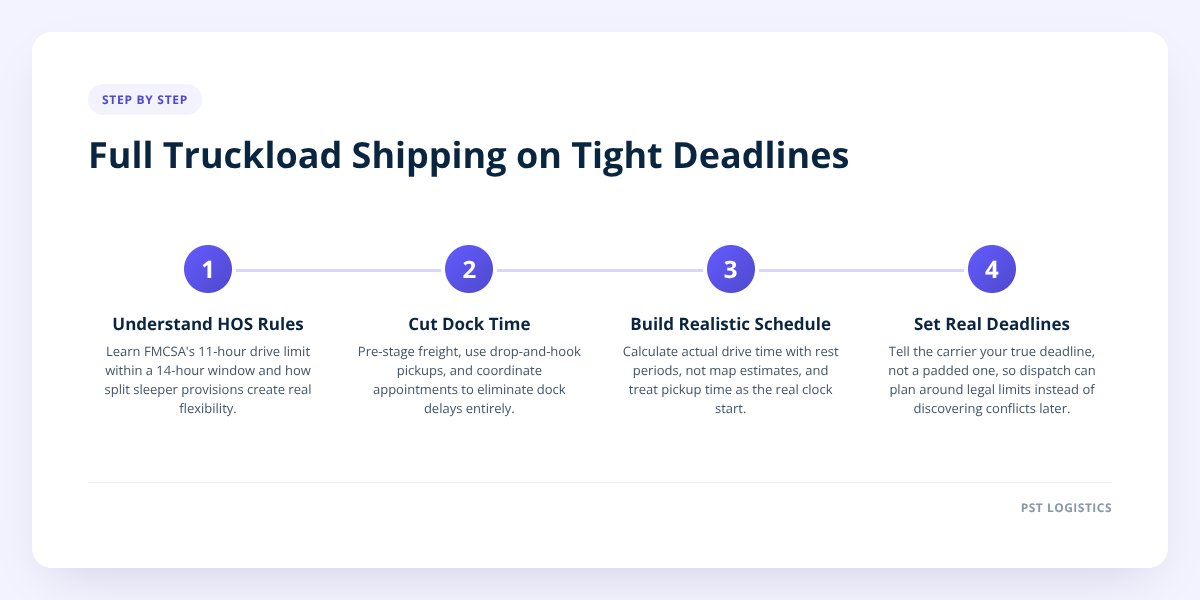
Step 1: Understand What HOS Rules Actually Allow
The hours-of-service rules set firm limits, but they also build in real flexibility a shipper can plan around. Under FMCSA's framework, a property-carrying driver gets 11 hours of drive time within a 14-hour on-duty window, followed by a mandatory 10 consecutive hours off duty. Here's where the planning flexibility actually lives:
- The split sleeper berth provision lets a driver divide the required off-duty time into two periods — commonly 7 and 3 hours, or other FMCSA-approved splits — instead of one unbroken 10-hour stretch. Used well, this can let a driver reposition during a lower-traffic window and still log full legal rest.
- The 14-hour rule is a window, not a workday. Once it starts, it keeps running whether the driver is driving, loading, or stuck at a dock — which is exactly why dock delays are so costly. An hour lost to a slow pickup is an hour gone from available drive time, permanently.
- A 34-hour restart resets a driver's weekly 60/70-hour limit, which matters on longer dedicated runs but rarely helps a single tight-window shipment — it's a weekly tool, not a daily one.
None of this is a workaround. It's the legal structure a dispatcher uses to build a realistic schedule instead of guessing. We covered how these same rules intersect with multi-stop planning in Planning Multi-Stop Freight Routes Within HOS Limits, and a recent regulatory shift is covered in FMCSA HOS Pilot Program and Delivery Windows.
Step 2: Cut Dock Time Before the Truck Arrives
The single fastest way to buy back drive-time hours is to never spend them standing still at your own dock. Every minute a loaded truck sits waiting is a minute permanently lost from that driver's legal window — it can't be made up later by driving faster, because the clock doesn't pause.
A few load-prep choices make an outsized difference:
- Pre-stage the freight. Pallets built, counted, and wrapped before the truck backs in turns a potential hour-long load into a 20-minute one.
- Arrange pallets for trailer balance and easy count. A standard 53' dry van runs up to 26 standard pallets and a 45,000-lb payload — know your count before the driver arrives so there's no recount or reshuffle at the dock.
- Use drop-and-hook where it's available. A pre-loaded, sealed trailer that the driver hooks to and leaves eliminates dock wait time entirely — it's the single biggest time-saver on this list.
- Coordinate appointment windows with the carrier, not just the receiver. A pickup slot that looks fine on your calendar can still be wrong for the driver's clock if it starts the window too late in the day.
We go deeper on pallet counts and trailer arrangement in How to Plan and Load Pallets for Full Truckload Shipping, and on avoiding pickup-side delays in How to Avoid No-Shows and Delays on Truckload Pickups.
Step 3: Choose a Lane and Route That Actually Fit the Clock
Not every route eats hours the same way, and knowing the common friction points lets a shipper set a window that's tight but real. PST Global's core lanes run Midwest to Southeast, the Texas triangle, and I-80 westbound to the coast, with reload markets in Atlanta, Dallas, Laredo, Savannah, Newark, and Los Angeles — corridors with well-known rest stop and fuel positioning that make the hours math predictable.
| Route type | What drives the timeline | Shipper takeaway |
|---|---|---|
| Midwest to Southeast | Metro congestion around Atlanta and Chicago on either end | Build in buffer for urban delay, not just mileage |
| I-80 westbound | Long rural stretches with fewer dock and rest options | Fuel and rest stops must be planned, not improvised |
| Texas triangle | Short mileage between major points, heavy regional traffic | Drive time is often less than expected — dock time is the risk |
A dedicated run on a known lane is more predictable than a one-off shipment on an unfamiliar route, simply because the rest stops, fuel positioning, and traffic patterns are already known quantities to the carrier. We detailed how one specific corridor plays out in Planning a Naperville-to-Southeast Full Truckload Run, and multi-stop lane planning in Planning a Multi-Stop Full Truckload Run.
Step 4: Brief the Carrier Like the Deadline Is Real
Tell the carrier the actual delivery deadline, not a buffered one — dispatch can only plan legally around the real number. A padded deadline doesn't give a carrier more room; it just hides the true constraint until it's too late to plan around it, which is the opposite of what a shipper wants when the window is genuinely tight.
Before booking, ask the carrier these questions directly:
- Confirm the realistic transit time given HOS limits on this specific lane, not just mileage.
- Ask what contingency time is built in for weather, traffic, or a dock delay at either end.
- Confirm the detention policy in writing before the truck is dispatched, so a slow receiver doesn't become a surprise charge. We cover the specifics in How to Prevent Detention Fees on Full Truckload Shipping.
- Verify active operating authority and a current certificate of insurance — a carrier that can produce these same-day is one that runs a tight operation generally.
- Ask whether the load will run with one driver start to finish, since a driver swap mid-route adds its own delay and communication risk.
This is also where working with an asset-based carrier changes the conversation. At PST Global, dispatch answers the phone 24/7, including weekends, and runs the load with the same truck and same driver from pickup to delivery — which means the person planning your window is the same person who knows exactly where that truck is at hour 9. PST Global maintains a 99% on-time delivery rate across dry van and temperature-controlled freight in all 48 states, built on realistic scheduling rather than rushed driving.
What to Do Next
A tight window is a planning problem, not a speed problem. Fix the schedule, the load prep, and the carrier conversation in that order, and the deadline that looked impossible on paper usually turns out to be entirely doable — legally, and without anyone cutting corners.
If you have a lane and a deadline you need checked against real hours-of-service math before you book it, request a rate and talk it through with PST Global's dispatch team directly.
Checklist: Plan a Tight-Window Truckload Shipment
- Calculate real drive time using HOS limits, not straight mileage or map-app estimates.
- Pre-stage and count pallets before the truck is scheduled to arrive.
- Confirm whether drop-and-hook is available for this pickup.
- Set the appointment window early enough in the day to protect the driver's 14-hour clock.
- Give the carrier the true delivery deadline, not a padded one.
- Ask the carrier directly what contingency time is built into the quoted transit.
- Get the detention policy confirmed in writing before dispatch.
- Verify the carrier's active authority and certificate of insurance before booking.