Planning a Naperville-to-Southeast Full Truckload Run

Quick answer: A clean full truckload shipment from Naperville to the Southeast comes down to five things done in order: lock your weight and pallet count 48 hours out, confirm the delivery appointment before the truck dispatches, pick drop-and-hook or live load based on your dock's real capacity, have your BOL and any required paperwork ready before the driver arrives, and turn repeat lanes into a standing checklist with your carrier. Skip any one of these and you risk detention charges, missed appointments, or a truck sitting at your dock burning hours you'll pay for.
Key takeaways
- Most detention billing starts after a set free period at pickup or delivery — carriers typically begin the clock at 2 hours, so a driver stuck 90 minutes past that window can trigger charges.
- A 53-foot dry van holds up to 26 standard pallets and 45,000 lbs of payload — giving the carrier the wrong count can mean a second truck or a rejected load at the dock.
- Drop-and-hook appointments move faster than live loads because the driver swaps a loaded trailer for an empty one instead of waiting through a dock cycle.
- Reefer freight headed to the Southeast needs a pre-cool confirmation and a logged setpoint before the doors open — not after.
!Naperville-to-Southeast Truckload Planning
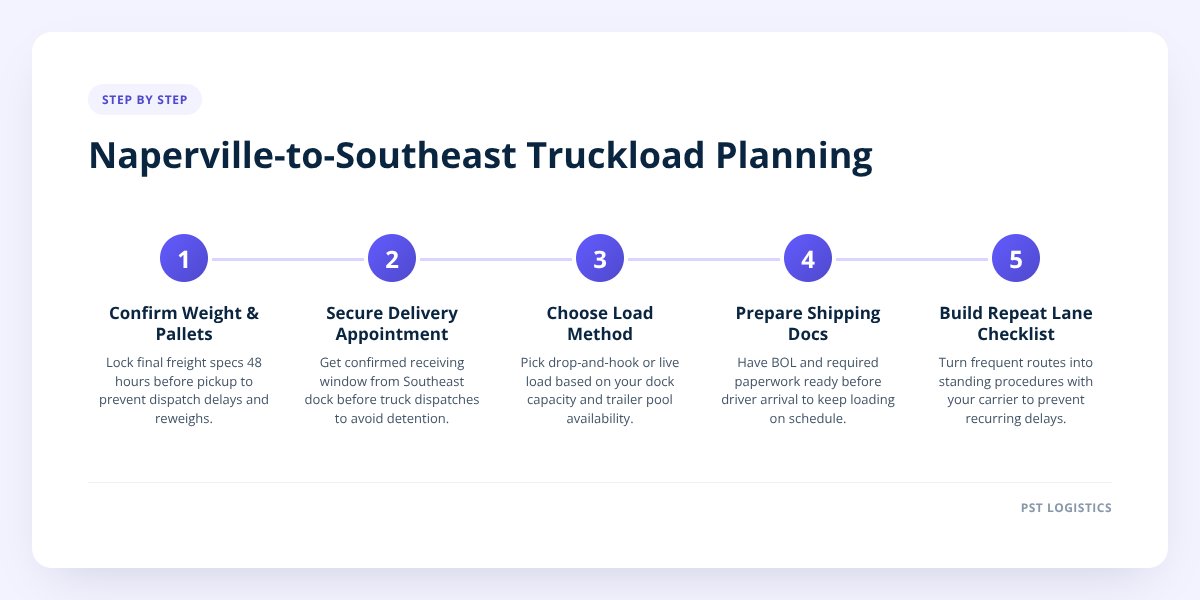
Step 1: Confirm Weight, Dimensions, and Pallet Count 48 Hours Before Pickup
Carriers build their dispatch schedule around the freight specs you give them, so wrong numbers at the last minute throw off everything downstream. A dispatcher assigning a 53-foot dry van to your load needs to know whether you're sending 18 pallets or 26, because that number determines whether the truck can take on a second stop or needs to run direct.
Weight matters just as much as pallet count. A dry van trailer can carry up to 45,000 lbs of payload — if your actual freight comes in heavier than what you quoted, the carrier may have to reweigh, re-route, or in some cases decline the load at the dock. That's a delay you caused, not one the carrier caused, and it can still cost you the appointment window.
Give yourself 48 hours of lead time to lock these numbers:
- Verify final pallet count against the pick ticket or warehouse count, not the original order.
- Confirm gross weight including pallets, shrink wrap, and any dunnage.
- Note freight dimensions if anything is oversized, stackable, or floor-loaded instead of palletized.
- Flag any hazmat classification or temperature requirement before the truck is assigned.
- Send the finalized numbers to your carrier's dispatcher in writing, not a phone call you'll forget to follow up on.
We cover the pallet-loading side of this in more detail in How to Plan and Load Pallets for Full Truckload Shipping, including how stacking and floor-loading change what actually fits.
Step 2: Lock the Delivery Appointment Before the Truck Dispatches
Coordinating your drop-off window with the carrier before the truck leaves Naperville is what keeps detention charges off your invoice. A truck that dispatches without a confirmed appointment is a truck that might sit in a receiving queue for hours once it arrives — and most of that sitting time becomes billable detention once the facility's free period runs out.
Here's the mechanic: carriers generally allow a set number of free hours for loading or unloading, commonly around 2 hours, before detention charges start accruing. If your Southeast receiver doesn't have a confirmed slot and the driver shows up to find three trucks ahead of them, that free-hour clock is ticking against you, not them.
Appointment scheduling solves this because it lets the carrier plan the drive to arrive inside the receiver's actual window, not just "sometime Tuesday." A dispatcher who knows the appointment time can also build in realistic transit time from Naperville — which sits well for day-drive access to the eastern half of the country — instead of guessing and either running early (truck waits) or late (receiver reschedules).
Don't skip this: Never let a truck dispatch toward a Southeast delivery without a confirmed appointment time from the receiving dock. An unconfirmed window is the single biggest cause of detention on this corridor.
We go deeper on the billing side of this problem in How to Avoid Detention Fees on Drop-and-Hook Loads and Avoid Detention and Demurrage Fees in Freight Shipping.
Step 3: Choose Drop-and-Hook or Live Load Based on Your Dock, Not Habit
Drop-and-hook almost always moves faster than a live load, but it only works if your facility has the yard space and trailer pool to support it. Here's the real difference and how to decide which fits your operation.
| Factor | Drop-and-Hook | Live Load |
|---|---|---|
| Driver wait time | Minimal — swap trailers and go | Full loading/unloading cycle |
| Facility requirement | Yard space for spare trailers | Open dock door at appointment time |
| Detention risk | Low | Higher if dock is backed up |
| Best for | High-volume repeat lanes | One-off or low-frequency shipments |
| Trailer pool needed | Yes, carrier must stage trailers | No |
If your Naperville facility ships to the same Southeast reload markets — Atlanta or Savannah, for example — regularly enough to justify a staged trailer, drop-and-hook will cut your detention exposure significantly. If you're a lower-volume shipper without yard space for a spare trailer, live load is the realistic option, but it means your dock crew needs to be ready the moment the appointment window opens, not ten minutes after.
Either way, tell your carrier which one you're running before the truck is dispatched, not after it arrives. A driver who shows up expecting a drop-and-hook and finds out it's a live load has already lost planning time he can't get back.
Step 4: Have Your Paperwork Ready Before the Truck Pulls In
A truck idling at your dock while someone tracks down a bill of lading is detention time you're paying for, and it's entirely avoidable. The bill of lading (BOL) — the shipping document that lists the freight, the parties, and the terms of carriage — needs to be printed, accurate, and in the driver's hands at pickup, not generated while the driver waits in the parking lot.
What delayed paperwork actually looks like in practice:
- A BOL with the wrong pallet count, which the driver then has to get corrected before he'll sign and move
- Missing certificate of insurance when the receiver's security desk requires one for site access
- No hazmat placarding or documentation ready when the load requires it, which can stop a pickup cold
- A reefer load with no temperature setpoint written on the paperwork, leaving the driver guessing what to log
For reefer freight heading to the Southeast — produce, dairy, or anything that needs a controlled setpoint between -20°F and 70°F — paperwork gets one more layer. The trailer needs to be pre-cooled before the doors open, and the setpoint should be confirmed and logged from pickup through delivery so the receiver has a complete temperature record, not a gap. We cover the perishable-specific steps in Prepare Perishable Freight for Interstate Shipping.
A same-business-day certificate of insurance request is standard for most carriers with active authority on file — if your receiver's security office requires one at check-in, request it from your carrier early in the week, not the morning of pickup.
Step 5: Build a Standing Checklist for Repeat Lanes
If you run the Naperville-to-Southeast lane more than occasionally, a written checklist shared with your carrier turns every shipment into a repeat process instead of a fresh negotiation. Predictable freight is worth more to a carrier than one-off freight, and that predictability tends to show up in better rates and fewer accessorial charges over time — because the carrier isn't pricing in the risk of the unknown.
A good repeat-lane checklist, built once and reused every time, covers:
- Standard pallet count and weight range for this specific lane
- Preferred appointment windows at both the Naperville origin and the Southeast destination
- Drop-and-hook or live load designation for this account
- Named dock contact and after-hours contact at the receiving facility
- Required paperwork (BOL template, COI, hazmat docs, temperature log sheet for reefer)
- Any seasonal adjustments — holiday dock closures, weather-related rescheduling, inventory surges
This is also where working with an asset-based carrier instead of a broker pays off, because the same dispatcher and often the same driver handle your lane run after run. There's no re-explaining your dock rules to a new carrier each time a broker reassigns the load. We walk through what to verify before you commit to any carrier in What to Check Before Booking a Freight Carrier.
What to Do Next
Start with the checklist below before your next Southeast shipment leaves Naperville. If you want a dispatcher who already runs this corridor and can talk through your dock setup before the truck is booked, PST Logistics hauls dry van and temperature-controlled freight from Naperville into the Southeast with one driver from pickup to delivery — no cross-docking, no transloading — and 24/7 dispatch that answers the phone. Request a rate on your lane and get the appointment scheduling conversation started early.
Checklist: Plan a Naperville-to-Southeast Truckload Shipment
- Confirm final pallet count and gross weight 48 hours before pickup.
- Flag any hazmat classification or temperature requirement to your dispatcher early.
- Request a confirmed delivery appointment window from the receiver before dispatch.
- Decide drop-and-hook or live load based on your dock's yard space and crew readiness.
- Print the BOL with accurate freight details before the truck arrives.
- Request a certificate of insurance in advance if your receiver requires one at check-in.
- Confirm reefer setpoint and pre-cool status before the trailer doors open.
- Save a written lane checklist with your carrier for the next repeat shipment.