Verify a Trucking Company's Authority and Insurance First

Quick answer: Before booking any carrier, confirm three things: their USDOT number shows active operating authority on the FMCSA's SAFER system, their insurance certificate lists cargo and liability coverage that's currently in force (not expired), and their safety rating and inspection history don't show recent out-of-service orders. All three checks are free, take about 15 minutes combined, and can be done online or by phone before you ever sign a rate confirmation.
Key takeaways
- The Federal Motor Carrier Safety Administration's SAFER system (safer.fmcsa.dot.gov) lets anyone look up a carrier's USDOT number, operating status, and safety record for free, with no login required.
- Federal rules require interstate for-hire carriers to maintain a minimum of $750,000 in public liability insurance, though many shippers require higher limits for high-value freight — confirm the actual certificate, not just the legal minimum.
- A carrier with "Not Authorized" or "Revoked" status on file cannot legally haul your freight across state lines, and booking with them can leave your cargo claim with nowhere to go.
- Certificates of insurance should come directly from the carrier's insurance agent or broker, not as a PDF forwarded by the carrier itself, since that document can be altered.
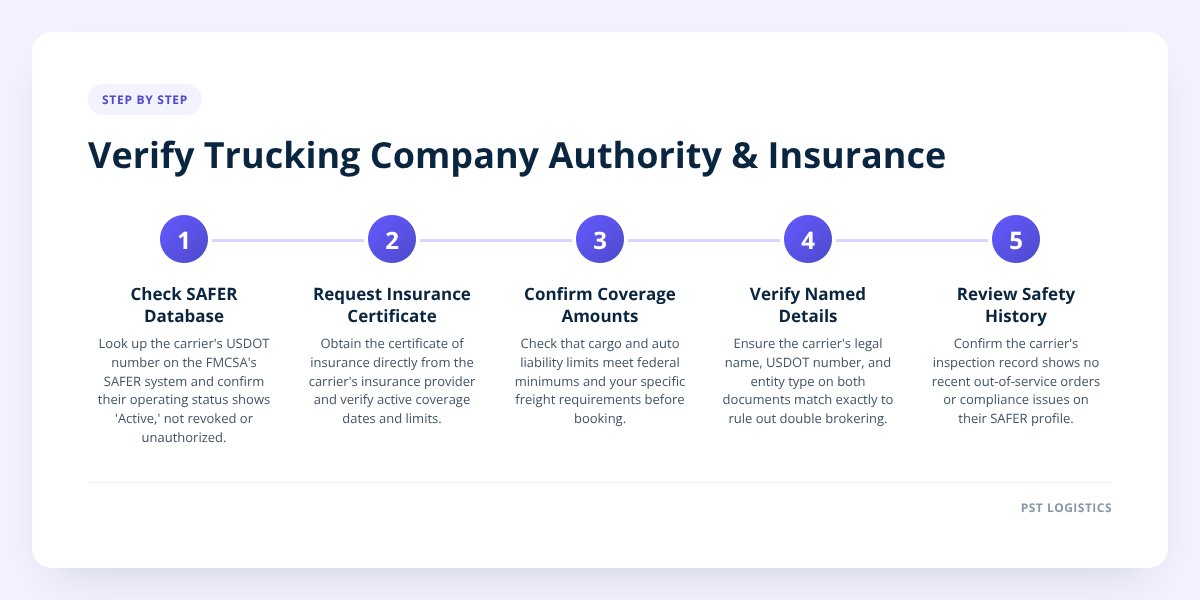
!Verify Trucking Company Authority & Insurance
Why This Check Matters Before You Book
Skipping this step puts your freight and your budget at risk in a way that's hard to undo after the fact. If a carrier's authority has lapsed or their insurance has expired, any cargo claim you file may go unpaid, and you could be left negotiating with a company that has no legal standing to have hauled the load in the first place.
This isn't a rare problem. Double brokering, insurance lapses, and carriers operating on revoked authority show up often enough in freight claims that shippers and brokers who move regular volume build verification into their process every time, not just for new carriers. A carrier that was fully authorized and insured three months ago can lose that status today over an unpaid premium or a missed filing.
The fix is simple: verify before you book, not after something goes wrong. We covered the broader due-diligence process in What to Check Before Booking a Freight Carrier, but authority and insurance deserve a closer look because they're the two things that determine whether you have any legal recourse at all.
Don't skip this: If a carrier's SAFER record shows "Not Authorized," "Revoked," or "Out of Service," do not book that load under any circumstances — federal rules prohibit that carrier from legally operating in interstate commerce, and your cargo claim will have no insurance behind it.
Step 1: Look Up the Carrier's DOT Authority on SAFER
Every carrier that moves freight across state lines must have a USDOT number issued by the Federal Motor Carrier Safety Administration, and you can check its status for free in under two minutes. Go to the FMCSA's SAFER Company Snapshot (safer.fmcsa.dot.gov), enter the carrier's USDOT or MC number, and pull up their record.
What to look for on that page:
- Operating status — it should read "Active," not "Inactive," "Not Authorized," or "Revoked."
- Entity type — confirm they're listed as a "Carrier," not a broker operating without authority to haul.
- Operation classification — check whether they're authorized for interstate or intrastate operation, matching the lane you need.
- Power units and drivers — a sudden mismatch, like a company claiming a large fleet but showing two trucks on file, is worth a phone call to clarify.
- MCS-150 filing date — carriers must update this biennially; a record that's several years stale is a sign the carrier isn't actively maintaining their FMCSA filings.
If the carrier gives you a company name that doesn't match what comes up under their DOT number, stop and ask why. Name mismatches are one of the most common signs of double brokering, where a broker poses as a carrier without ever touching the freight.
Step 2: Request and Read the Insurance Certificate
A certificate of insurance (COI) is the document that proves a carrier's coverage is active, and you should request one directly from the carrier's insurance provider, not just accept a copy forwarded by email. According to FMCSA regulations, interstate for-hire motor carriers must carry a minimum of $750,000 in public liability coverage for general freight, with higher minimums required for carriers hauling hazardous materials.
When the certificate arrives, check these fields specifically:
| What to check | Why it matters |
|---|---|
| Policy effective and expiration dates | Confirms coverage is active today, not lapsed or not yet started |
| Cargo liability limit | Covers loss or damage to your freight in transit — separate from auto liability |
| Auto liability limit | Covers accidents involving the truck; federal minimum is $750,000 but many shippers require $1,000,000 |
| Named insured | Must match the carrier's legal name and USDOT number exactly |
| Certificate holder / additional insured | Confirms you or your company is listed if your contract requires it |
Cargo coverage is the one shippers most often overlook. Auto liability protects third parties in an accident, but it does nothing for your freight if it's damaged, stolen, or spoiled in transit. Ask specifically for the cargo liability limit and whether it covers the commodity you're shipping — some policies exclude high-value goods or certain perishables unless specifically endorsed.
If you're shipping temperature-sensitive freight, this matters even more. A reefer breakdown that spoils a full trailer of dairy or produce is a cargo claim, and you want to know before pickup that the carrier's cargo policy actually covers refrigerated loss, not just dry freight. We go into more detail on protecting perishable shipments in Prepare Perishable Freight for Interstate Shipping.
Step 3: Check the Safety Rating and Inspection History
A carrier's SAFER record also shows their safety rating — Satisfactory, Conditional, Unsatisfactory, or Unrated — along with a summary of recent roadside inspections and crashes pulled from FMCSA's CSA (Compliance, Safety, Accountability) data. This is where you catch problems that don't show up on an insurance certificate.
Things to flag as you review:
- A rating of Conditional or Unsatisfactory, which signals the carrier failed a compliance review.
- A high number of out-of-service violations relative to inspections, especially in vehicle maintenance or driver fitness categories.
- Any recent out-of-service order, which means the carrier was legally barred from operating until a violation was corrected.
- A pattern of crashes reported in the last 24 months, which FMCSA tracks separately from inspection violations.
- A gap where the carrier shows no recent inspections at all — this can mean a very small fleet or very low mileage, which isn't necessarily disqualifying but is worth asking about.
None of this data by itself proves a carrier is unsafe, but a pattern across several categories is a real signal. We laid out the most common warning signs in more depth in 8 Red Flags That Signal an Unreliable Trucking Company, and it's worth reading before your next booking if you haven't already.
Step 4: Ask for References and Confirm Who Actually Hauls Your Load
A carrier's paperwork can look clean while the actual operation still falls short, so a quick reference check rounds out the picture. Ask for one or two shippers the carrier has hauled for recently, ideally on a similar lane or commodity, and ask them directly about on-time performance and communication.
It's also worth asking a simple operational question: will the same truck and driver handle the load from pickup to delivery, or does the freight get cross-docked or transloaded along the way? Every handoff is a point where freight can be damaged, delayed, or lost track of, and it's a fair question to ask any carrier before you book.
Pre-Booking Checklist: What to Confirm Every Time
Here's the full sequence worth running before you hand off a load, whether it's a one-time shipment or a carrier you're considering for dedicated lanes:
- Look up the carrier's USDOT number on FMCSA's SAFER system and confirm "Active" operating status.
- Confirm the entity type is "Carrier" and the operation classification matches your lane (interstate or intrastate).
- Request a certificate of insurance directly from the carrier's insurance agent, not a forwarded copy.
- Verify the COI's effective and expiration dates cover your ship date.
- Check that cargo liability coverage applies to your specific commodity, especially for high-value or temperature-sensitive freight.
- Review the carrier's safety rating and recent inspection history on SAFER for red flags.
- Ask for one or two recent shipper references on a comparable lane.
- Confirm whether your freight will stay with one truck and driver or get transferred between carriers en route.
- Save copies of the authority lookup and insurance certificate with your shipment records in case a claim comes up later.
Running through this list takes less time than most shippers expect, and it becomes routine after the first few bookings. It's also exactly the kind of transparency a legitimate carrier should be glad to provide without hesitation.
At PST Global, that transparency isn't an afterthought. We operate with active authority and insurance on file, a Satisfactory safety rating, clean CSA basics, and $1,000,000 in auto liability coverage plus cargo coverage, and we send certificates of insurance the same business day they're requested. You can review our full compliance and safety record directly, or request a rate quote on your next dry van or reefer load knowing the paperwork behind it is clean.
Checklist: Verify a Trucking Company's Authority and Insurance
- Look up the carrier's USDOT number on FMCSA's SAFER system.
- Confirm operating status reads "Active" rather than "Inactive" or "Revoked."
- Verify the entity type and operation classification match your lane.
- Request a certificate of insurance directly from the carrier's insurance agent.
- Confirm policy dates, cargo liability limit, and auto liability limit on the COI.
- Review the carrier's safety rating and recent inspection history for red flags.
- Ask for recent shipper references on a comparable lane or commodity.
- Confirm whether one truck and driver handles the load end to end.
- Save your authority lookup and insurance certificate with your shipment records.