What to Check Before Booking a Freight Carrier

Quick answer: Before booking any freight carrier, verify three things directly through federal records: active USDOT and MC operating authority, current insurance with adequate coverage limits, and a safety rating with a clean Out-of-Service percentage. All three are checkable in minutes using the FMCSA's free public tools — skipping this step is how shippers end up with delayed freight, denied cargo claims, or a carrier that can't legally be on the road.
Key takeaways
- The FMCSA's SAFER system and Licensing & Insurance portal let anyone check a carrier's authority status, insurance on file, and crash history at no cost.
- A certificate of insurance should show at least $750,000 in auto liability for general freight (federal minimum under 49 CFR 387), though many reliable carriers carry $1,000,000 or more.
- A carrier's Out-of-Service rate measures how often its trucks or drivers are pulled from service during roadside inspections — compare it against the national average published by the FMCSA, not against zero.
- Authority that shows "Revoked," "Inactive," or "Not Authorized" means the carrier cannot legally haul your freight, regardless of what their paperwork or sales pitch says.
!Freight Carrier Vetting Checklist
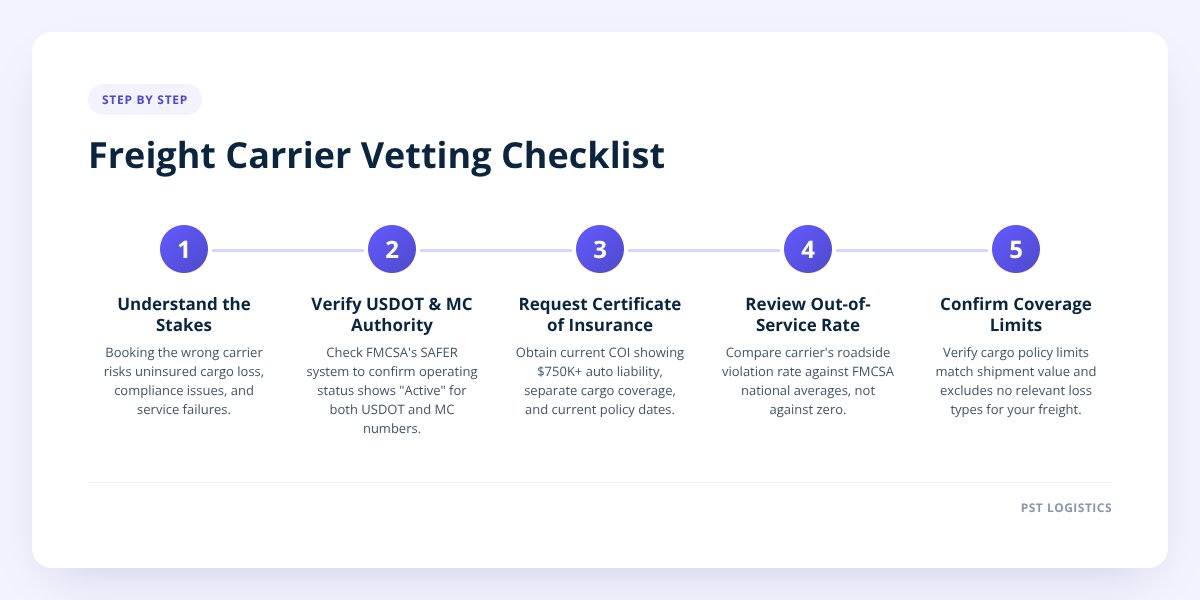
Step 1: Understand What's Actually at Stake Before You Book
Booking the wrong carrier costs more than a late delivery — it can leave you holding an uninsured cargo loss. If a carrier's insurance has lapsed and your freight is damaged or stolen in transit, you may have no recourse to recover that value, because the policy that was supposed to cover it doesn't exist anymore.
Authority problems create a different kind of mess. A carrier operating without active USDOT authority is doing so illegally, which means any accident, violation, or claim during that shipment gets complicated fast — insurance carriers can deny claims tied to unauthorized operations, and your freight becomes evidence in someone else's compliance problem instead of cargo that just needs to arrive.
Then there's the service failure that never makes the news but still costs real money: a truck that breaks down with no backup plan, a driver who runs out of hours mid-route, or a carrier that simply stops answering the phone. None of these show up on a rate confirmation sheet. They show up in missed delivery windows, detention charges, and a customer on the other end asking where their order is.
This is why vetting a carrier isn't paperwork for its own sake — it's the fastest way to predict whether a shipment will actually show up on time, intact, and covered. We go deeper on what reliability actually requires in Reliable Freight Transportation Takes More Than Trucks.
Step 2: Verify Active USDOT and MC Authority
Pull up the carrier's USDOT number and check it against the FMCSA's SAFER (Safety and Fitness Electronic Records) system before you book anything. This free, public database shows operating status, entity type, and authority history in real time — there's no reason to book blind when this check takes under five minutes.
Here's what to look for once you're in the record:
- Operating status should read "Active." Anything marked "Out of Service," "Not Authorized," or "Revoked" means the carrier cannot legally move your freight.
- Entity type tells you whether you're booking a carrier, a broker, or both. A broker-only entity has no trucks of its own — more on why that matters below.
- Operating authority (MC number) status should show "Active" for Common or Contract authority. This is separate from the USDOT number and both need to check out.
- Authority history shows whether the carrier has had authority revoked and reinstated before — a pattern worth asking about directly.
The FMCSA's Licensing & Insurance (L&I) System gives a second, more detailed view of the same authority record, including insurance filings on file with the agency. Cross-checking both takes a few extra minutes and catches discrepancies that a single lookup might miss.
Don't skip this: An MC number that "sounds right" or a carrier that says "we're fully authorized" is not verification. Pull the actual FMCSA record yourself, every time, even for a carrier you've used before — authority status can change between shipments.
Step 3: Request and Read the Certificate of Insurance
Ask every carrier for a current certificate of insurance (COI) before the truck is dispatched — not after. A legitimate carrier can produce this same business day, because the policy already exists and the paperwork is routine.
A COI that's worth anything shows these details clearly:
| What to check | What it should show |
|---|---|
| Auto liability limit | At least $750,000 (federal minimum per 49 CFR 387 for general freight); many carriers carry $1,000,000 |
| Cargo insurance | Separate line item — auto liability alone does not cover damaged or stolen freight |
| Policy effective dates | Current date falls inside the policy period, not expired or not-yet-active |
| Named insured | Matches the legal carrier name on the authority record, not a different entity |
| Certificate holder | Issued to you or your company, not a generic or outdated certificate |
Two details trip up shippers most often. First, auto liability and cargo coverage are not the same policy — a carrier can have solid liability coverage and zero cargo coverage, which means a damaged pallet of goods has nothing backing it. Second, a COI with an expiration date that's already passed, or one that was issued months ago for a different customer, tells you the carrier isn't keeping their paperwork current — which is itself a signal worth noticing.
For high-value or temperature-sensitive freight, ask the carrier directly whether their cargo policy excludes spoilage or temperature-related loss. Some do. If you're shipping produce, dairy, or frozen goods, this single question matters more than almost anything else on the certificate.
Step 4: Pull the Safety Rating and Read the Numbers Correctly
Check the carrier's safety rating and crash history through the FMCSA's SAFER system, and don't stop at the headline rating alone. The FMCSA assigns one of three ratings — Satisfactory, Conditional, or Unsatisfactory — based on a compliance review, but many carriers simply have "Not Rated" because they haven't had a review, so the rating alone doesn't tell the whole story.
The number that tells you more day-to-day is the Out-of-Service (OOS) percentage — the rate at which a carrier's vehicles or drivers are pulled from service during roadside inspections. The FMCSA publishes national average OOS rates for comparison, so a useful rule is: compare the carrier's rate to the published national average for that category, not to zero. A single inspection or two shouldn't sink a small fleet's numbers, but a rate running consistently well above the national average across vehicle, driver, and hazmat categories is worth a direct conversation before you book.
Also pull the carrier's crash history from the same record. Look for:
- Frequency — occasional incidents happen in an industry that logs millions of miles; a cluster in a short window is different.
- Severity — tow-away and injury crashes carry more weight than minor non-preventable incidents.
- Recency — a clean record over the last 12-24 months matters more than one bad year from several years back.
None of these numbers exist in isolation, and a single data point shouldn't make or break a decision on its own — but a carrier that's clean across authority, insurance, OOS rate, and crash history in combination is a carrier you can book with confidence.
Step 5: Watch for Red Flags That Override a Clean-Looking Record
Some warning signs matter more than a single number on a safety report, because they point to a structural problem rather than a one-time issue.
- Broker-only entity booking as if they're the carrier. If the FMCSA record shows a broker entity type and no trucks, ask directly who is actually hauling the freight and whether that carrier has been vetted separately.
- Authority listed as "Active" but recently reinstated after revocation. This isn't automatically disqualifying, but it's worth asking what caused the revocation.
- Insurance certificate that's generic, outdated, or doesn't name your company. A carrier that can't produce a current, specific COI same-day is telling you something about how they run their back office.
- Reluctance to share safety numbers or get specific about equipment. A carrier confident in its record will usually point you to its own FMCSA profile without hesitation.
- No real answer about who's driving your freight start to finish. Cross-docking and transloading between multiple carriers introduce more handoffs — and more chances for something to go wrong — than a single driver running the load door to door.
If you're assembling a shipment and want a broader prep list beyond carrier vetting, Prepare Freight for Interstate Trucking: Checklist covers what to have ready on the shipper side once the carrier is confirmed.
What a Vetted, Asset-Based Carrier Looks Like
PST Global runs active authority, $1,000,000 in auto liability coverage, cargo coverage in place, and a Satisfactory safety rating with clean CSA basics — the exact record a shipper should be checking for before booking anyone. As an asset-based carrier, the same truck and same driver run the full route from pickup to delivery, with no cross-docking, no transloading, and no layers between the driver and the dispatcher who answers the phone 24/7. Certificates of insurance and carrier packets go out the same business day they're requested, so there's never a reason to book blind.
Whether you need a dry van for palletized freight or a temperature-controlled reefer holding a tight setpoint for produce or frozen goods, you can request a rate on your lane and get a dispatcher who can speak to compliance, equipment, and coverage before the truck ever shows up.
Checklist: Vetting a Freight Carrier Before Booking
- Look up the carrier's USDOT number in the FMCSA SAFER system.
- Confirm operating status reads "Active," not revoked or not authorized.
- Cross-check the MC number and authority status in the FMCSA L&I System.
- Request a current certificate of insurance naming your company as certificate holder.
- Confirm auto liability meets at least the federal minimum and check for separate cargo coverage.
- Verify the policy's effective dates cover your shipment window.
- Pull the carrier's safety rating and Out-of-Service percentage from FMCSA records.
- Compare the OOS rate against the published national average, not against zero.
- Review crash history for frequency, severity, and recency.
- Ask directly whether the entity is a carrier, a broker, or both.