Prepare Freight for Interstate Trucking: Checklist
Quick answer: Freight that's ready for interstate transport has a complete bill of lading, is packaged and braced to survive 500+ miles of highway vibration, carries the correct labels and weight markings, and has been walked through once by someone who isn't the driver. Skipping any one of these is the single biggest cause of pickup delays, refused loads, and damage claims. Most problems show up in the same three places: missing paperwork, unsecured freight, and mismatched weights — all preventable the day before the truck arrives.
Key takeaways
- A bill of lading with a wrong weight or missing NMFC class is the most common reason dispatchers report pickup delays.
- Federal securement rules under 49 CFR 393.100–136 require cargo to withstand 0.8g deceleration forward and 0.5g in other directions — that's a real physics requirement, not a guideline.
- Pallets stacked more than a few inches past the pallet's edge, or loaded without corner boards, account for a large share of concealed damage claims filed after delivery.
- A single driver running your load from pickup to delivery — standard practice at carriers like PST Logistics — reduces handling touches that cause damage, compared to loads that get cross-docked or transloaded.
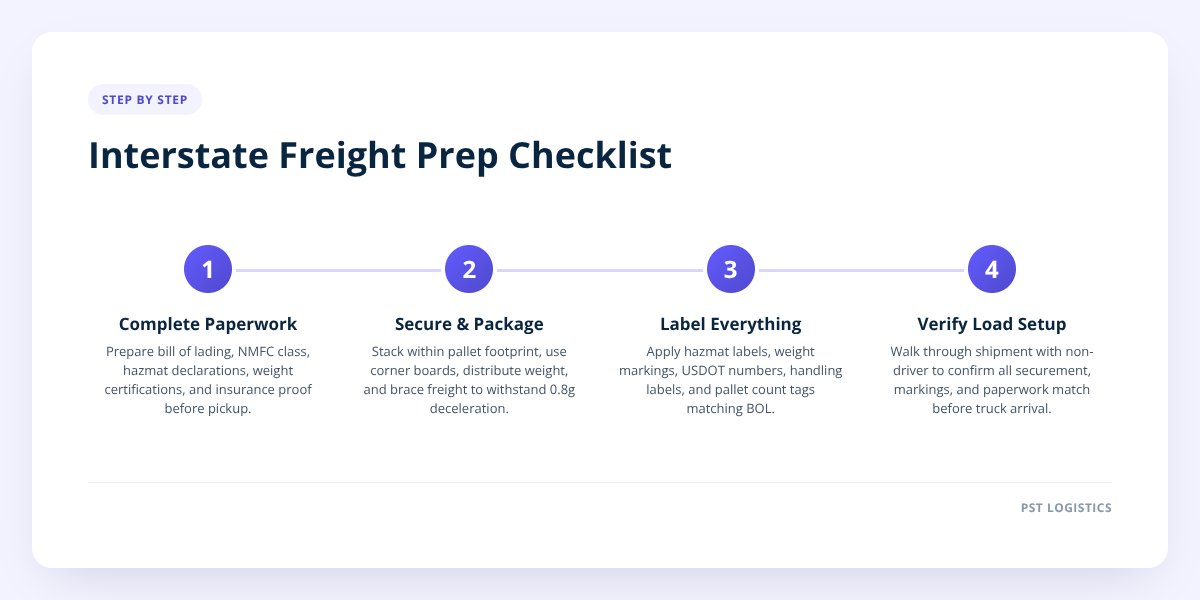
!Interstate Freight Prep Checklist
Step 1: Get Your Paperwork Complete Before the Truck Shows Up
Incomplete paperwork is the fastest way to turn a scheduled pickup into a delayed one. The driver isn't authorized to guess at missing information, and dispatch can't fix it once the truck is already at your dock.
Every interstate shipment needs a bill of lading (BOL) — the legal document that describes the freight, states who's shipping and receiving it, and sets the terms of the move. Get this wrong and the whole shipment stalls at the scale or the dock.
Before pickup day, confirm you have:
- Prepare a complete bill of lading listing shipper, consignee, piece count, and accurate weight.
- Assign the correct NMFC freight class if the shipment is rated by class (this affects billing, not just paperwork accuracy).
- Complete a hazmat shipping declaration if any portion of the load is regulated — proper shipping name, UN number, hazard class, and packing group all need to match the Hazardous Materials Regulations under 49 CFR Parts 172 and 173.
- Attach weight certifications for anything that will be weighed at a certified scale, especially oversized or high-value freight.
- Have your carrier's certificate of insurance and MC/DOT number ready if your receiving facility requires proof of authority at check-in.
- Print extra copies of the BOL — drivers, receivers, and your own records each need one, and a torn or missing copy at delivery can delay signature and payment processing.
If you're not sure what's legally required versus what's just standard practice, we broke down the difference in What Interstate Trucking Regulations Actually Require.
Step 2: Package and Secure the Freight So It Survives the Miles
Freight damage almost never happens because a driver hit a pothole — it happens because the load wasn't built to handle normal highway motion in the first place. A pallet that looks stable sitting still in a warehouse can shift completely during a hard brake or a highway merge.
Federal cargo securement rules, found in 49 CFR 393.100 through 393.136, require that freight be able to withstand 0.8g of deceleration force in the forward direction and 0.5g in the rearward and lateral directions, according to the Federal Motor Carrier Safety Administration. That's the equivalent of the truck braking hard enough to throw an unsecured load forward — your packaging has to hold up to that, every time, for the whole trip.
Practical steps that prevent the damage claims we see most often:
- Stack pallets within the footprint of the pallet itself — freight overhanging the edges gets crushed when pallets are stacked or when straps compress the load.
- Use corner boards and edge protectors on stretch-wrapped freight to stop straps from cutting into product during transit.
- Distribute weight evenly across the trailer floor — a nose-heavy or tail-heavy load affects axle weights and can trigger a scale violation even if the total weight is legal.
- Confirm stackability in writing if pallets will be double-stacked — freight rated "do not stack" that gets stacked anyway is one of the most common damage claim triggers.
- Brace floor-loaded freight against trailer walls with load bars or airbags so nothing shifts during braking or turns.
- Re-wrap any pallet where the stretch wrap has torn or loosened from staging and handling before the truck arrives.
Don't skip this: Freight that isn't secured to withstand 0.8g of forward deceleration doesn't just risk damage — it can be cited during a roadside inspection and held until it's re-secured, which delays your delivery regardless of who's at fault.
Step 3: Label and Mark Everything the Way an Inspector Expects to See It
Labels aren't paperwork for paperwork's sake — they're what a roadside inspector or receiving clerk uses to verify your shipment matches what's on the BOL in seconds, without opening a single box. Mismatched or missing labels are one of the fastest ways to get a load flagged.
Here's what inspectors and dock staff are actually checking:
| Marking type | What it must show | Who checks it |
|---|---|---|
| Hazmat labels | Correct hazard class diamond, UN number, proper shipping name | Roadside inspectors, receiving docks |
| Weight markings | Gross weight matching BOL and scale ticket | Weigh station staff, dispatch |
| USDOT number | Carrier's assigned number, visible on the power unit | FMCSA roadside inspectors |
| Handling labels | Fragile, this-side-up, do-not-stack, as applicable | Dock crews at pickup and delivery |
| Pallet count tags | Matches piece count on the BOL | Driver at pickup, receiver at delivery |
If even one of these doesn't match — say, the BOL says 22 pallets but only 20 are tagged — expect the pickup to pause while someone tracks down the discrepancy. That's lost time nobody planned for.
Step 4: Walk the Load Before the Driver Does
A five-minute walkthrough by someone on your team, done before the truck backs up to the dock, catches almost everything that would otherwise surface during the driver's own inspection. Drivers are required to check that cargo is properly secured before they leave — if they find a problem, they're the ones who have to fix it or refuse the load, and that's time you don't get back.
Do your own version of that walkthrough first:
- Check every pallet for visible damage, leaning, or loose wrap before it's staged for pickup.
- Verify the BOL piece count against what's physically on the dock — recount if the number was written down earlier in the day.
- Confirm hazmat placarding is on the correct sides of any container that requires it.
- Test that stretch wrap and strapping haven't loosened from staging equipment or forklift handling.
- Recheck weight if anything was added or removed from the load after the original BOL was drafted.
- Clear a straight, unobstructed path to the trailer so loading doesn't require awkward angles that increase handling risk.
Red flags that commonly delay departure include mismatched weights between the BOL and the scale ticket, hazmat freight without a shipping declaration, pallets that exceed the trailer's usable height, and freight staged in a way that blocks the forklift's approach. Catching these before the truck arrives is far cheaper than catching them after. We cover the day-of version of this in more detail in Freight Pickup Day Checklist: What to Prepare.
What to Do Next
Freight prep isn't a formality — it's the difference between a pickup that takes twenty minutes and one that eats half your afternoon. The good news is that every item on this list is something you control before the truck ever pulls in.
If you're evaluating whether to book directly with a carrier or go through a broker for your next shipment, that decision affects how much of this prep responsibility falls on your team versus someone else's — we compare the two in Trucking Company vs. Freight Broker: Who Should You Hire?
For shippers moving general freight, full truckloads, or temperature-controlled product across state lines, PST Logistics runs dry van and reefer freight with the same truck and same driver from pickup to delivery — no cross-docking, no handoffs, and dispatch that answers around the clock out of Naperville, Illinois. If you want your load quoted or your paperwork reviewed before pickup day, call PST Logistics or request a rate through their online form.
Checklist: Prepare Freight for Interstate Pickup
- Prepare a complete bill of lading with accurate weight, piece count, and NMFC class.
- File a hazmat shipping declaration for any regulated materials in the load.
- Gather weight certifications for oversized or high-value freight.
- Print extra copies of the BOL for driver, receiver, and your own records.
- Stack and wrap pallets within their footprint, using corner boards on stretch-wrapped freight.
- Brace floor-loaded freight with load bars or airbags against trailer walls.
- Distribute weight evenly across the trailer to avoid axle weight violations.
- Attach correct hazard labels, weight markings, and handling tags to every applicable pallet.
- Walk the load yourself and recount pieces against the BOL before the truck arrives.
- Clear a straight path to the trailer to reduce handling and forklift risk.