Choosing a Trucking Company in Naperville

Quick answer: The right general freight provider for a Naperville shipper combines a documented on-time record, a fleet that matches your freight type (dry van versus reefer), direct dispatch access instead of layers of account managers, and proof of insurance and DOT compliance you can verify before the first load ever moves. Ask for references, a sample rate confirmation, and their claims process in writing before you sign anything. If a carrier is vague about any of those four things, keep looking.
Key takeaways
- A trustworthy carrier can produce its DOT number, MC number, and current insurance certificate within one business day — if they can't, that's a sourcing risk, not a paperwork delay.
- Naperville's location gives day-drive access to most of the eastern U.S. and westbound Chicago lanes, which matters directly for your transit times and appointment windows.
- Same-truck, same-driver service (no cross-docking or transloading) reduces damage claims and keeps your freight traceable from pickup to delivery.
- A carrier that says yes to every load type — dry van, reefer, flatbed, LTL — is often spreading capacity thin; narrower specialization usually means tighter execution.
!Choosing a Naperville Trucking Company
What to Look For in a Naperville Trucking Company
Start with capacity that actually fits your freight, not a company that claims to do everything. A carrier specializing in dry van and temperature-controlled truckload is set up to run those loads well — pre-trip inspections tuned to those trailers, drivers trained on reefer setpoints, maintenance schedules built around that equipment. A carrier that also does flatbed, LTL, and specialized hauling on the side is managing more variables with the same headcount.
Look for these baseline qualifications before you request a quote:
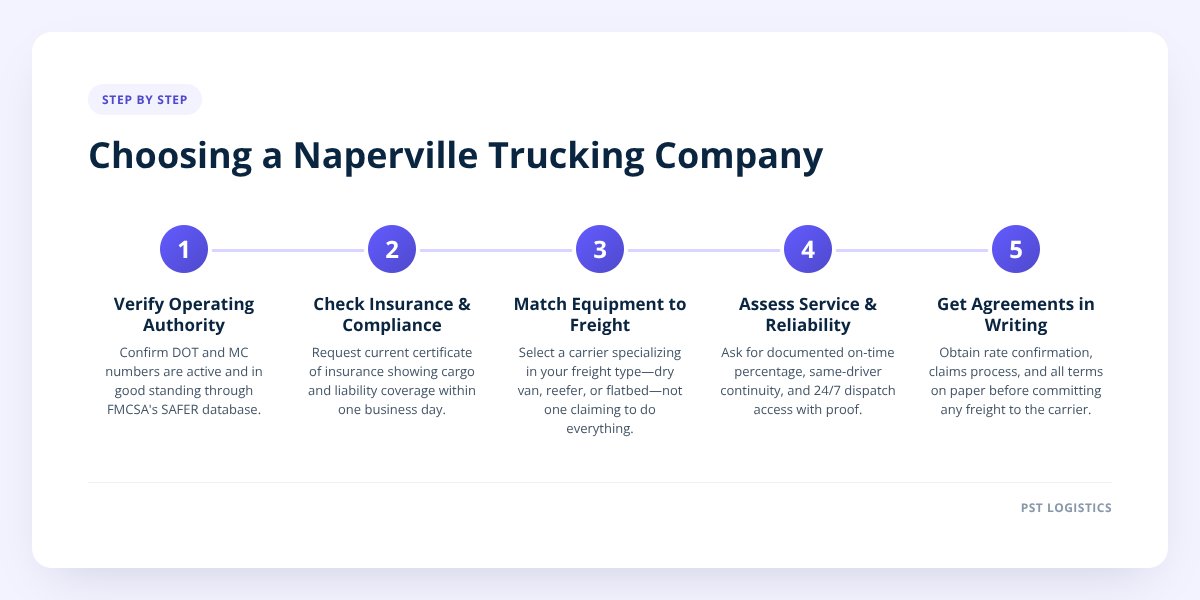
- Active operating authority. Confirm the carrier's DOT and MC numbers are active and in good standing through the Federal Motor Carrier Safety Administration's SAFER database.
- Current insurance. Ask for a certificate of insurance showing cargo and liability coverage, and confirm the policy hasn't lapsed.
- Equipment that matches your product. A 53-foot dry van rated for roughly 45,000 pounds and up to 26 standard pallets is a different tool than a reefer holding a setpoint between -20°F and 70°F for frozen goods.
- A documented on-time record. Ask what percentage of loads they deliver on schedule and how they track it — not just a verbal claim.
- Single-driver, single-truck continuity. Freight that changes trucks or gets cross-docked mid-route has more handling points, and more handling points mean more opportunity for damage or delay.
We covered the fundamentals of this evaluation in more detail in How to Choose a Trucking Company in Naperville, IL, including how to weigh price against service history.
What Questions Should You Ask Before Booking a Load?
Ask about dispatch access first — a shipper who can't reach a live person after hours has already lost visibility on the load. Here's the fuller list worth running through with any carrier before you commit freight to them:
- "Who answers the phone at 9 p.m. if my load is delayed?" A carrier with 24/7 dispatch should be able to name the process, not just say "we're always available."
- "Will the same driver and truck run this load start to finish?" If the answer involves cross-docking or transloading, ask why, and factor in the added handling risk.
- "Can you send a certificate of insurance and carrier packet today?" A carrier with organized back-office operations can typically turn this around same business day.
- "How do you log temperature on reefer loads?" Look for continuous or cycle-sentry monitoring with a logged, retrievable record — not just a driver's word that the reefer was running.
- "What's your claims process if freight arrives damaged?" Get this in writing before the load ships, not after something goes wrong.
- "Do you maintain your own trailers, or lease from a third party?" In-house preventive maintenance and DOT inspection programs tend to correlate with fewer roadside breakdowns.
If you're weighing a carrier against a broker relationship instead, Trucking Company vs. Freight Broker: Who Should You Hire? walks through when each makes sense.
What Are the Red Flags in a Freight Carrier?
The biggest red flag is a carrier that can't answer a direct question about insurance, authority, or equipment without hedging. Vague answers to specific questions usually mean the information doesn't exist or isn't favorable.
Watch for these warning signs during your evaluation:
- Reluctance to share DOT/MC numbers. Legitimate carriers list this information freely; it's public record through FMCSA anyway.
- No clear answer on who's driving your freight. If they can't tell you whether it's one driver, one truck, all the way through, assume it isn't.
- Rock-bottom quotes with no explanation. A quote well below market on a truckload lane often means something's being cut — insurance coverage, driver pay, or maintenance intervals.
- No after-hours contact. If dispatch only answers during business hours, you have no recourse when a delay happens at 7 p.m. on a Friday.
- Pressure to sign without a written rate confirmation. A verbal agreement with no paper trail leaves you exposed if a dispute comes up later.
- Unwillingness to provide references from shippers in your industry. A carrier confident in its service history will connect you with a current customer.
Don't skip this: verify DOT and MC authority through FMCSA's SAFER system before you book, not after. A carrier's own website can say anything; the federal record is the one source that can't be dressed up.
We go deeper on this in 8 Red Flags That Signal an Unreliable Trucking Company, including patterns that show up after the first few loads rather than during the sales call.
Why Does Choosing a Local Naperville Carrier Matter?
A Naperville-based carrier gives you day-drive access to a large share of freight lanes without needing a relay or team drivers. Naperville sits close enough to the Chicago rail and highway network to reach much of the eastern half of the U.S. in a single day's drive, and it's positioned for westbound lanes heading out toward the coast along I-80. That geography translates directly into tighter transit windows and fewer overnight layovers where your freight sits unattended.
Local also means something more practical day to day: a dispatcher who knows your account, your typical lanes, and your appointment requirements without you re-explaining it every time you call. Compare that to a national broker network routing your load through whichever carrier has a truck free that week — you get a different driver, different equipment, and a different level of care on every shipment.
Here's how the two models typically compare for a shipper running regular truckload freight:
| Factor | Local dedicated carrier | Broker-routed / rotating carrier network |
|---|---|---|
| Driver continuity | Same driver, same truck, pickup to delivery | Varies load to load |
| Dispatch relationship | Direct line to a dispatcher who knows your account | Often routed through an account rep, then a separate carrier |
| Transit time from Naperville | Day-drive access to eastern U.S. and Chicago westbound lanes | Depends on which carrier is assigned |
| Accountability if something goes wrong | One company, one point of contact | May involve broker and carrier, adding a layer |
| Rate transparency | Direct rate from the carrier moving your freight | Marked-up rate between broker and carrier |
For more on why this location specifically matters for freight movement, see Why Naperville Is a Strategic Hub for Freight Transportation.
How Do You Prepare Freight Before the Truck Arrives?
The carrier's reliability only matters if your freight is ready to move when the truck shows up. Palletized freight should be stacked to the trailer's rated capacity — for a standard 53-foot dry van, that's typically up to 26 standard pallets and around 45,000 pounds — with weight distributed evenly and load-bearing surfaces confirmed. For sealed loads, make sure paperwork matches the seal number exactly, since any mismatch can hold up delivery at the receiving dock.
For reefer freight, confirm the setpoint with the carrier before the truck arrives, not after it's loaded. A trailer pre-cooled to spec before the doors open protects product integrity far better than adjusting the reefer once freight is already inside. Ask whether the carrier logs temperature continuously or on a cycle-sentry basis, and get that record with your delivery paperwork — it's the documentation you'll want on hand if there's ever a quality dispute with the receiver.
We laid out a full prep checklist in Prepare Freight for Interstate Trucking: Checklist, covering everything from bill of lading accuracy to dock scheduling.
---
Choosing a freight carrier isn't just a price comparison — it's a decision about who's accountable for your product from the dock door to the delivery signature. PST Logistics, based in Naperville, runs dry van and temperature-controlled truckload freight with the same truck and same driver for the full run, 24/7 dispatch that actually answers, and a 99% on-time delivery rate backed by in-house maintenance and DOT compliance. If you're ready to talk lanes, request a rate quote from PST Logistics or call to get an insurance certificate and carrier packet the same business day.
Checklist: Choosing a Freight Carrier in Naperville
- Verify the carrier's DOT and MC numbers through FMCSA's SAFER database.
- Request a current certificate of insurance showing cargo and liability coverage.
- Confirm the trailer type matches your freight — dry van versus reefer with your required setpoint.
- Ask whether one driver and one truck will run the load start to finish.
- Get a written rate confirmation before the load ships.
- Ask how temperature is logged and request the record with delivery paperwork if running reefer freight.
- Get the claims process in writing before you need it.
- Request references from shippers moving similar freight in your industry.
- Confirm after-hours dispatch contact and response expectations.