Diesel Volatility Hitting Freight Bills

Quick answer: Diesel price swings this quarter are being driven by Middle East supply risk, state-level fuel tax relief proposals, and shifting refinery output — and each of those flows into your freight invoice through the fuel surcharge (FSC) line, usually on a one- to two-week lag. The fix isn't guessing where diesel goes next; it's locking surcharge terms into your contract now, understanding the index your carrier actually uses, and planning lane volume around the pattern rather than reacting to it. Shippers who negotiate FSC caps or floors before rates reset for the next quarter avoid the worst of the whiplash.
Key takeaways
- The U.S. Energy Information Administration (EIA) publishes the weekly On-Highway Diesel Fuel Price report every Monday — this is the benchmark most carrier FSC formulas are built on, so it's worth checking directly rather than trusting a single carrier's number.
- Most FSC tables use a baseline diesel price (often somewhere between $1.20 and $1.25 per gallon in older contracts) and adjust the surcharge in cents-per-mile increments for every few cents the index moves above that baseline.
- A surcharge that doesn't move with the EIA index for two or more consecutive weeks is a signal to ask the carrier which index and which lag period they're actually using.
- Locking a dedicated lane rate with a built-in FSC cap protects budget predictability even if diesel spikes again before the quarter ends.
!Managing Diesel Price Volatility in Freight
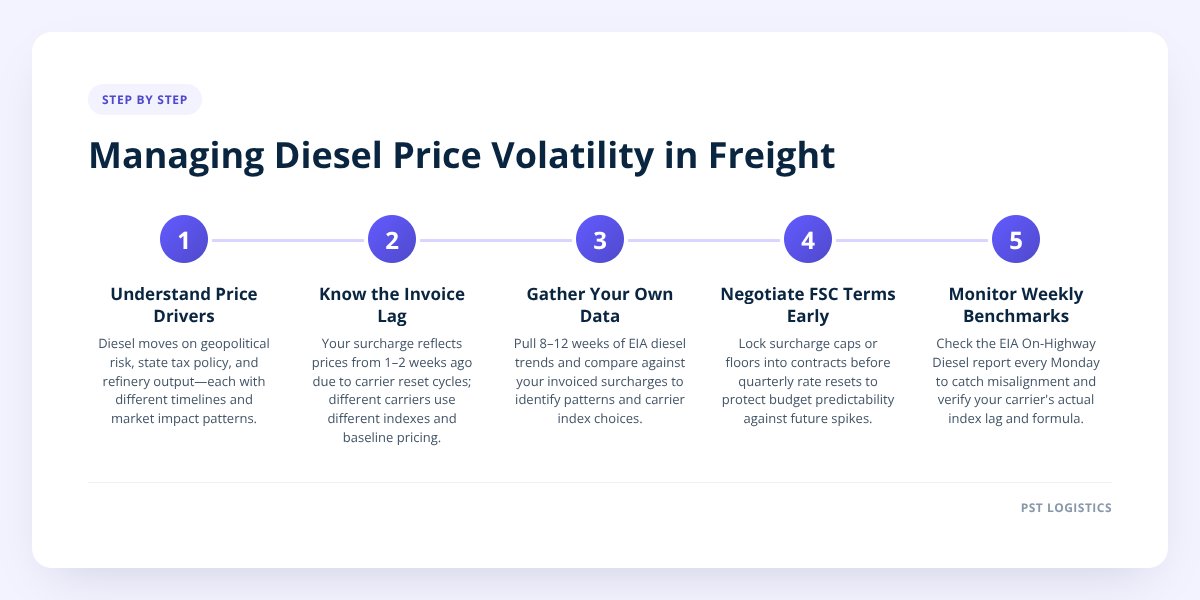
Step 1: Understand What's Actually Moving Diesel Prices Right Now
Diesel hasn't moved on one cause this quarter — it's moved on three overlapping ones, and each has a different timeline.
The first is geopolitical. Continued tension tied to the conflict involving Iran has put upward pressure on crude oil markets, and diesel, which is refined from crude, tends to react faster than gasoline to supply-risk headlines because commercial and industrial demand is less elastic. When shipping lanes or production in the region face disruption risk, markets price that in within days, not weeks.
The second is policy. Several states have floated or enacted temporary suspensions of state fuel taxes to blunt pump prices for consumers, and the White House has reportedly weighed relief measures tied to red-dyed diesel tax treatment. These moves can shave cents off the retail price in specific states, but they don't change the national wholesale price — which means your FSC, if it's tied to a national index like the EIA average, may not reflect a state-level tax cut at all.
The third is refinery and production timing. OPEC+ output decisions and seasonal refinery maintenance schedules shift supply independent of any single headline event. This is the slower-moving driver, but it sets the floor or ceiling that geopolitical spikes bounce around.
Don't skip this: a state fuel tax suspension lowers what you pay at a retail pump in that state — it does not necessarily lower the national diesel index your carrier's surcharge is built on. Don't assume a tax holiday in one state means your FSC line should drop.
Here's what that means for the next 60 to 90 days: expect continued volatility rather than a clean trend in either direction. Plan your freight budget around a range, not a single forecast number.
Step 2: Know the Lag Between Pump Price and Your Invoice
Your invoice this week reflects diesel prices from one to two weeks ago, not today's price at the pump. Most carrier fuel surcharge tables reset on a weekly or biweekly cycle using the prior week's average from a published index — commonly the EIA's weekly On-Highway Diesel Fuel Price report, which comes out every Monday covering the previous week's average.
That lag matters in both directions. When diesel spikes fast — as it has during periods of acute Middle East supply concern — your surcharge hasn't caught up yet, so you're temporarily paying less than current market conditions would justify. When diesel drops fast, the opposite happens: you keep paying the higher surcharge for another week or two after the price break.
This is also why two carriers quoting the same lane on the same day can show different FSC numbers. The differences usually come down to:
- Index source — EIA national average versus a regional PADD (Petroleum Administration for Defense Districts) average, which can run several cents apart from the national figure.
- Reset frequency — weekly versus biweekly adjustment cycles mean one carrier is already reflecting a price move the other hasn't applied yet.
- Baseline diesel price — the per-gallon figure the surcharge scale starts counting from, which varies by contract and by how recently it was negotiated.
- Increment structure — how many cents the surcharge moves for every cent (or nickel) the index moves, which is rarely identical across carriers.
We walked through the mechanics of this formula in more detail in How Fuel Surcharges Work on Your Freight Bill, including how the cents-per-mile scale is typically built.
Step 3: Pull the Right Numbers Before You Negotiate
Before you call a carrier or broker about rates for the next quarter, gather your own data so you're negotiating from facts, not vibes.
- Pull the last 8 to 12 weeks of EIA weekly diesel averages for your primary lanes' regions.
- Compare that trend against the FSC line on your last three invoices from each carrier you use.
- Identify which index and baseline each carrier's contract references — ask directly if it isn't written down.
- Flag any week where your invoiced surcharge moved opposite to the EIA trend, and note the date.
- Calculate your average monthly fuel surcharge spend as a percentage of total freight spend over the last two quarters.
That last number is the one that matters most in negotiation. If fuel surcharges are running close to 20% or more of your total freight cost on a lane, a one-cent shift in the index baseline has real budget impact — and that's exactly the lever worth negotiating before you sign anything for the next quarter.
Step 4: Lock Terms In Before the Quarter Rolls, Not After
The best time to negotiate FSC structure is before a new quarterly rate agreement starts, not mid-quarter when diesel is already spiking and the carrier has less flexibility to move on terms. A few concrete options to raise:
| Option | What it does | Best for |
|---|---|---|
| FSC cap | Surcharge stops increasing above a set ceiling regardless of index movement | Shippers with tight, fixed freight budgets |
| FSC floor | Surcharge doesn't drop below a set minimum, trading some upside for rate stability | Carriers protecting margin, sometimes traded for a cap on the shipper side |
| Locked all-in rate | Base rate plus fuel bundled into one number for the contract term | High-volume, predictable lanes with consistent mileage |
| Dedicated lane agreement | Fixed capacity and rate structure for a recurring lane, often with FSC terms built in upfront | Shippers running the same lane weekly or more |
| Shift to off-peak pickup windows | Avoids capacity-driven rate premiums that stack on top of fuel volatility | Flexible shippers who can adjust appointment timing |
A dedicated freight arrangement — where a carrier commits capacity to your lane on a recurring basis — is often the most effective way to stabilize both the base rate and the fuel terms at once, because the carrier can plan equipment and driver time around your volume instead of pricing in uncertainty.
If you're shipping palletized freight that needs the same truck and driver from pickup to delivery with no cross-docking in between, that consistency also reduces the number of touchpoints where fuel and handling costs can compound. PST Global runs dry van truckload freight this way — one driver, one trailer, pickup to delivery — which keeps the variables in a quote limited to what's actually negotiable: base rate, fuel terms, and transit time.
Step 5: Watch for FSC Numbers That Don't Match the Market
A surcharge that drifts away from the published index for more than a couple of weeks is the clearest sign something's off in how a carrier is calculating or applying it. If your invoice shows a fuel surcharge that hasn't moved in a month while the EIA weekly average has climbed or dropped several cents, that's worth a direct question to the carrier: what index are you using, what's the reset date, and what's the baseline?
There's also a pricing pattern worth watching for, sometimes described as "low base rate, high FSC." A carrier quotes an unusually low linehaul rate to win the bid, then makes up the margin through a surcharge structure with a lower baseline, a steeper increment, or less transparency than competitors. The all-in cost can end up higher than a carrier quoting a fair base rate with a standard, index-matched surcharge — but it's harder to spot because the headline rate looks like the better deal.
We covered the broader budgeting mechanics of this in Why Fuel Surcharges Exist and How to Budget for Them, and the seasonal timing angle in Fall 2026 Freight Planning for Shippers.
The protection against both problems is the same: ask for the full rate breakdown — base rate, fuel surcharge formula, index source, and reset frequency — in writing before you sign, and compare the all-in cost per mile across quotes rather than comparing base rates alone.
What to Do Next
Diesel volatility this quarter isn't a one-event problem, so the response shouldn't be either. Pull your own index data, know exactly what formula each carrier is using, and get fuel terms written into your next contract before conditions force your hand mid-quarter.
If you're planning truckload volume for the next 60 to 90 days and want rate and fuel terms laid out clearly before you commit, PST Global runs dry van and temperature-controlled truckload freight out of Naperville, Illinois, with dispatch that answers 24/7 and a single driver on your load from pickup to delivery. Request a quote on your lane and ask directly about the fuel surcharge formula — a straight answer on that question tells you a lot about how the rest of the relationship will go.
Checklist: Protecting Your Freight Budget from Fuel Volatility This Quarter
- Pull the EIA weekly On-Highway Diesel Fuel Price report for the last 8 to 12 weeks.
- Compare that data against your last three invoices from each carrier.
- Ask each carrier directly which index, baseline, and reset frequency their FSC formula uses.
- Calculate fuel surcharge as a percentage of total freight spend for your top lanes.
- Flag any invoice where the surcharge didn't track the published index for two or more weeks.
- Request an FSC cap or floor before your next quarterly rate agreement is signed.
- Compare all-in cost per mile across quotes, not just base rate.
- Ask about dedicated lane options if you run the same route weekly or more often.