Weight Limit Exemptions and Oversize Permits in the Midwest

Quick answer: Most general freight moves under standard federal weight limits — 80,000 lbs gross on the Interstate system under Federal Highway Administration rules — so no permit is needed. You only need an oversize or overweight permit when a load exceeds your state's legal limits on length, width, height, or axle weight, and each state in your route issues its own permit, so a load crossing Illinois, Iowa, and Nebraska needs separate paperwork from each one. Some states grant seasonal or industry-specific weight easements — Minnesota's agriculture and forestry weight allowances are a current example — but those exceptions apply only to the commodities and roads they name, not to general freight.
Key takeaways
- The federal gross weight limit on Interstate highways is 80,000 lbs, with axle weight limits of 20,000 lbs (single) and 34,000 lbs (tandem), per the Federal Highway Administration's bridge formula.
- Oversize and overweight permits are issued state by state — there's no single multi-state permit, so a Midwest-to-Texas move can require four or more separate applications.
- Minnesota's agriculture and forestry weight easements apply to specific seasonal hauls on specific roads, not to general dry van or reefer freight.
- A standard 53' dry van loaded to 45,000 lbs of palletized freight almost never needs a permit at all — permits become relevant for dimensional overages or axle weight distribution, not typical truckload cargo.
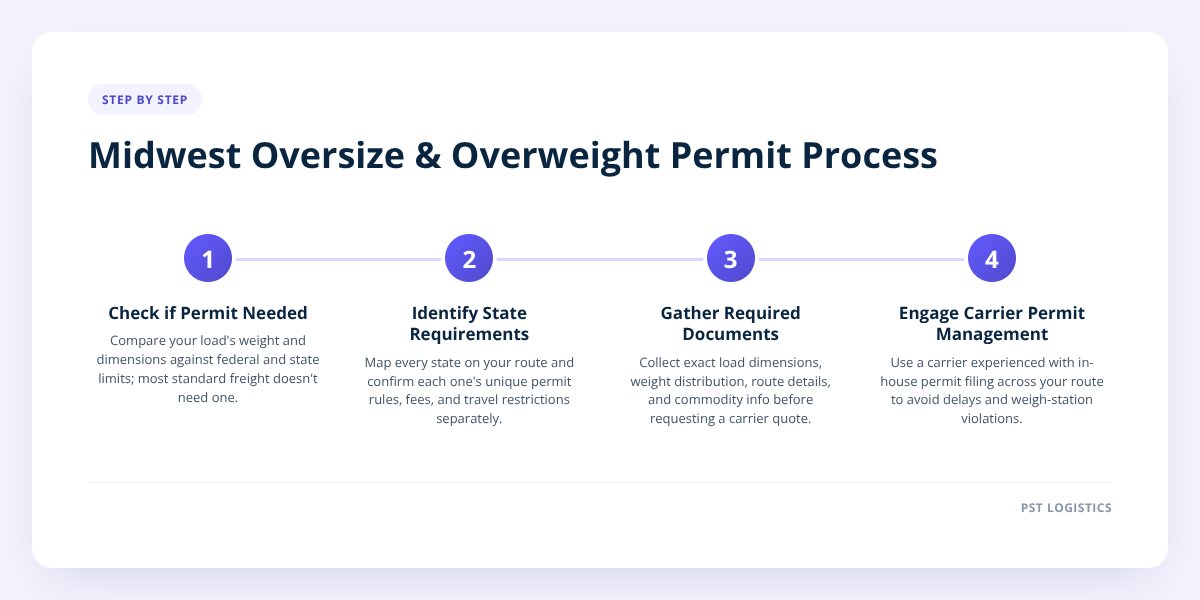
!Midwest Oversize & Overweight Permit Process
Step 1: Figure out if you actually need a permit
Start by comparing your load's dimensions and weight against federal and state legal limits — most general freight never crosses that line. The Federal Highway Administration sets the baseline for Interstate highways: 80,000 lbs gross vehicle weight, 20,000 lbs on a single axle, and 34,000 lbs on a tandem axle group, all governed by the bridge formula that spreads weight across axles to protect road surfaces and bridges.
Standard trailer dimensions also have legal ceilings that don't need a permit. A typical 53-foot dry van, loaded with palletized freight up to 45,000 lbs, sits comfortably inside these limits on nearly every lane. You only enter permit territory when:
- Your cargo's length, width, or height exceeds state legal limits (commonly 8.5 feet wide, 13.5 to 14 feet tall, depending on the state).
- Your gross weight or axle weight exceeds federal or state limits even after proper load distribution.
- Your trailer configuration itself — a lowboy, flatbed with overhang, or multi-axle specialty trailer — is nonstandard.
If none of these apply, you're clear to run as general freight with standard documentation. If one does, move to the next step.
Step 2: Identify which states on your route require what
Every state sets its own permit rules, fees, and travel restrictions, and they don't match each other. This is the part shippers underestimate most — a load that's legal and permitted in Illinois can still need a separate overweight permit in Iowa, Nebraska, and every other state before it reaches the coast.
Here's how that plays out on two corridors PST Global runs regularly:
| Corridor | States crossed | Permit complexity |
|---|---|---|
| I-80 westbound (Chicago to West Coast) | IL, IA, NE, WY, UT, NV, CA | Each state issues its own overweight/oversize permit; some restrict night travel or require escort vehicles above certain dimensions |
| Texas triangle (Dallas–Houston–San Antonio) | TX only, but high load density | Texas has its own permit portal and axle weight tables separate from federal defaults |
| Midwest to Southeast | IL, IN, OH/KY, TN, GA | Mountainous terrain in TN and GA can trigger added routing restrictions for oversize loads |
Some states also grant temporary or seasonal exemptions for specific industries. Minnesota, for example, has issued weight easements for agricultural and forestry hauls, allowing qualifying loads to run above standard limits on designated roads during specific periods. These easements are narrow by design — they apply to the commodity and road type named in the order, not to general freight, dry van, or reefer loads moving unrelated cargo.
Don't skip this: A permit from one state never carries over into the next. If your route crosses five states, confirm permit requirements and fees in all five before the truck leaves the dock — not after it's already rolling.
Step 3: Gather the paperwork your carrier needs from you
Your carrier can't file for a permit without specific information from you, and missing details are the single most common cause of permit delays. Before you request a quote or book the load, have this ready:
- Confirm exact outer dimensions of the load — length, width, height, including any overhang.
- Provide total gross weight and, if known, per-axle weight distribution.
- Share the exact route or origin/destination if you have a routing preference.
- Note any travel time restrictions your facility requires (no night delivery, dock hours, etc.).
- Flag whether the load requires escort vehicles, which some states mandate above certain width or weight thresholds.
- Confirm the commodity being hauled, since some state exemptions are commodity-specific.
- Provide a certificate of insurance request lead time if your receiving facility requires one on file before arrival.
Most of this is information you already have from your bill of lading and load specs. The work is making sure it reaches your carrier's dispatcher before the truck is dispatched, not after it's already en route and permits are being filed under time pressure.
Step 4: Let your carrier manage the permit filing — and know what to ask them
A carrier that manages permits in-house saves you the state-by-state filing work and the risk of a load getting pulled at a weigh station for a missing document. When you're vetting who handles this, ask directly:
- Who files the permit — you, or does the carrier handle it as part of the move?
- How far in advance do they need load specs to guarantee the permit is in hand before pickup?
- Do they have same-day turnaround on paperwork like certificates of insurance, which some receiving facilities require before a load is accepted?
- What happens if a state's permit portal is delayed — is there a backup routing plan?
For general freight that doesn't need an oversize or overweight permit at all — the bulk of dry van and reefer truckload moves — the paperwork question is simpler but still matters. PST Global runs standard 53' dry van and temperature-controlled reefer equipment, keeps $1,000,000 in auto liability coverage and active cargo insurance on file, and sends certificates of insurance the same business day they're requested — which matters when a receiving facility won't open the dock without one in hand. We've written more on what to have ready before a load ships in Prepare Freight for Interstate Trucking: Checklist.
Step 5: Avoid the mistakes that cause routing delays and surprise fees
The costliest mistakes happen before the truck ever leaves the dock, not on the road. The most common ones:
- Assuming one permit covers the whole route. It doesn't — each state requires its own, and skipping one risks fines and delays at weigh stations.
- Confusing a state weight easement with a blanket exemption. Minnesota's agriculture and forestry allowances, for instance, apply to named commodities and roads, not to general freight running through the state.
- Underestimating axle weight distribution. A load can be under 80,000 lbs gross and still violate the bridge formula if weight isn't distributed correctly across axles — that's a separate check from total weight.
- Waiting until pickup day to confirm dimensions. Permits can take time to process depending on the state; last-minute applications risk missed pickup windows.
- Not asking who absorbs a permit fee or delay cost. Get this settled with your carrier or broker before the load is booked, not after an invoice arrives.
If you're also weighing whether to book this kind of move through a broker or direct with a carrier, that decision affects who's accountable for the permit paperwork too — we cover that tradeoff in Trucking Company vs. Freight Broker: Who Should You Hire?
What to do next
Most shippers moving standard truckload freight — palletized dry goods, produce, frozen cargo in a 53' reefer — will find they don't need an oversize or overweight permit at all. The real work is confirming that early, not discovering it at a weigh station.
PST Global runs dry van and temperature-controlled freight across all 48 states out of Naperville, Illinois, with core lanes covering the Midwest to Southeast corridor, the Texas triangle, and I-80 westbound. Dispatch answers 24/7 and can tell you quickly whether your load's dimensions and weight fall inside standard limits or need permit coordination before you book the lane. Request a rate quote and get a straight answer on what your load needs before it ships.
Checklist: Qualify for a weight or oversize permit
- Measure your load's exact length, width, height, and total gross weight.
- Compare those figures against federal limits — 80,000 lbs gross, 20,000 lbs single axle, 34,000 lbs tandem.
- List every state your route crosses and check each one's permit requirements separately.
- Confirm whether any state-specific seasonal easement applies to your commodity — most general freight won't qualify.
- Send your carrier full load specs, including axle weight distribution, before pickup is scheduled.
- Ask your carrier who files the permit and how long turnaround takes in each state on your route.
- Request a certificate of insurance in advance if your receiving facility requires one on file.
- Confirm travel restrictions — night travel bans or escort vehicle requirements — before dispatch.