Managing Freight Costs During a Diesel Price Spike

Quick answer: When diesel spikes, protect your freight budget by locking in rates on your steady lanes before the increase fully hits, consolidating smaller shipments into fewer full truckloads, and reviewing your fuel surcharge clause so you know exactly how and when it adjusts. Most carriers update surcharges weekly based on the U.S. Energy Information Administration's diesel index, so your bill will lag the pump price by several days — use that lag to plan, not panic.
Key takeaways
- The U.S. Energy Information Administration publishes a weekly average diesel price every Monday, and most carrier fuel surcharge tables reset against that number — so your invoice reflects last week's fuel cost, not today's.
- Consolidating two or three partial shipments into one full truckload can cut your per-unit fuel exposure because the surcharge is typically calculated as a flat cents-per-mile add-on, not a percentage of freight value.
- A fuel surcharge clause that doesn't specify the index source, the base price, or the adjustment frequency leaves you guessing every time prices move — ask for all three in writing before you sign.
- Rate locks make sense for predictable, recurring lanes; staying on the spot market makes sense when your volume is irregular or your lanes change month to month.
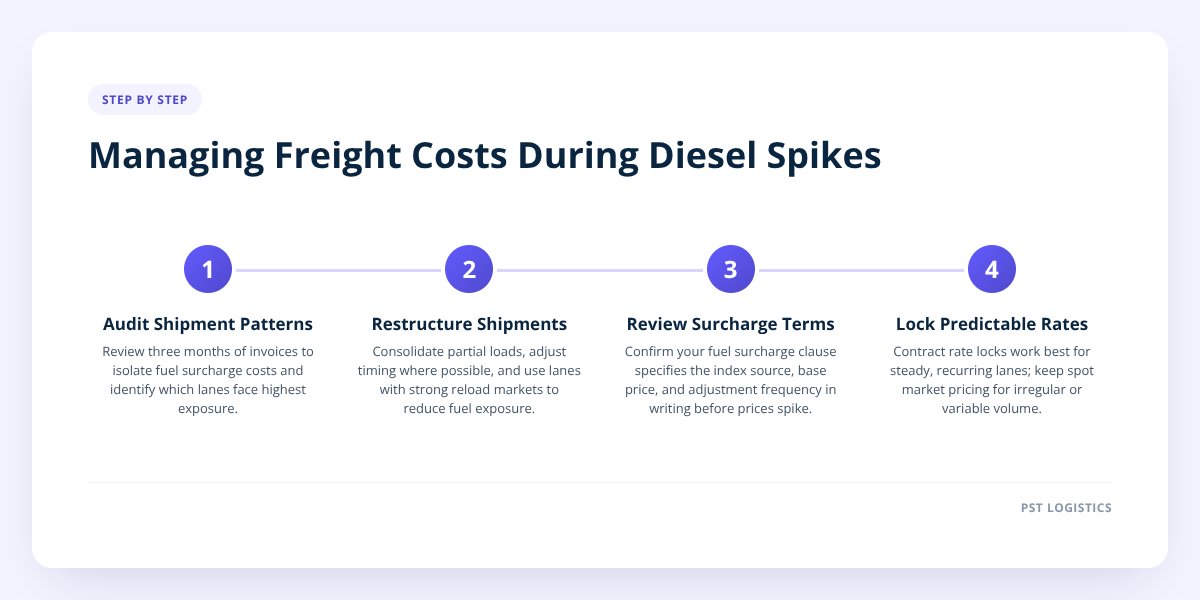
!Managing Freight Costs During Diesel Spikes
Why Fuel Spikes Hit Your Freight Bill Harder Than Other Costs
Diesel is one of the few line items on a freight invoice that changes weekly instead of annually. Warehouse rent, insurance, and labor costs move slowly and get renegotiated on a schedule you can see coming. Fuel does not work that way — a geopolitical event or a refinery outage can move the price 20 to 30 cents a gallon in a matter of days, and that change shows up on your next invoice almost immediately.
Most truckload carriers pass fuel costs through using a fuel surcharge, a separate line item added to the base linehaul rate that adjusts with the price of diesel. This exists because a carrier quoting a rate today can't predict what diesel will cost next month, and without a surcharge mechanism, either the carrier eats the increase or refuses the load. The surcharge is the industry's way of splitting that risk predictably instead of renegotiating every rate every week.
The timing matters more than most shippers realize. We covered the mechanics of this in How Fuel Surcharges Work on Your Freight Bill, but the short version is this: surcharges typically reset on a weekly cycle tied to the EIA's published diesel average, which means there's usually a several-day gap between a price spike at the pump and when it fully lands on your invoice. That gap is your planning window — not a loophole, but a real stretch of time to adjust shipment timing, volume, or lane choice before the higher rate locks in.
Step 1: Audit Your Shipment Patterns Before You React
Before changing anything, look at the last three months of your freight invoices and separate fuel surcharge dollars from base linehaul dollars. Shippers often don't realize how much of a bill increase is fuel versus capacity tightness or lane-specific demand — and you can't fix a problem you haven't isolated.
Pull this data and ask:
- Which lanes carry the highest surcharge-to-linehaul ratio? Shorter, high-frequency lanes often feel fuel spikes more because the surcharge is a bigger share of a smaller base rate.
- Are you shipping partial loads on any of these lanes that could be consolidated?
- Do you have recurring volume on any lane that would justify a dedicated, contracted rate instead of spot pricing?
- Is your current fuel surcharge table based on a national average or a regional diesel price? Regional pricing can run higher or lower than the national number depending on where you're loading and delivering.
This audit takes an afternoon and tells you which of the strategies below actually apply to your freight — not every shipper needs every tool.
Step 2: Restructure Shipments to Reduce Fuel Exposure
Once you know where the exposure sits, there are three practical ways to reduce it without changing carriers or renegotiating your whole contract.
Consolidate smaller shipments into full truckloads. Fuel surcharges are generally calculated as a flat rate per mile, not a percentage of cargo value, which means a half-empty trailer pays almost the same surcharge as a full one. If you're running two 15,000-lb partial shipments on the same lane in the same week, combining them into one full truckload — PST Logistics runs dry van trailers up to 45,000 lbs and 26 standard pallets — spreads that fixed surcharge cost across twice the freight.
Adjust shipment timing where your delivery windows allow. Diesel prices don't move uniformly across regions, and a load that doesn't need to move Monday morning might cost less to dispatch Wednesday, depending on how your carrier's surcharge table resets. This only works if your receiver has flexible appointment windows — don't compromise a hard delivery date to chase a marginal fuel savings.
Reconsider lane and reload strategy. Lanes with strong reload markets on the return leg tend to have more stable capacity and pricing because carriers aren't running empty miles to reposition. PST Logistics' core lanes run Midwest to Southeast, the Texas triangle, and I-80 westbound to the coast, with reload markets in Atlanta, Dallas, Laredo, Savannah, Newark, and Los Angeles — lanes like these are less prone to the sharp spot-rate swings that hit freight moving into markets with little return freight.
Don't skip this: Never let a driver sit on a hard appointment time to chase a fuel savings — a missed delivery window usually costs more in detention fees and strained relationships than the surcharge difference ever saves.
Step 3: Read Your Fuel Surcharge Clause Before Prices Move, Not After
The time to understand your fuel surcharge clause is before diesel spikes, not while you're staring at a surprise invoice. A clause that's vague on three specific points will cost you flexibility exactly when you need it most.
Check your contract or carrier agreement for these details:
| Clause element | What to look for | Why it matters |
|---|---|---|
| Index source | Named source, ideally the EIA's weekly on-highway diesel average | An unnamed or carrier-internal index can't be independently verified |
| Base price | The diesel price at which the surcharge starts applying (often around $1.20–$1.25/gallon in common tables) | Below this threshold, you may pay no surcharge at all |
| Adjustment frequency | Weekly is standard; some run biweekly or monthly | Less frequent resets mean slower pass-through in both directions |
| Calculation method | Cents-per-mile table vs. percentage of linehaul | Determines how consolidation and lane choice affect your exposure |
| Regional vs. national pricing | Specified region or national average | Regional diesel prices can diverge from the national number by a meaningful margin |
If any of these are missing or vague, ask your carrier to add specific language before your next contract renewal. A surcharge clause with a named index, a clear base price, and a defined reset schedule protects both sides — you know what to expect, and the carrier isn't accused of marking up fuel arbitrarily.
This is also the point to ask about flexibility: can the surcharge table be revisited if diesel prices fall and stay low for an extended period? Most carriers will adjust the base price periodically, but it should be written down, not assumed.
Step 4: Decide When to Lock In a Rate vs. Stay Flexible
Lock in a contracted rate when your volume is predictable and recurring; stay on the spot market when your lanes or volume change frequently. This is the single biggest decision shippers face during a fuel spike, and getting it backwards is expensive in either direction.
Lock in a rate when:
- You ship the same lane weekly or monthly with consistent volume.
- You want budget certainty for forecasting, even if it means paying slightly above the current spot rate in a falling market.
- Your carrier offers a dedicated service — PST Logistics' dedicated freight services pair a shipper with consistent capacity and a known rate structure for recurring lanes, which removes the week-to-week guessing game entirely.
Stay flexible when:
- Your shipping volume or lanes change month to month and you'd be locking in capacity you might not use.
- You expect diesel prices to come back down and don't want to be stuck above the spot market for the length of a contract.
- You're testing a new lane or a new product line and don't yet have enough history to commit.
A simple way to decide: if you can name your next three shipments on a lane before they happen, you have enough predictability to benefit from a locked rate. If you can't, the spot market — with a clear-eyed look at the fuel surcharge table — is the more honest fit for your freight pattern right now.
What to Do Next
Start with the audit in Step 1 — you can't make a smart decision about locking rates or consolidating loads until you know which lanes are actually driving your fuel exposure. From there, bring your findings to a conversation with your carrier about surcharge clause specifics and dedicated lane options.
PST Logistics runs dry van and temperature-controlled truckload freight from Naperville, Illinois across all 48 states, with 24/7 dispatch and a 99% on-time delivery rate. If you're weighing a dedicated lane against spot pricing, or just want a straight answer on how a quote is built, request a rate on your lane and talk it through with a dispatcher who'll know your freight by name, not a ticket number.
Checklist: Manage Freight Costs During a Fuel Price Spike
- Pull three months of invoices and separate fuel surcharge dollars from base linehaul dollars.
- Identify which lanes have the highest surcharge-to-linehaul ratio.
- Check whether any partial shipments on the same lane can be consolidated into one full truckload.
- Confirm your fuel surcharge clause names a specific index, base price, and reset frequency.
- Ask your carrier whether the surcharge is calculated per mile or as a percentage of linehaul.
- Review delivery windows to see if any shipments have timing flexibility.
- List your recurring lanes to evaluate against a dedicated or contracted rate.
- Request a rate quote on your highest-volume lane to compare against current spot pricing.