How to Qualify for Expedited Freight and When to Use It

Quick answer: Expedited freight qualifies when a load has a hard delivery deadline that standard truckload or LTL transit times can't meet — think a production line that stops without a part, or a trade show that opens on a fixed date. It costs more because a carrier commits a dedicated truck and driver to your freight alone, often with faster pickup and no stops for other shippers. Before paying the premium, confirm your deadline is truly fixed, check whether a well-planned standard truckload move could still make it, and get a straight answer from your carrier on what "expedited" actually guarantees.
Key takeaways
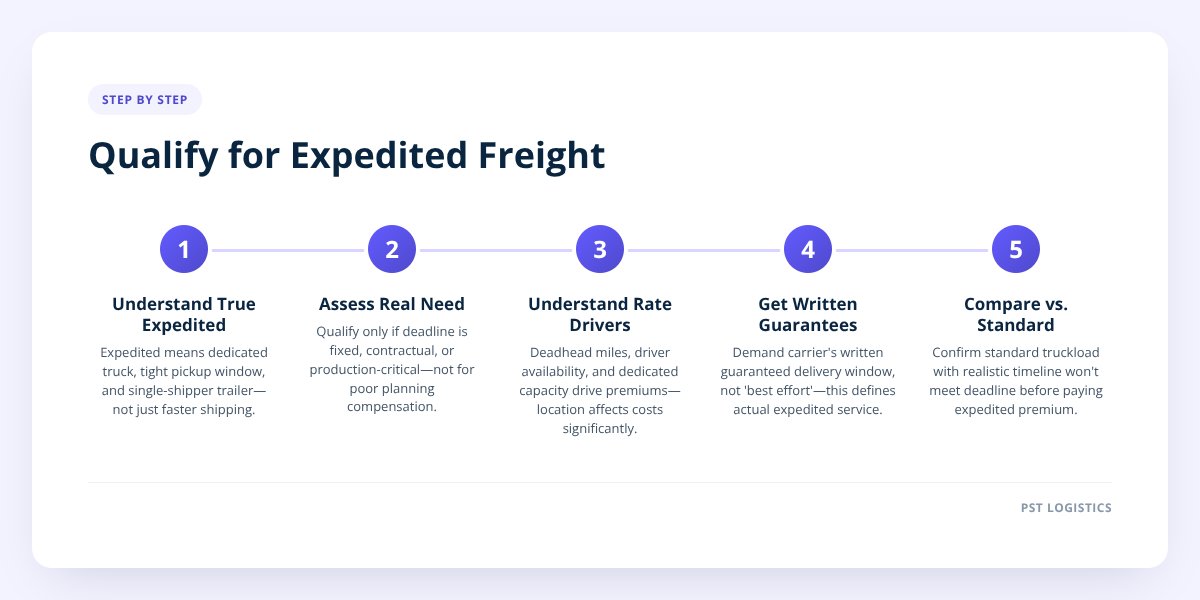
- Expedited freight means a dedicated truck, a tighter pickup window, and usually a single shipper per trailer — not just "ship it faster."
- The premium typically reflects deadhead miles, driver availability on short notice, and the opportunity cost of a truck that could have carried a full, planned load.
- A standard full truckload move with a realistic transit estimate often meets the same deadline for less money — the gap is usually in planning lead time, not trucking speed.
- Asking your carrier for a guaranteed delivery window in writing, not just a "best effort," is the single best way to know if you're paying for a real service or just a label.
!Qualify for Expedited Freight
Step 1: Understand what "expedited" actually means before you ask for it
Expedited freight isn't a single product — it's a tier, and the tiers matter. At the low end, some carriers will simply move your freight up in the queue and shave a day off a standard truckload transit. At the high end, you're booking a dedicated truck and driver, sometimes with a hot-shot or team-driver setup, committed to your load exclusively from pickup to delivery.
The differences that actually define the tier:
- Pickup window. Standard truckload freight is often booked a day or more out. Expedited freight typically means pickup within hours of the call.
- Dedicated capacity. A true expedited load has one truck assigned to one shipment — no consolidating with other freight, no detours to pick up a second load.
- Guarantee type. Some carriers offer a guaranteed delivery appointment with a penalty or refund if missed. Others offer "best effort," which is faster than standard but not contractually guaranteed. These are not the same thing, and the price difference between them should reflect that.
- Routing discipline. Expedited loads generally run direct, with minimal layovers, and sometimes with hours-of-service planning built around making the deadline rather than around driver convenience alone.
If a carrier uses the word "expedited" without being able to tell you which of these apply to your load, ask directly. A dispatcher who can't answer whether your delivery window is guaranteed or estimated hasn't actually sold you an expedited service — they've sold you a faster-sounding version of standard freight.
Step 2: Decide if your shipment actually qualifies for the premium
Expedited freight earns its cost in a narrow set of situations. Outside of those, it's usually overkill.
When it pays off:
- A manufacturing line is down waiting on a part, and every hour of downtime costs more than the shipping premium.
- A retail or event deadline is fixed and public — a store opening, a trade show, a seasonal cutoff — and missing it means lost revenue, not just an apology.
- A perishable or temperature-sensitive load has a narrow shelf-life window where even a half-day delay means lost product.
- A contractual penalty clause makes a late delivery cost more than the expedited premium itself.
When it's probably overkill:
- The deadline is a few days out and a standard full truckload or dry van move, booked today, would still make it comfortably.
- The shipment is flexible freight — inventory restock, non-urgent materials — where a day's delay has no real cost attached.
- You're trying to compensate for late booking on freight that was never actually time-critical, just poorly planned.
- LTL freight is being expedited at truckload pricing when it never needed a dedicated trailer in the first place.
That last point trips up more shippers than any other. A load that's genuinely time-critical justifies dedicated capacity. A load that's just late because of internal scheduling usually doesn't need a dedicated truck — it needs an earlier phone call. We cover this distinction in more depth in Expedited Freight 101: When Speed Is Worth the Premium.
Step 3: Know what actually drives the rate before you accept a quote
Expedited rates are built differently than standard truckload rates, and understanding the components helps you spot a fair quote from an inflated one.
| Cost driver | Standard truckload | Expedited freight |
|---|---|---|
| Pickup lead time | Booked a day or more ahead | Often same-day or next-hour |
| Truck utilization | Backhaul and multi-stop planned | Dedicated, single-shipper trailer |
| Deadhead miles | Minimized through reload markets | Often absorbed to reach you fast |
| Driver assignment | Standard dispatch rotation | Pulled from availability, sometimes on short notice |
| Delivery commitment | Estimated transit window | Guaranteed appointment (carrier-dependent) |
| Fuel surcharge | Standard published index | Same index, applied to a higher base rate |
The biggest lever is usually deadhead — the empty miles a truck drives to reach your dock on short notice instead of rolling straight off a planned, backhaul-friendly lane. A carrier based in a reload-rich corridor has less deadhead to price in, which is one reason location matters more than shippers assume.
Fuel surcharges apply the same way to expedited loads as standard ones — they're not usually where the premium hides. If you want the mechanics of how that line item is calculated, we walk through it in How Fuel Surcharges Work in Freight and Why They Change. The real premium is almost always in dedicated capacity and short-notice driver availability, not fuel.
Step 4: Ask these questions before you commit
Before you sign off on an expedited rate, get clear answers on these points — in writing if possible, not just a verbal assurance.
- Is the delivery window guaranteed or estimated? Ask the carrier to state this plainly and confirm what happens if they miss it.
- Is my freight sharing the trailer with anyone else? A true expedited load should be dedicated; if it's not, you may be paying a premium for standard consolidated freight.
- What's the actual pickup time, not just "today"? Hours matter when you're paying for speed.
- Does the carrier run this lane regularly, or is this a one-off? A carrier with established lanes and reload markets has more flexibility to move fast without excess deadhead cost.
- What equipment is being used, and does it match my freight? A reefer load needs a pre-cooled trailer and temperature logging, not just a fast truck — confirm this is built into the expedited service, not an afterthought.
- What's the carrier's on-time track record? A number like a documented 99% on-time delivery rate tells you more than a sales pitch does.
Don't skip this: if a carrier can't tell you whether your delivery window is a guarantee or a best-effort estimate, assume it's an estimate — and price your risk accordingly.
Step 5: Consider the alternatives that solve the same deadline for less
Full expedited service isn't the only way to beat a tight deadline. Before you pay the premium, run through these options.
- Book standard full truckload earlier. Many "expedited" situations are really late-booking situations. A dry van truckload move booked with normal lead time often meets the same deadline as an expedited one, for the standard rate.
- Use a carrier with strong lane density near your dock. A carrier running regular lanes through your region — say, Midwest-to-Southeast or I-80 westbound — can often turn a load around fast without the full expedited surcharge, simply because a truck is already nearby.
- Separate "fast" from "guaranteed." If you don't need a contractual guarantee, ask for a best-effort rush rate instead of full expedited pricing. It's often meaningfully cheaper.
- Re-examine your own lead time. If expedited requests are a recurring pattern, the fix may be in your order-to-ship process, not in trucking. Tightening your internal booking window by even a day can eliminate the need for expedited service entirely.
- Talk to your carrier about dedicated capacity instead of one-off expediting. If time-critical freight is a regular part of your business, a dedicated lane arrangement can build in reliability without paying the one-off expedited premium every time.
For a broader look at how standard freight costs are built — useful context when you're deciding if the expedited premium is worth it — see Estimate Freight Hauling Costs for Shipping.
What to do next
Start by pinning down whether your deadline is truly fixed or just uncomfortable. If it's fixed — a production stoppage, a perishable load, a contractual penalty — expedited freight is likely worth the premium, and you should ask your carrier the guarantee and dedication questions above before booking. If it's flexible, a standard truckload move booked today will usually get there for less.
PST Global runs dry van and temperature-controlled truckload freight out of Naperville, Illinois, with a 99% on-time delivery record, one driver for the full run, and a dispatcher who answers the phone 24/7 — including weekends. If you've got a load that needs to move fast and you want a straight answer on whether it truly needs dedicated capacity, request a rate on your lane and we'll tell you plainly what it'll take.
Checklist: Decide if your shipment needs expedited freight
- Confirm the deadline is contractually or operationally fixed, not just preferred.
- Calculate the real cost of a missed deadline — downtime, penalty, or lost sale — in dollars.
- Ask your carrier whether the delivery window is guaranteed or best-effort.
- Verify the trailer is dedicated to your freight alone, not consolidated with other shippers.
- Check the carrier's documented on-time delivery rate before you pay a premium for speed.
- Compare the expedited quote against a standard truckload rate booked with normal lead time.
- Confirm equipment match — pre-cooled reefer with temperature logging for perishables, air-ride dry van for sensitive palletized freight.
- Review your own order-to-ship timeline to see if earlier booking removes the need for expediting altogether.