How Diesel Price Swings Change Your Trucking Timeline

Quick answer: When diesel prices spike, carriers don't just raise rates — they change how they build routes, which loads they consolidate, and which shipments wait. Non-urgent and non-dedicated freight gets pushed back first because carriers prioritize loads that keep trucks full and miles profitable. Shippers who book earlier, stay flexible on pickup windows, and lock in dedicated capacity ride out the swings with far less disruption.
Key takeaways
- Diesel costs can run 20–30% of total operating cost for a truckload carrier, so a sustained price jump forces real operational changes, not just a line-item surcharge.
- Spot market freight and multi-stop LTL-style loads are typically the first to see delayed pickup or rerouted service during fuel spikes — dedicated freight and contracted lanes are more insulated.
- Carriers often consolidate partial loads, tighten empty-mile routing, and favor reload markets during volatile fuel periods, which can add a day or more to delivery windows.
- Booking further ahead and accepting a wider pickup window typically costs less and moves faster than booking tight and last-minute during a fuel spike.
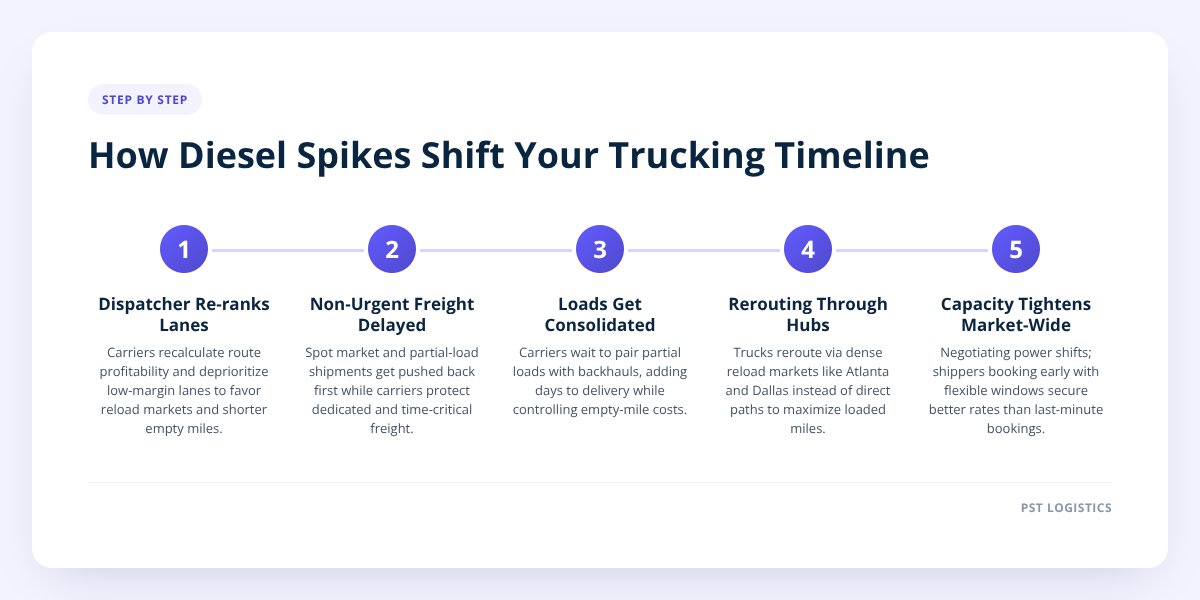
!How Diesel Spikes Shift Your Trucking Timeline
Why does a diesel price spike change more than my fuel surcharge?
Because the surcharge only covers the extra cost per mile — it doesn't fix the math problem a carrier faces on every single lane. When diesel jumps, a dispatcher has to re-run the profitability of every route in the network, not just raise a number on an invoice.
Fuel is typically one of the largest line items in a trucking company's operating cost, often cited in industry discussions as running in the range of a fifth to a third of total costs per mile, depending on the truck, the lane, and current prices. When that cost jumps fast, a load that was profitable at $3.50 diesel can turn marginal at $4.50 diesel, especially on long, low-density lanes.
That forces carriers to make real decisions, not just pass along a surcharge:
- Reroute for shorter empty miles. A truck that normally deadheads 150 miles to reposition for the next pickup becomes a lot more expensive to run empty — so dispatch starts hunting harder for backhauls.
- Favor reload markets. Carriers lean on hubs where freight is dense enough to find a return load quickly — for PST Global that means markets like Atlanta, Dallas, Laredo, Savannah, Newark, and Los Angeles.
- Re-rank which lanes get priority. Long, thin lanes with poor backhaul options get deprioritized in favor of lanes that keep the truck moving loaded both directions.
We walked through the surcharge mechanics themselves in How Fuel Surcharges Work in Freight and Why They Change — this post is about what happens operationally once that surcharge isn't enough to make the math work.
Which shipments get delayed first when fuel prices spike?
Non-urgent, non-dedicated freight gets delayed first, because carriers protect the loads that keep a truck full and the miles paid. If your freight isn't on a contracted lane or isn't time-critical, it's the easiest thing for a dispatcher to slide back a day or two in favor of freight that pays better per mile right now.
Here's roughly how the priority stack tends to shift during a fuel spike:
| Shipment type | Typical impact during fuel spikes |
|---|---|
| Dedicated freight (contracted lane, same driver/truck) | Minimal — capacity is already committed |
| Expedited / time-critical truckload | Low — shippers pay for priority, carriers protect it |
| Scheduled full truckload, flexible window | Moderate — may shift a day to consolidate miles |
| Spot market truckload, tight window | High — first to get rerouted or rebooked |
| Partial loads needing consolidation | Highest — often held until a matching load is found |
Partial and consolidated loads feel the squeeze hardest because a carrier won't run a half-empty trailer across several states at elevated fuel cost if there's any way to wait for a second shipper to fill it. That's a math decision, not a service failure — but it means your pickup date can move if your freight doesn't fill a trailer on its own.
Don't skip this: if your shipment has a hard delivery date — a production line, a retail reset, a perishable load — say so when you request the quote. Carriers prioritize what they know is time-sensitive; they can't protect a deadline they were never told about.
Does fuel volatility actually add days to delivery, or just dollars?
It can add both, and the day delay usually comes from consolidation and rerouting, not from trucks driving slower. A truck doesn't take longer to cross Illinois because diesel is expensive — it takes longer because the carrier is waiting one more day to pair your load with a backhaul, or routing through a reload market instead of running the most direct path.
This is where single-driver, pickup-to-delivery service matters. A load that gets cross-docked or transloaded during a fuel spike picks up extra handling time at every transfer point, on top of whatever rerouting is already happening. PST Global runs full truckload only, with the same truck and driver from pickup to delivery — no cross-docking, no transloading — which removes one entire source of delay that shows up industry-wide when carriers start consolidating freight to control cost.
Being based in Naperville also factors in here. Naperville sits in a position for day-drive access to the eastern half of the country and westbound Chicago lanes, which means a truck can often reach a reload market or make a scheduled delivery within a single drive shift — one less overnight, one less place for a fuel-driven reroute to add a day.
What else gets more expensive besides the per-mile surcharge?
Your negotiating position changes, not just your rate. During a fuel spike, capacity tightens on the lanes carriers consider marginal, which means spot market rates on those lanes can climb faster than the surcharge alone would suggest — carriers that do take the load price in the uncertainty of finding a profitable return trip.
A few things shift at once:
- Fuel efficiency becomes a bigger differentiator. Carriers running well-maintained trucks with current preventive maintenance get more miles per gallon than a neglected fleet, which matters more when diesel is expensive. PST Global handles preventive maintenance and annual DOT inspections in-house for exactly this reason — a truck running at spec burns less fuel per mile, spike or no spike.
- Load consolidation shifts leverage to carriers who can fill a trailer fast. If your freight is 26 pallets or less and doesn't fill a 53' van, a carrier with strong reload relationships in markets like Dallas or Atlanta can move it faster than one without.
- Spot rates become less predictable than contracted rates. This is the direct reason dedicated freight becomes more attractive during volatile fuel periods — the rate was set before the spike, so it isn't repriced mid-swing.
We go deeper on the budget side of this in How Rising Diesel Prices Affect Your Freight Budget if you're building a freight line item into next quarter's forecast.
How should a shipper plan freight around fuel volatility?
Book earlier, stay flexible on the pickup window, and consider dedicated capacity for your recurring lanes. Each of those three moves gives a carrier more room to route your freight efficiently instead of scrambling to fit it in at the last minute during an already-tight fuel market.
A practical plan looks like this:
- Request your rate quote further ahead of your target ship date — a few extra days gives dispatch room to consolidate your load efficiently instead of rushing it.
- Offer a pickup window instead of a fixed hour when the shipment allows it — flexibility here is often worth more than you'd expect during a fuel spike.
- Separate your truly time-critical freight from your flexible freight, and say which is which when you request the quote.
- Ask about dedicated freight service if you ship the same lane regularly — a committed lane and truck removes you from spot market volatility entirely.
- Confirm your carrier's on-time record and equipment maintenance practices before a spike hits, not during one — a carrier with in-house preventive maintenance and a documented delivery record is the one still running reliably when fuel gets expensive.
- Keep your paperwork and load specs ready in advance — a clean carrier packet and clear freight details mean less back-and-forth when dispatch is already managing a tighter network.
If your freight moves the same corridor regularly — Midwest to Southeast, the Texas triangle, or westbound along I-80 — a dedicated arrangement is worth a real conversation before the next price swing, not during it.
For shippers getting freight ready for its first interstate move, our Prepare Freight for Interstate Trucking: Checklist covers the documentation and load-prep side that keeps a shipment from losing time at pickup, fuel market aside.
PST Global runs dry van and temperature-controlled truckload freight out of Naperville, Illinois with a 99% on-time delivery rate and 24/7 dispatch that answers the phone — including weekends, including when fuel prices are making every other carrier's network harder to plan. If you want a rate on your lane, request a quote and talk to a dispatcher who'll tell you straight whether your timeline needs to flex.
Checklist: Plan your freight around fuel price swings
- Request your rate quote several days ahead of your target ship date.
- Offer a pickup window rather than a single fixed hour when the load allows it.
- Flag which shipments are time-critical and which have flexibility.
- Ask your carrier about dedicated freight service for recurring lanes.
- Confirm your carrier's on-time delivery record and maintenance practices before a spike hits.
- Have your load specs, pallet count, and paperwork ready before you call.
- Separate partial-load freight from full truckload freight when you plan your ship date.