Avoid Detention and Demurrage Fees in Freight Shipping

Quick answer: Freight detention fees get charged when a truck sits at your facility longer than the free time allowed — usually two hours for loading or unloading — and they typically run $50 to $100 per hour after that. You avoid them by confirming dock appointments in advance, having freight staged and paperwork ready before the truck arrives, and communicating delays to the carrier the moment you know about them. Demurrage is the similar charge for containers or trailers held past their free time at a port, rail yard, or shipper's yard.
Key takeaways
- Most carriers allow two hours of free time for loading or unloading before detention charges start, though this varies by carrier agreement.
- Detention fees commonly range from $50 to $100 per hour, which means a four-hour delay can cost $200 to $400 on a single load.
- Demurrage applies to equipment held at a port, rail ramp, or yard past its free days, while detention applies to trucks held at a shipper's or receiver's dock.
- Clear communication the moment a delay is likely — not after the truck has already been waiting an hour — is the single biggest factor in avoiding disputes over these charges.
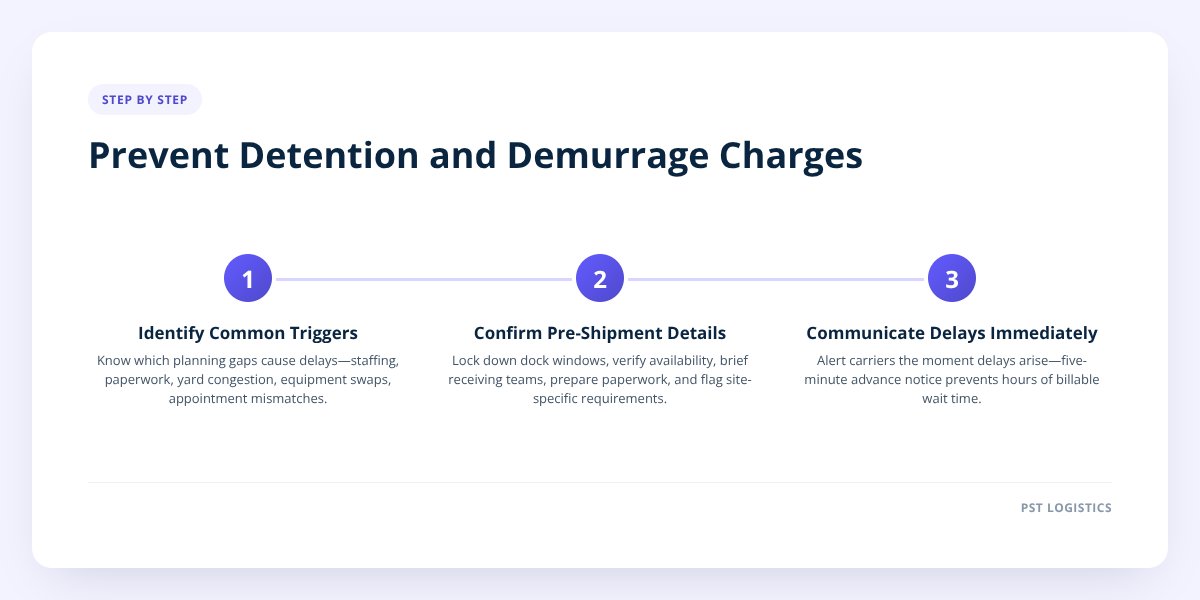
!Prevent Detention and Demurrage Charges
What's the Difference Between Detention and Demurrage?
Detention is the fee a carrier charges when its truck and driver are held at a shipping or receiving dock beyond the agreed free time, usually because loading or unloading takes too long. Demurrage is a similar fee, but it applies to equipment — a container, chassis, or trailer — sitting idle at a port, rail ramp, or storage yard past its allotted free days.
Both charges exist for the same reason: a truck or container that isn't moving isn't earning. A driver stuck at your dock for four extra hours isn't hauling another load that day, and that lost time has a cost. Carriers pass that cost to the party responsible for the delay.
The terms get used loosely in everyday conversation, and a lot of shippers use them interchangeably. But the distinction matters when you're reading a carrier contract or disputing a charge:
| Term | Applies to | Common trigger | Typical free time |
|---|---|---|---|
| Detention | Truck and driver at dock | Slow loading/unloading, missing paperwork | 2 hours |
| Demurrage | Container or chassis at port/yard | Container not picked up or returned on time | 2–5 days |
| Layover | Driver held overnight | Facility closes before load/unload finishes | Varies by carrier |
Free time and per-hour rates are set in the rate confirmation or carrier contract, not by a universal industry standard — always check the specific agreement for the load you're shipping.
Step 1: Know What Triggers the Charge Before You Book the Load
Detention charges almost always trace back to one of a few repeat offenders. Knowing them in advance lets you fix the root cause instead of arguing about the bill afterward.
- Unloading delays — your receiving team is short-staffed, working through a backlog, or wasn't told a truck was coming.
- Documentation holds — the bill of lading, purchase order, or special paperwork isn't ready when the driver arrives, so nothing can be signed off.
- Yard congestion — too many trucks scheduled in the same window, so drivers queue outside the gate before they even reach a dock door.
- Equipment swap-outs — a drop-and-hook location doesn't have an empty trailer ready, so the driver has to wait for one to be dropped or power-washed.
- Appointment mismatches — the truck arrives on time for the scheduled window, but the dock was double-booked or running behind from the prior load.
Each of these is a planning problem, not a driver problem. That's good news, because it means they're preventable with better scheduling and communication — not something you have to just absorb as a cost of doing business.
Step 2: Lock Down Pre-Shipment Logistics Before the Truck Leaves
Most detention charges are decided before the truck ever arrives at your dock. The prep work in the 24 to 48 hours before pickup or delivery matters more than anything that happens once the driver is on-site.
Here's what to confirm before you book:
- Confirm the exact unload or load window with the receiving facility, not just a general day.
- Verify dock availability matches the scheduled appointment time, especially at high-volume distribution centers.
- Brief the receiving team on what's arriving, how many pallets, and any special handling needs.
- Prepare all paperwork — bill of lading, packing slips, purchase order numbers — before the truck is dispatched.
- Flag any site-specific requirements, like a check-in procedure, PPE rules, or a separate will-call window.
- Build in a buffer if the facility has a history of running behind schedule.
This is the same discipline that prevents a lot of the hidden costs we covered in how to vet a freight carrier and avoid hidden costs — a surprise detention bill is really just a hidden cost that showed up at the dock instead of on the invoice.
Don't skip this: if you know a facility runs slow on Mondays or during a specific receiving shift, say so when you book the load. A dispatcher who knows to build in extra time will plan around it; one who finds out on arrival can't.
Step 3: Keep the Line Open While the Load Is Moving
Flag delays the moment you know about them, not after the truck has already been sitting for an hour. A five-minute call that says "we're running behind, expect a 30-minute wait" costs nothing. A driver who shows up to a locked gate with no warning starts racking up free-time minutes before anyone even knows there's a problem.
This matters more on multi-stop or appointment-based freight, where one delay cascades into the next stop's window. If a pickup runs long, the receiving facility two states away needs to know before the truck is already late — not when it rolls up outside the appointment window.
A few habits that keep communication tight during transit:
- Share direct contact information between your receiving team and the carrier's dispatcher, not just a general office line.
- Update the carrier as soon as a delay becomes likely, even if it's just a 20-minute estimate.
- Confirm who has authority to approve a late appointment or reschedule on short notice.
- Ask the carrier to flag yard congestion or equipment issues on their end the same way you'd flag dock delays on yours.
This is where a carrier's dispatch model actually shows up in your bottom line. PST Global runs 24/7 dispatch that answers the phone, including weekends, and keeps the same driver on a load from pickup to delivery — no cross-docking, no handoffs between carriers where a delay on one leg gets blamed on the next. Fewer handoffs means fewer places for a miscommunication to turn into a detention charge.
Step 4: Clear Equipment and Paperwork Fast After Delivery
Demurrage and detention charges don't stop the moment freight comes off the truck — they stop when the equipment is released and the paperwork is closed out. A trailer sitting in your yard after unloading, waiting on a signature or a forklift to free up a door, is still on the clock.
- Release the trailer or container as soon as unloading is complete, not at the end of the day.
- Sign the bill of lading and any delivery receipts immediately rather than batching them for later.
- Note any discrepancies — shortages, damage, wrong count — on the paperwork at the time of delivery, not after the driver has left.
- Return drop trailers to the agreed location promptly if your facility uses a drop-and-hook arrangement.
- File any detention or demurrage dispute within the window specified in your carrier agreement, since most contracts set a deadline for claims.
Keep a simple log of every delay, even small ones, with the date, cause, and duration. If detention fees show up on an invoice, that log is what lets you confirm the charge is accurate — or push back if it isn't. Carriers that log hours of service electronically, as PST Global does on every unit, make it easier to verify exactly when a truck arrived and when it was released, which cuts down on disputes over who actually caused the delay.
What to Do Next
Detention and demurrage fees are one of the few freight costs that are almost entirely within a shipper's control. The trucks, the drivers, and the paperwork rules don't change — what changes is how well your facility is staged to move freight the moment it arrives.
If you're planning a shipment and want to talk through pickup and delivery windows before you book, PST Global runs dry van and temperature-controlled full truckload freight with a single driver from pickup to delivery and dispatch that answers 24/7. Request a rate quote and talk through your dock schedule with a dispatcher before the truck ever leaves Naperville.
Checklist: Avoid Detention and Demurrage Fees
- Confirm the exact load or unload window with the facility before booking.
- Verify dock and yard availability matches the scheduled appointment.
- Prepare all paperwork — bill of lading, PO numbers, packing slips — before the truck arrives.
- Brief receiving staff on incoming freight details and any special handling needs.
- Share direct contact information between dispatch and the receiving team.
- Flag delays the moment they're likely, not after the truck is already waiting.
- Release trailers and sign delivery paperwork as soon as unloading finishes.
- Log every delay with date, cause, and duration for dispute purposes.
- File any detention or demurrage dispute within your carrier agreement's deadline.