How FMCSA Hours-of-Service Rules Affect Freight Delivery

Quick answer: FMCSA hours-of-service (HOS) rules limit truck drivers to 11 hours of driving within a 14-hour on-duty window, followed by at least 10 consecutive hours off duty — and those limits directly set the ceiling on how fast freight can legally move. A load that looks like a 14-hour run on a map often takes two calendar days once you factor in mandatory rest, which is why realistic transit estimates build in HOS math from the start, not after a truck goes "out of hours" near your delivery window.
Key takeaways
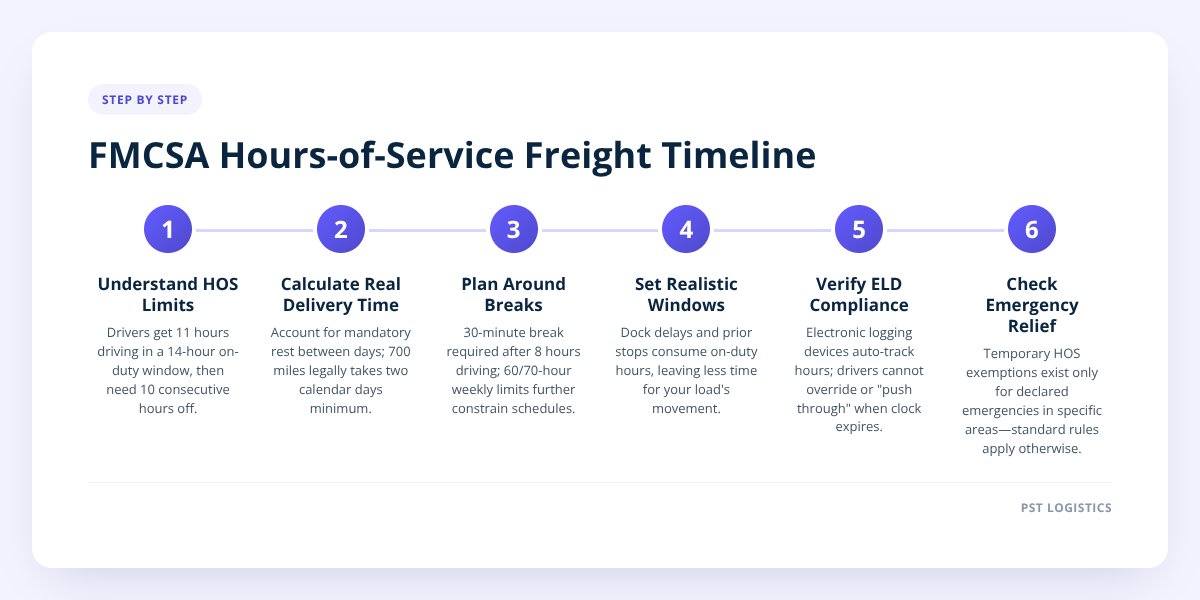
- Drivers get 11 hours of driving time inside a 14-hour on-duty clock, then need 10 straight hours off before driving again, per the Federal Motor Carrier Safety Administration (FMCSA).
- A 700-mile lane at highway speeds can take two days to deliver legally, even though the drive time alone fits under 12 hours.
- FMCSA's hours-of-service flexibility test program is evaluating adjustments to the existing rules — it has not replaced or suspended the standard limits.
- Electronic logging devices (ELDs), required industry-wide under FMCSA's ELD rule, track hours automatically, so built-in rest isn't negotiable no matter how urgent the load is.
!FMCSA Hours-of-Service Freight Timeline
What Are FMCSA Hours-of-Service Rules, and Why Do They Exist?
The hours-of-service rules are federal limits on how long a commercial driver can be behind the wheel before taking mandatory rest. According to the Federal Motor Carrier Safety Administration, property-carrying drivers may drive up to 11 hours after 10 consecutive hours off duty, and that driving must happen within a 14-hour on-duty window that starts as soon as the driver begins any work for the day.
These aren't arbitrary paperwork requirements. They exist because driver fatigue is a documented factor in truck crashes, and FMCSA's mandate under federal law is specifically to reduce crashes, injuries, and fatalities involving commercial vehicles.
A few other pieces matter for timeline planning:
- 30-minute break rule: Drivers must take a 30-minute break after 8 cumulative hours of driving.
- 60/70-hour limit: Drivers can't drive after accumulating 60 hours on duty in 7 consecutive days, or 70 hours in 8 days, depending on the carrier's operating schedule.
- Sleeper berth provision: Drivers running team or long-haul routes can split their required off-duty time between the sleeper berth and off-duty status under specific combinations FMCSA allows.
- 34-hour restart: A driver can reset their weekly clock with 34 consecutive hours off duty.
Every one of these rules eats into the calendar even when the miles themselves are easy.
How Do HOS Limits Actually Affect Pickup and Delivery Windows?
HOS limits mean the fastest possible delivery is the legal delivery — there's no way to compress it by pushing the driver. Here's what that looks like on real freight:
Example 1: the deceptively short run. A load picks up in Naperville, Illinois, at 2:00 p.m. and needs to reach Indianapolis, about 180 miles away. That's roughly 3 hours of driving. But if the driver already logged 9 hours on duty that day handling a prior stop, fuel, and a pre-trip inspection, they may only have 2 hours left on the 14-hour clock. The load doesn't move until the next morning — not because of traffic or breakdowns, but because the clock ran out.
Example 2: the multi-day interstate haul. A dry van run from Naperville to Savannah, Georgia, covers roughly 850 miles. At 11 hours of driving per day, that's two full driving days minimum, plus the 10-hour reset in between. Add a live unload appointment and dock delays on either end, and a shipper should plan on the better part of three calendar days, not "it's an 800-mile trip so call it a day and a half."
Example 3: the reefer load with a tight appointment. Temperature-controlled freight headed from Naperville toward Atlanta on a hard delivery appointment has less room for error. If the driver loses an hour to a late pickup or dock congestion, that hour comes straight out of the next day's available driving time — there's no borrowing against tomorrow's clock. This is exactly why appointment scheduling and realistic cushion matter more on reefer freight than on loads with flexible delivery windows.
Don't skip this: HOS limits are tracked automatically by electronic logging devices on essentially every commercial truck today. A driver cannot "push through" to make up lost time — when the clock hits zero, the truck stops, regardless of how close it is to the destination.
What Changed With FMCSA's Hours-of-Service Flexibility Test?
FMCSA has been evaluating a hours-of-service flexibility test and related emergency relief measures, but shippers should understand what these actually do: they explore narrow, specific adjustments to the existing framework — they do not eliminate the core driving and rest limits. According to FMCSA's public rulemaking process, pilot programs and exemptions typically target things like split sleeper-berth flexibility or adjustments for specific operating conditions, and any changes go through a public rulemaking and comment process before they apply broadly.
Emergency relief declarations are a separate, older mechanism. FMCSA and state authorities can issue temporary HOS exemptions during declared emergencies — a hurricane response, a regional fuel shortage, a natural disaster — to let carriers move essential goods like fuel, food, or medical supplies faster. These relief declarations are:
- Geographically limited to the declared emergency area
- Time-limited, with defined start and end dates
- Specific to certain commodities or types of relief effort, not a blanket suspension of HOS for all freight
The practical point for shippers: unless your freight is explicitly covered by an active, published emergency declaration or exemption, standard HOS rules apply in full. Don't assume flexibility rules give your lane extra hours — confirm directly with your carrier whether any exemption currently applies to your freight, and treat the standard 11-hour/14-hour/10-hour framework as the baseline for every quote and delivery estimate.
How Should Shippers Build Realistic Timelines Around HOS?
Build your timeline around the driver's clock, not just the mileage. The math is straightforward once you know the rule: divide the total trip distance by a realistic average speed (closer to 50-55 mph accounting for stops, not posted speed limits), then check whether that driving time fits inside one 11-hour window or spans into a second day requiring a 10-hour reset.
| Trip distance | Rough driving time | Realistic delivery |
|---|---|---|
| Under 500 miles | 9-10 hours | Same day, if picked up early |
| 500-650 miles | 10-12 hours | Same day or next morning |
| 650-1,000 miles | 13-18 hours | 2 days minimum |
| 1,000-1,800 miles | 20-33 hours | 2-3 days |
| Over 1,800 miles | 33+ hours | 3-4 days, team drivers can compress this |
A few habits make this easier in practice:
- Quote the lane, not just the miles. Ask your carrier for an honest transit estimate that already accounts for HOS, not a straight mileage-to-hours conversion.
- Build in dock time. Loading, unloading, and detention at the receiver eat into the driver's 14-hour window just like driving does.
- Avoid same-day miracles on long lanes. If a load is more than about 600 miles from origin to destination, same-day delivery usually isn't legally possible with a single driver.
- Flag hard appointments early. If a receiver has a strict delivery window, tell your carrier before the truck is dispatched, not after it's already rolling.
- Ask about reset timing. A driver who needs a 10-hour or 34-hour reset mid-route will tell you exactly when that happens if you ask at booking.
We covered how these same rules intersect with freight pricing in How FMCSA Rules Shape Your Freight Costs and Timeline, since HOS constraints and detention time both show up on the invoice, not just the delivery date.
What Does a Reliable Carrier Do When HOS Affects Your Shipment?
A carrier that's communicating well tells you about an HOS-driven delay before it becomes a surprise at the dock. That means a dispatcher who can say, specifically, "the driver has 4 hours left on today's clock, so the truck will reset tonight and deliver by 10 a.m. tomorrow" — not a vague "it's held up, we'll keep you posted."
PST Global runs ELD-monitored hours of service on every unit in its fleet, which means the same system that keeps drivers compliant also gives dispatch an exact, real-time picture of what's achievable on any given lane. Because PST Global keeps the same truck and the same driver on a load from pickup to delivery — no cross-docking, no transloading — there's no handoff where information about remaining hours gets lost between carriers. The dispatcher who quoted your lane is the same one tracking it.
That matters most on time-sensitive freight. A reefer load with a hard appointment in Atlanta or a dry van run on a tight dock schedule in Dallas needs a carrier that flags HOS constraints at booking, not one that discovers them en route. PST Global's 24/7 dispatch answers the phone to work through exactly that kind of scheduling question before the truck leaves Naperville.
If you're planning a shipment and want a transit estimate that already accounts for hours-of-service realities on your lane, request a rate quote from PST Global and ask for the honest delivery window — not just the mileage.
Checklist: Planning a Freight Timeline Around HOS
- Calculate driving time using 50-55 mph average speed, not posted limits.
- Check whether the trip fits inside one 11-hour driving window or needs a 10-hour reset.
- Add dock time for loading, unloading, and any detention at the receiver.
- Confirm with your carrier whether any active FMCSA emergency relief applies to your lane.
- Share hard delivery appointments with your carrier before dispatch, not after pickup.
- Ask your dispatcher how many hours the driver has left at the time of booking.
- Build a one-day buffer into any lane over 650 miles before quoting a hard delivery date to your own customer.
- Request status updates at pickup, mid-route, and before any required reset.