FMCSA HOS Pilot Program and Delivery Windows

Quick answer: The FMCSA split sleeper berth pilot gives participating drivers more flexibility in how they divide their required off-duty time, which can shift pickup and delivery windows by a few hours in either direction on longer hauls. Shippers who build a little slack into appointment times and ask carriers directly whether a driver is running under pilot rules will avoid most of the friction. The core fix is simple: talk to your carrier about hours-of-service status before you lock in a delivery appointment, not after a truck is running late.
Key takeaways
- The FMCSA has been developing a split sleeper berth pilot program that would let qualifying drivers split their required off-duty time into different combinations than the standard rule allows.
- Any change to how a driver splits sleeper berth time can move the math on when a 500- to 800-mile load actually arrives, even though total hours of service don't change.
- Freight that depends on a tight appointment window — produce, dairy, retail replenishment — is more exposed to these timing shifts than freight with a flexible delivery day.
- Asking your carrier one question — "is this driver running standard hours or pilot-program hours on this load?" — resolves most scheduling confusion before it becomes a missed appointment.
!FMCSA Split Sleeper Berth Pilot Program
What does the FMCSA split sleeper berth pilot actually allow?
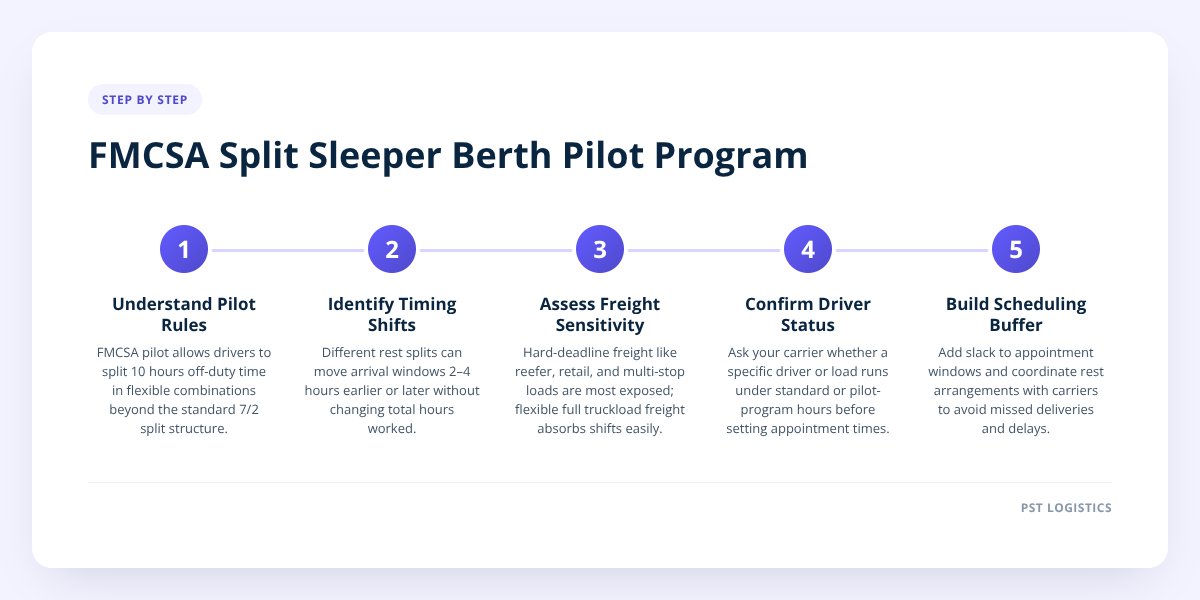
The pilot is built around giving drivers more ways to divide their 10 hours of required off-duty time between the sleeper berth and other rest periods, rather than one fixed split. Under the current hours-of-service rule, the Federal Motor Carrier Safety Administration already allows drivers to split sleeper berth time into two periods — one at least 7 hours and the other at least 2 hours — with neither period counting against the 14-hour driving window, according to FMCSA's published hours-of-service regulations. The pilot program FMCSA has been developing would test additional split combinations beyond that 7/2 structure, giving drivers more ways to arrange rest periods around traffic, loading delays, and personal fatigue patterns.
This matters for shippers because the pilot isn't a blanket change to how many hours a driver can work. It's a change to how those hours can be arranged across a 24-hour period. A driver isn't getting more driving time — they're getting more flexibility in when they take it.
FMCSA has indicated the program will roll out as a formal pilot with specific eligibility and enrollment requirements, not an across-the-board rule change applied to every carrier automatically. That means:
- Not every truck on the road will be running under pilot rules.
- Carriers and drivers participate on a defined basis set by FMCSA, not by individual choice day to day.
- Shippers should confirm with their carrier whether a given driver or fleet is actually enrolled rather than assuming.
Because the pilot is still moving through FMCSA's regulatory process, the exact split combinations being tested and the enrollment mechanics should be confirmed directly on FMCSA's website before you build long-term planning assumptions around it.
How does this change traditional driving windows and arrival times?
A different sleeper berth split can shift a driver's available driving window by a few hours without changing total hours worked. Here's a simple way to see why. Under the standard 7/2 split, a driver who takes their long break starting at 10 p.m. is generally back on the road and counting a fresh 14-hour window by around 5 or 6 a.m. If pilot rules allow a different combination — say a shorter first rest period paired with a longer second one — that same driver might be road-legal two or three hours earlier, or might need to delay departure to finish out a required rest segment, depending on how the split falls.
Neither outcome is good or bad on its own. The problem is that a dispatcher or shipper who plans a delivery appointment assuming the standard split, when the driver is actually running a pilot split, can be off by a window that matters a lot to a receiver with a narrow dock schedule.
| Scenario | Typical standard-split arrival | Possible pilot-split arrival |
|---|---|---|
| 650-mile day-drive load, one overnight rest | Early-to-mid morning next day | Could shift 2–4 hours earlier or later |
| Multi-stop route with appointment windows | Appointments set around fixed rest block | Appointment windows may need re-sequencing |
| Expedited single-driver run | Tight margin built around standard HOS | Margin can tighten or loosen depending on split used |
The takeaway for shippers isn't that the pilot makes freight less predictable in general — it's that the predictability depends on knowing which rule set the truck is running under before you set the appointment.
Which freight types and routes feel this the most?
Freight with a hard delivery window feels pilot-related timing shifts more than freight with a flexible delivery day. Reefer loads headed to a grocery distribution center with a 30-minute appointment slot, retail replenishment freight tied to a store reset schedule, and multi-stop routes with sequential appointments are the most exposed, because there's little room to absorb a 2- to 3-hour shift in arrival time.
Freight that tends to handle the flexibility well:
- Full truckload dry van freight moving to a receiver with a flexible delivery day rather than a fixed hour.
- Long-haul loads where the destination has dock capacity to absorb an early or late arrival without rescheduling.
- Loads where the shipper has already built a buffer into the quoted transit time.
Freight that needs closer coordination:
- Temperature-controlled loads where the receiver's cold chain protocol requires a scheduled, attended unload.
- Multi-stop routes where one delayed or early stop pushes every stop behind it.
- Expedited freight already running on a tight single-driver timeline with little slack built in.
Routes matter too. A day-drive lane out of the Midwest to the Southeast, where a single driver can often complete the run within one duty cycle, is less sensitive to split changes than a longer westbound run — say Chicago to the West Coast along I-80 — where the driver needs multiple rest periods and the cumulative effect of a different split compounds over several days.
How do you factor this into your shipment timeline and carrier conversation?
You factor it in by asking directly, early, and in writing. The single most useful question a shipper can ask when booking a load is whether the driver assigned to that run is operating under standard hours-of-service rules or under the FMCSA pilot program, and if the latter, what split pattern that driver typically uses.
A practical sequence looks like this:
- Confirm the freight's real deadline. Distinguish between a date that must hold and a date that's a planning target — they get treated differently.
- Ask the carrier whether the driver is pilot-enrolled. If yes, ask what split pattern is typical for that driver on that lane length.
- Build a buffer window into appointment-sensitive freight. A 2- to 3-hour buffer on either side of a scheduled appointment absorbs most of the variance a split change can introduce.
- Get the transit estimate in writing, not just verbally from a dispatcher mid-call. A written quote with an estimated pickup and delivery window gives you something to hold the carrier to.
- Flag multi-stop loads for extra scrutiny. If one stop runs early or late, ask how that affects the stops behind it before the truck is already loaded.
Don't skip this: Never assume a quoted transit time already accounts for pilot-program flexibility unless the carrier confirms it in writing. A verbal "should be fine" from a broker or dispatcher isn't the same as a dispatcher who actually checked the driver's current hours-of-service status against your appointment window.
We covered the broader regulatory backdrop — how FMCSA rule changes ripple into freight cost and transit time more generally — in How FMCSA Rules Shape Your Freight Costs and Timeline, which is worth a read if you're trying to understand the cost side of compliance changes, not just the scheduling side.
Why does talking to your carrier about HOS status prevent delays?
Because the dispatcher is the only person who actually knows, in real time, which hours-of-service rules a given driver is running under on a given day. Shippers and receivers don't have visibility into a driver's logbook or duty status — the carrier does. If that information doesn't get communicated clearly at booking, the first time a shipper learns about a timing shift is often when the truck is already two hours later than expected at the dock.
This is one of the reasons a smaller, more direct fleet structure matters for scheduling reliability. PST Logistics runs dry van and temperature-controlled truckload freight out of Naperville, Illinois with the same truck and same driver from pickup to delivery — no cross-docking, no transloading, and no layers between the driver and the person planning your load. Every unit runs on ELD-monitored hours of service, so when you call to ask about a driver's status on your lane, you're getting it from a dispatcher who answers the phone 24/7 and knows your name and your freight, not a call center reading off a screen.
That direct line matters most on appointment-sensitive freight. For a reefer load headed to a distribution center with a tight unload window, knowing in advance whether your driver's rest pattern might shift arrival by a couple of hours is the difference between a smooth check-in and a missed appointment that costs you a detention fee.
If you're planning a shipment and want a straight answer on timing before you commit to a delivery appointment, request a rate on your lane and ask the dispatcher directly about hours-of-service status for the driver assigned to your load.
Checklist: Plan a shipment around HOS flexibility
- Confirm whether your delivery date is a hard deadline or a flexible target before you book.
- Ask the carrier whether the assigned driver is operating under standard HOS rules or the FMCSA pilot program.
- Request the driver's typical rest-period pattern for a load of that length and lane.
- Build a 2- to 3-hour buffer into appointment-sensitive delivery windows.
- Get your pickup and delivery window in writing from the carrier, not just a verbal estimate.
- Flag multi-stop routes for extra review, since one early or late stop shifts every stop after it.
- Verify the carrier's hours-of-service monitoring method — ask if their fleet runs on ELDs.
- Check FMCSA's website directly for the pilot program's current enrollment status before relying on it in long-term planning.