Planning Freight Shipments on I-80 and I-90 This Winter

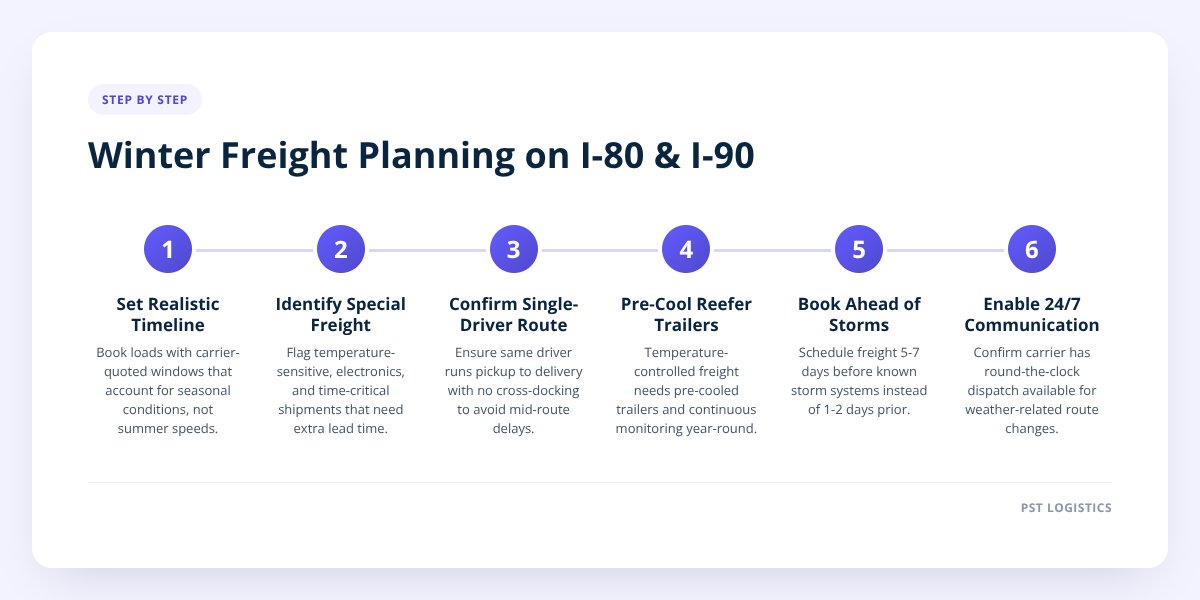
Quick answer: Winter freight planning on I-80, I-90, and I-55 means building extra transit time into your schedule before the first storm hits, confirming your carrier runs a single driver from pickup to delivery, and getting temperature-sensitive freight on the road with pre-cooled trailers and backup delivery windows. Shippers who lock in realistic timelines and keep communication open with dispatch in November avoid the worst of the January and February backups. The biggest mistake is treating a winter lane like a summer lane with a few extra hours tacked on.
Key takeaways
- Interstate corridors through Illinois, Iowa, Nebraska, Wisconsin, and Minnesota see reduced speed limits and intermittent closures during winter storms, and a single system can add a full day to a coast-to-coast run.
- Carriers that run one driver from pickup to delivery avoid the added delay of cross-docking or transloading freight onto a second truck mid-route.
- Temperature-controlled freight needs pre-cooled trailers and continuous monitoring in winter just as much as summer — cold ambient air doesn't protect a reefer load from freezing or thawing outside its setpoint.
- Booking freight 5-7 days ahead of a known storm system, instead of 1-2 days, is the single biggest lever a shipper has over winter delays.
!Winter Freight Planning on I-80 & I-90
Why Winter Breaks the Usual Transit Time Math
Winter adds unpredictability to Midwest freight because ice, snow, and low visibility slow trucks down in ways that don't show up on a normal mileage-and-hours calculation. A dry stretch of I-80 across Iowa that normally runs 65 mph can drop to 35 mph or get shut down entirely during a storm, and that's before accounting for the backup once traffic starts moving again.
The corridors that matter most for Midwest freight — I-80 east-west through Illinois, Iowa, and Nebraska; I-90 through Wisconsin, Minnesota, and South Dakota; I-55 running north-south through Illinois and Missouri — all cross open plains with little windbreak. That geography makes them prone to whiteout conditions and drifting snow even when the storm itself isn't severe.
A few things compound the risk on these specific routes:
- Flat, exposed terrain on I-80 and I-90 means wind-driven snow reduces visibility even after plows have cleared the lanes.
- Bridge and overpass icing happens before the rest of the road surface freezes, catching drivers off guard on sections that looked clear minutes earlier.
- State DOT speed restrictions in Iowa, Nebraska, Wisconsin, and Minnesota can drop posted limits by 10-20 mph during active weather, and those restrictions are enforced.
- Multi-state storm systems mean a truck can run into the same system twice — once crossing Nebraska, again crossing Illinois — if the timing lines up wrong.
We cover the mechanics of this in more depth in How Weather Impacts Freight Timelines in the Midwest, but the practical takeaway here is simple: a route that runs 14 hours in July can realistically take 18-20 hours in a January storm, and shippers who don't plan for that gap end up with missed appointments.
Step 1: Set a Realistic Delivery Window With Your Carrier Before the Storm Hits
The time to talk about winter timelines is when you book the load, not the morning a storm is forecast. A good dispatcher will give you a delivery window with a built-in buffer for the season rather than quoting you the same number they'd give in June.
Ask your carrier these questions before you commit a load to a winter lane:
- What delivery window are you quoting, and does it already account for seasonal conditions on this route?
- Will the same driver and truck run the entire route, or does the freight change hands partway?
- How will I be notified if a storm forces a route change or delay?
- What's your plan if the delivery appointment falls during an active weather advisory?
That second question matters more than most shippers realize. When freight changes trucks mid-route — through a cross-dock or transload — every handoff adds a delay risk on top of the weather risk. PST Global runs full truckload freight with a single driver from pickup to delivery, with no cross-docking or transloading, which removes one entire category of winter delay before the storm is even a factor.
Don't skip this: if your carrier can't tell you who to call at 2 a.m. when a load is stopped on I-80 in a storm, find out before you book the lane, not during it. PST Global runs 24/7 dispatch that answers the phone, including weekends.
Step 2: Identify Which Freight on Your Load Needs Extra Lead Time
Not all freight carries the same winter risk, and knowing which of your shipments need extra handling lets you prioritize your planning time. Three categories deserve particular attention.
Temperature-sensitive freight — produce, dairy, frozen goods, pharmaceuticals — needs a pre-cooled or pre-heated trailer before the doors ever open for loading. Cold outside air doesn't do this job for you; a reefer trailer sitting in a 10°F parking lot still needs to hit its setpoint before product loads, and it needs to hold that setpoint for the entire run regardless of how cold or warm it gets outside. Reefer units built for a -20°F to 70°F setpoint range handle both deep winter loads and the warmer freight that still moves through December and January.
Electronics and sensitive cargo can be damaged by extreme cold even in a dry van, particularly anything with a battery, display, or liquid component. If your freight has a manufacturer cold-weather handling spec, flag it for your carrier at booking, not after the truck is already loaded.
High-value or time-critical freight needs the longest lead time of all three categories, because a missed appointment on a retail or manufacturing deadline is often more costly than the freight charge itself. If a load absolutely has to land on a specific day, build the schedule around the worst-case transit time for the season, not the average.
| Freight type | Main winter risk | What reduces it |
|---|---|---|
| Reefer (produce, dairy, frozen) | Setpoint drift during long delays or idling | Pre-cooled trailer, continuous temperature logging |
| Electronics / sensitive cargo | Cold damage during loading or extended stops | Dry van with minimal dwell time, early booking |
| High-value / deadline-driven freight | Missed appointment from storm delay | 5-7 day lead time, single-driver continuous run |
| Standard palletized dry freight | General transit delay | Buffer added to quoted delivery window |
Step 3: Know What to Expect Once the Truck Is Rolling
Expect lower average speeds, not necessarily a canceled run — most winter freight still moves, it just moves slower. According to the Federal Motor Carrier Safety Administration's hours-of-service rules, drivers are permitted to stop driving when conditions become unsafe without it counting against their available drive time in the same way a normal break would, which means a responsible carrier will have a driver pull off rather than push through a whiteout.
Here's what typically happens to a load once a winter system moves into a route:
- Speed reductions of 10-20 mph are common even before a state DOT posts an official restriction, as drivers adjust for reduced traction and visibility.
- Route adjustments happen when a specific stretch — a known problem overpass, a stretch of I-90 prone to drifting — is closed or advised against, and the driver or dispatcher reroutes around it.
- Planned stops increase, both for safety and because chain laws or traction requirements in some states require a check before continuing.
- Delivery appointment changes get communicated as early as possible once a delay becomes likely, rather than as a surprise at the dock.
This is also where a dispatcher who knows the load personally earns their keep. A large fleet routing freight through an automated system may not catch a specific storm cell affecting one truck on one lane; a small operation with direct lines between drivers and planners can call a receiver and reschedule an appointment within the hour. PST Global's 99% on-time delivery rate reflects normal operating conditions, not a guarantee against severe weather — no honest carrier promises that — but it does reflect a dispatch structure built to adjust fast when conditions change.
Step 4: Build Winter Buffer Into Your Shipping Calendar, Not Just Your Storm Response
The shippers who handle winter best aren't the ones who react well to a single storm — they're the ones who've already adjusted their shipping calendar for the season. If you have freight that absolutely must arrive by a specific date in January or February, book it to ship several days earlier than you would for the same lane in July.
A few scheduling habits make a real difference:
- Shift standing order ship dates earlier by 1-2 days for any lane crossing Iowa, Nebraska, Wisconsin, or Minnesota between December and March.
- Avoid scheduling critical deliveries for the Monday after a weekend storm system, when backlogs from the storm are still clearing.
- Ask your carrier about reload markets on your route — PST Global's reload markets include Atlanta, Dallas, Laredo, Savannah, Newark, and Los Angeles — since knowing the network helps you understand realistic turnaround on a return lane.
- Confirm your receiver's dock hours account for possible late arrival, especially for appointment-only facilities with narrow windows.
If this is the first winter you're shipping a particular lane, it's worth reading Fall 2026 Freight Planning for Shippers before the season gets underway, since a lot of winter problems trace back to decisions made in October and November.
Checklist: Preparing Your Winter Freight Shipment
- Confirm your carrier runs a single driver from pickup to delivery with no cross-dock or transload step.
- Request a delivery window that already accounts for seasonal transit times on your specific route.
- Flag temperature-sensitive freight so the trailer can be pre-cooled or pre-heated before loading.
- Note any manufacturer cold-weather handling requirements for electronics or sensitive cargo.
- Book critical loads 5-7 days ahead of a forecasted storm system instead of 1-2 days.
- Confirm you have a direct phone line to dispatch, not just a tracking portal, for real-time updates.
- Verify your receiver's dock hours and appointment flexibility in case of weather delay.
- Request your insurance certificate and carrier packet in advance if your broker or customer requires it on file before shipping.
Winter freight doesn't have to mean guesswork. If you're planning shipments on I-80, I-90, or I-55 this season, PST Global runs dry van and temperature-controlled truckload freight out of Naperville with a dispatcher who answers the phone around the clock and a single driver on every load from pickup to delivery. Request a rate on your lane and get a realistic delivery window before the season's first storm forces the issue.