Why Fuel Surcharges Exist and How to Budget for Them

Quick answer: Fuel surcharges exist because diesel prices swing too much and too fast for carriers to build into a flat rate, so the surcharge separates the cost of fuel from the cost of the truck, trailer, and driver. Most carriers index the surcharge to a published diesel benchmark, like the U.S. Energy Information Administration's weekly On-Highway Diesel Fuel Price report, and adjust it on a set schedule. Shippers who understand the formula their carrier uses can forecast the surcharge line item almost as reliably as the base rate itself.
Key takeaways
- Diesel typically accounts for a large share of a truckload carrier's per-mile operating cost, which is why fuel isn't baked into the base linehaul rate.
- Most surcharge programs reset weekly and use the U.S. Energy Information Administration's national or regional diesel average as the index.
- A transparent carrier will show you the baseline price, the per-cent-per-gallon adjustment, and the update date in writing — not just a lump sum on the invoice.
- Locking in shipping schedules and lane commitments ahead of seasonal diesel spikes is one of the few ways shippers can actually manage surcharge exposure.
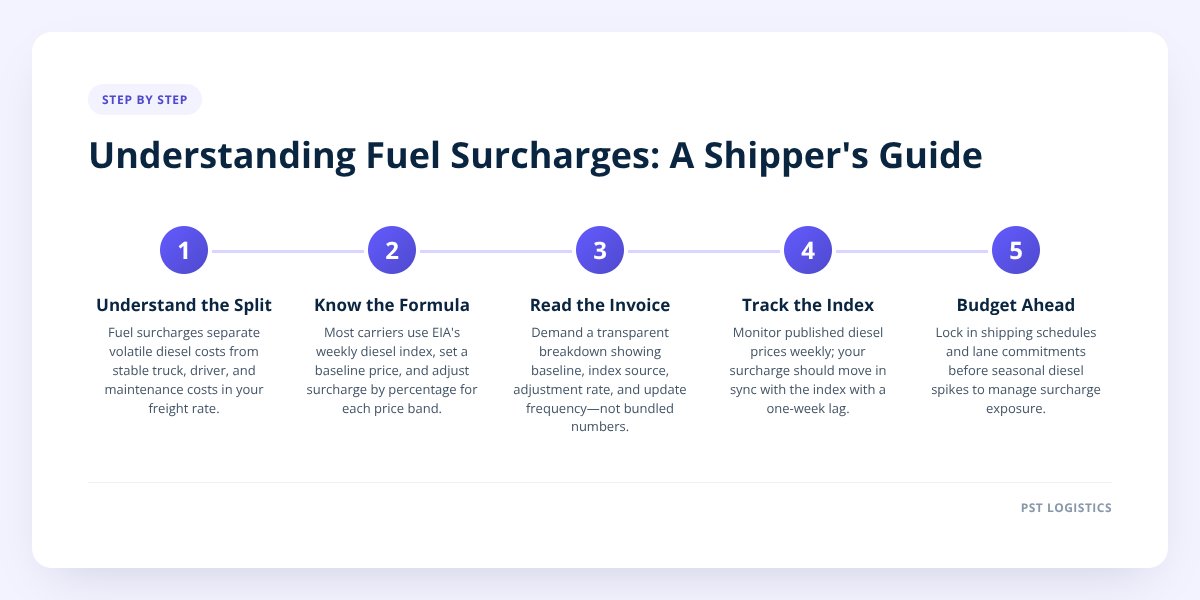
!Understanding Fuel Surcharges: A Shipper's Guide
Why can't carriers just build fuel into their rates?
Because diesel prices move too much, too often, for a flat rate to stay fair to either side. Fuel is one of the largest controllable operating expenses a trucking company carries, alongside the driver's pay and the truck payment itself. When diesel jumps 40 cents a gallon in a month — which has happened repeatedly over the last several years — a carrier running a fleet of trucks each covering 2,000+ miles a week absorbs that cost multiple times over before the next rate negotiation even happens.
If a carrier tried to price that risk into the base rate, one of two things would happen. Either the rate would sit artificially high most of the time to cover the worst-case fuel scenario, or the carrier would eat the difference during a spike and lose money on every loaded mile. Neither is sustainable, and neither is fair to a shipper who's paying for capacity, not for someone else's fuel bet.
A fuel surcharge (FSC) solves this by separating two costs that move on different timelines. The base rate reflects the truck, the trailer, the driver's time, insurance, and maintenance — costs that are relatively stable. The surcharge reflects only the fuel, and it moves with the market. We covered the mechanics of this split in more detail in How Fuel Surcharges Work in Freight and Why They Change.
How is the fuel surcharge actually calculated?
Most carriers calculate the surcharge as a percentage of the base rate or a flat cents-per-mile adder, tied to a published diesel index and a fixed baseline price. The formula generally works like this:
- Pick an index. Most carriers use the U.S. Energy Information Administration's (EIA) weekly On-Highway Diesel Fuel Price report, either the national average or a regional average that matches the lane.
- Set a baseline. The carrier agrees on a starting diesel price — for example, $3.00 a gallon — below which no surcharge applies, or above which it starts climbing.
- Set the increment. For every set amount the diesel price rises above baseline (commonly 5- or 10-cent bands), the surcharge adjusts by a matching percentage or per-mile amount.
- Set the update frequency. Most programs re-price weekly, using that week's published EIA number, so the surcharge you see this Monday reflects last week's average, not today's pump price.
Here's a simplified example. Say a carrier's baseline is $3.00/gallon, and the surcharge adds 1% to the base rate for every 10-cent increase above that. If the EIA's current weekly average is $3.60/gallon, that's 60 cents above baseline, or six 10-cent bands — a 6% surcharge on top of the base linehaul rate. If diesel drops back to $3.40 the following week, the surcharge recalculates down to 4%, automatically, without a phone call or a renegotiation.
This is why two carriers quoting the same base rate can land on different total costs — their baseline, their index, and their update cadence aren't identical. We go deeper on reading these numbers off an actual invoice in How Fuel Surcharges Work on Your Freight Bill.
What should the surcharge look like on your invoice?
It should appear as its own line item, calculated from a stated formula, not folded into the base rate where you can't see it move. A clean invoice separates:
| Line item | What it reflects | How often it changes |
|---|---|---|
| Base linehaul rate | Truck, trailer, driver, negotiated per lane | Set at contract or quote, rarely mid-term |
| Fuel surcharge (FSC) | Diesel cost above/below baseline | Weekly, tied to published index |
| Accessorials | Detention, layover, appointment fees | Per occurrence |
If your invoice shows a single bundled number with no breakdown, you have no way to check whether the surcharge tracked the actual diesel market or just crept upward. Ask for the index source, the baseline, and the update date in writing before you sign a rate agreement — a carrier with nothing to hide will hand this over without hesitation.
Don't skip this: if a carrier can't tell you which diesel index they use and how often it updates, you have no way to verify the surcharge is tracking real fuel costs — and no way to catch it if it isn't.
Month to month, expect the surcharge to move in the same direction as diesel prices, with a short lag since most indexes reflect the prior week's average. A carrier running lanes through the Midwest to Southeast corridor or out to the Texas triangle may quote a regional diesel average instead of the national one, which can create a modest gap between what you see in headlines and what shows up on your bill — regional averages sometimes run a few cents apart from the national number depending on refining and distribution costs in that area.
How do you forecast the fuel surcharge for your annual freight budget?
You forecast it by treating the surcharge as a variable cost tied to a public index, then modeling a range instead of a single number. Diesel prices don't move randomly — they follow seasonal and macroeconomic patterns you can plan around, even without predicting the exact number:
- Pull historical diesel data. The EIA publishes weekly historical diesel averages going back years, free to the public. Chart the last two or three years to see your seasonal pattern — diesel often runs higher in summer travel months and can spike again in winter heating season.
- Build three scenarios. Model your annual freight spend at a low, mid, and high diesel price based on that historical range, rather than betting on one forecast number.
- Apply your carrier's actual formula. Take your carrier's baseline and increment structure and run each diesel scenario through it to get a surcharge range per lane, per load, and per month.
- Flag your high-exposure lanes. Long-haul interstate lanes accumulate more surcharge dollars per load than short regional runs simply because they burn more fuel per mile — budget those lanes with more cushion.
- Revisit quarterly. Diesel markets shift with crude oil prices, refinery capacity, and seasonal demand, so a forecast built in January should be checked again before summer.
This kind of planning matters more when you're locking in shipping schedules months out. If you're setting your Q4 shipping calendar now, our Fall 2026 Freight Planning for Shippers post walks through how surcharge forecasting fits into broader seasonal capacity planning.
What questions should you ask a carrier about their fuel surcharge policy?
Ask direct questions before you sign, because a carrier's answers tell you as much about their reliability as their rates do. A vague or evasive answer to any of these is worth treating as a warning sign, similar to the red flags we outline in 8 Red Flags That Signal an Unreliable Trucking Company.
Checklist: questions to ask before signing a rate agreement
- Confirm which diesel index the carrier uses — national EIA average, regional EIA average, or a private index.
- Ask for the exact baseline price the surcharge is measured against.
- Ask how often the surcharge updates and on what day of the week it resets.
- Request the increment structure — how many cents of diesel movement trigger how much surcharge change.
- Ask whether the surcharge is a percentage of the base rate or a flat cents-per-mile adder.
- Confirm whether surcharge terms are written into the rate agreement or left informal.
- Ask how the carrier notifies you when the surcharge rate changes.
- Request a sample invoice showing the surcharge as a separate, itemized line.
A carrier that answers all of these without hesitation is treating fuel pricing as a documented, auditable part of the relationship, not a discretionary add-on. That kind of transparency is also what makes a long-term lane commitment work, which we cover in How to Build a Long-Term Carrier Partnership That Lasts.
At PST Logistics, based in Naperville with day-drive access to the eastern half of the country and westbound Chicago lanes, every quote comes with a documented fuel surcharge formula tied to a published diesel index — no guesswork, no bundled numbers. If you're setting up a dedicated lane or need a rate quote for full truckload or reefer freight, call our 24/7 dispatch or submit a lane request through joinpst.com and we'll walk you through exactly how the surcharge on your quote is built.
Checklist: budgeting for fuel surcharges on your freight spend
- Pull two to three years of historical diesel prices from the EIA's weekly report.
- Identify your seasonal high and low diesel months from that history.
- Get your carrier's baseline price and increment formula in writing.
- Build low, mid, and high diesel scenarios for your annual freight budget.
- Flag your longest-haul lanes as highest fuel-surcharge exposure.
- Request itemized invoices showing base rate and surcharge as separate lines.
- Re-check your forecast each quarter against current diesel trends.
- Confirm your carrier's update frequency so invoice timing isn't a surprise.