How to Plan and Load Pallets for Full Truckload Shipping
Quick answer: A standard 53-foot dry van holds up to 26 standard pallets and 45,000 pounds of freight, but hitting both numbers at once takes real math, not guesswork. Start with your pallet footprint and weight per pallet, check that your stacking plan keeps axle weights legal, and send your carrier the full load spec — pallet count, weights, dimensions, and stackability — before the truck shows up. Skipping that last step is the single biggest reason loads get rejected or trucks sit in detention.
Key takeaways
- A 53-foot dry van trailer has roughly 416 square feet of floor space and a legal payload limit most carriers cap around 45,000 pounds, per standard dry van equipment specs.
- Standard 48x40-inch pallets fit 26 to a trailer in a single-stacked, non-turned configuration; turning pallets sideways (pinwheeling) can reduce usable pallet positions.
- Uneven weight distribution is a leading cause of axle weight violations under Federal Motor Carrier Safety Administration (FMCSA) rules, even when total trailer weight is legal.
- Giving your carrier pallet count, weight per pallet, and stack height before pickup is the fastest way to avoid load rejections and detention charges.
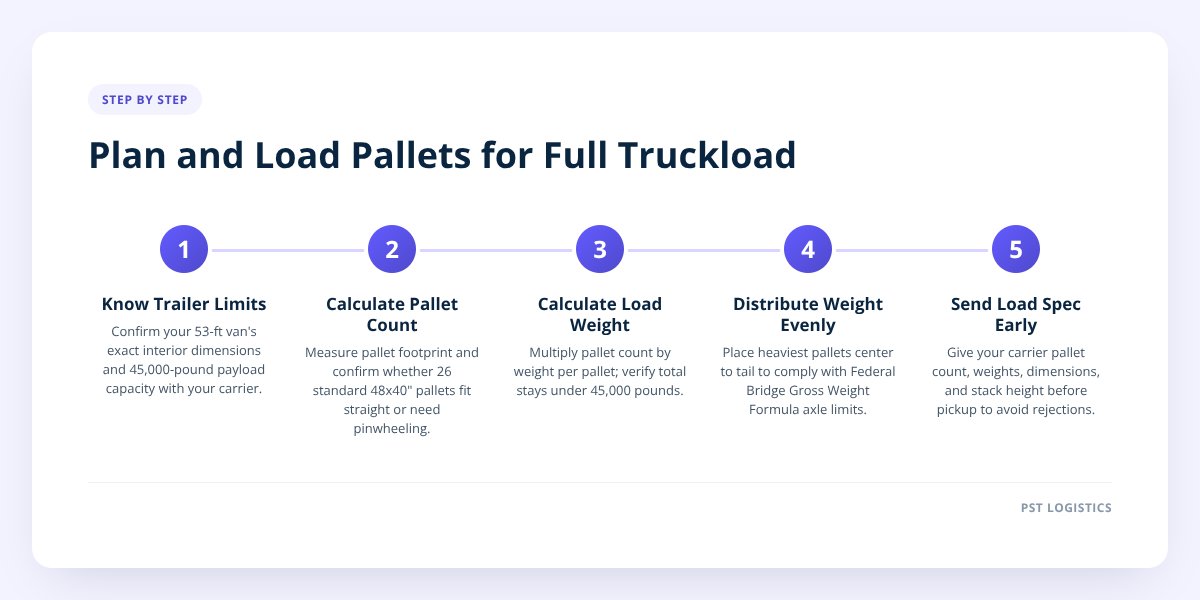
!Plan and Load Pallets for Full Truckload
Why Pallet Planning Actually Matters
Poor pallet planning turns into one of three expensive problems: a rejected load at the dock, a detention clock that starts ticking, or an extra truck you didn't budget for. None of these are rare. They're the predictable result of math nobody did before the trailer arrived.
Here's the chain reaction. A shipper books a full truckload assuming 26 pallets will fit, loads 28 because the warehouse had them ready, and the driver either can't close the doors or has to leave freight behind for a second move. Now you're paying for two trucks instead of one, and the driver who showed up on time is burning hours waiting on a replan.
Weight problems are worse because they're not always visible. A trailer can be well under its total 45,000-pound limit and still fail a weigh station check because too much weight sits over one axle group. We've covered how these delays cascade into fees in Avoid Detention and Demurrage Fees in Freight Shipping — but the cheapest fix is preventing the problem at the loading dock, not managing it after the fact.
Don't skip this: Total trailer weight can be legal while axle weight is not. Federal bridge formula limits govern how weight is distributed front-to-back across the trailer, and a driver can be cited even if the total load is under 45,000 pounds.
Step 1: Know Your Trailer's Real Limits
Before you calculate anything, confirm what the trailer can actually hold — dimensions and weight are two separate limits, and you need to clear both.
A standard 53-foot dry van trailer typically offers:
| Spec | Standard dry van |
|---|---|
| Interior length | ~53 feet (636 inches) |
| Interior width | ~100-102 inches |
| Interior height | ~110 inches (varies by trailer) |
| Floor space | ~416 square feet |
| Max payload | Up to 45,000 lbs |
| Standard pallet capacity | Up to 26 pallets (48x40") |
These are typical equipment specs, not a federal standard — always confirm exact interior dimensions with your carrier, since trailer manufacturers vary slightly. PST Global runs 53-foot air-ride vans built for palletized and floor-loaded freight, rated up to 26 standard pallets and 45,000 pounds of payload.
Two numbers matter more than the rest: your pallet footprint and your weight per pallet. Everything else in this guide is built on those two inputs.
Step 2: Calculate Your Pallet Count and Floor Space
Do the floor-space math before you do the weight math — a trailer that's full of air is just as useless as one that's overweight.
A standard pallet measures 48 inches by 40 inches. Loaded straight (not turned or pinwheeled), two rows of pallets run the length of the trailer, side by side, giving you the standard 26-pallet count most dry vans are rated for.
Here's the floor-space math in practice:
- Measure your pallet footprint — length times width, in inches.
- Confirm trailer interior width (around 100-102 inches for a standard dry van).
- Check whether two pallets fit side-by-side with clearance, or whether you need to turn them.
- Multiply usable rows by pallets per row to get your floor-space capacity.
- Compare that number against your actual pallet count before committing to one truck.
Turning pallets 90 degrees (a practice called pinwheeling) can sometimes squeeze in extra units on oddly sized freight, but it usually reduces your total count compared to straight-loading standard pallets. If your freight runs oversized or irregular, loop your carrier in early — this is exactly the kind of detail that changes whether one truck or two is the right call.
Step 3: Calculate Weight Per Pallet and Total Load Weight
Multiply your pallet count by average weight per pallet, then check that total against the trailer's rated payload — and don't stop there, because where that weight sits matters as much as how much there is.
Say you're shipping 24 pallets at 1,800 pounds each. That's 43,200 pounds total — under the 45,000-pound payload limit, so the load looks fine on paper. But if all 24 pallets are loaded toward the nose of the trailer, you can overload the steer or drive axles even though the trailer as a whole is legal.
This is where the Federal Bridge Gross Weight Formula comes in. FMCSA's bridge formula sets maximum weight limits based on axle spacing, not just total vehicle weight, specifically to prevent heavy concentrated loads from damaging roads and bridges. A driver can be stopped and cited at a weigh station for an axle violation even with a trailer that's nowhere near its total capacity.
The practical fix: distribute weight evenly from nose to tail, and put your heaviest pallets toward the center of the trailer rather than clustered at one end. If you're shipping a mixed load — some pallets heavy, some light — alternate them rather than grouping all the heavy ones together.
Step 4: Stack and Secure for Damage Prevention and Carrier Acceptance
Stack height and weight distribution aren't just safety issues — they're the two things that get a load flat-out refused at pickup. Drivers and carriers have the right to decline a load that looks unsafe to haul, and an unstable stack is the most common reason.
Good stacking practice looks like this:
- Place heavier pallets on the bottom, lighter ones on top — never the reverse.
- Keep stack height within what the commodity and packaging can structurally support; crushed bottom layers are a common damage claim.
- Use pallet stabilizers, shrink wrap, or strapping to keep stacked units from shifting in transit.
- Leave no more than minimal gaps between pallet rows — loose freight shifts under braking and turns.
- Match pallet height to trailer interior clearance, including any load bars or straps that take up vertical space.
- Avoid overhang — pallets that extend past the edge of their footprint can snag straps or get crushed against trailer walls.
For temperature-controlled freight, stacking has an added wrinkle: airflow. Reefer trailers need space around and above pallets for cold air to circulate, which means you often can't stack as tight or as high as you would in a dry van. If you're shipping produce, dairy, or frozen goods, build that airflow gap into your floor-space math from the start, not as an afterthought.
Step 5: Give Your Carrier the Full Load Spec Before Pickup
Send your carrier pallet count, per-pallet weight, dimensions, and stackability before the truck is dispatched — this single step prevents most of the rejections and reloads that cost shippers time and money. A dispatcher can't plan the right trailer, confirm legal weight distribution, or flag a problem in advance if they're working from "a full truckload of freight" with no specifics.
What to send, every time:
- State total pallet count and whether any pallets are non-standard dimensions.
- Provide weight per pallet and total shipment weight.
- Note stack height and whether pallets are stackable or must stay single-layer.
- Flag any temperature requirements, including setpoint range if the freight needs reefer service.
- Confirm pickup and delivery appointment windows, including any live-load or drop-and-hook preference.
- Mention any irregular freight — oversized pallets, floor-loaded cargo, or mixed commodities in one trailer.
- Share packaging details if freight is fragile or prone to shifting.
This is also the point where it pays to confirm you're working with a carrier who actually owns and maintains its own equipment. An asset-based carrier can tell you with certainty what their trailers are rated for, because it's their iron — not a broker relaying secondhand specs from an unknown truck. We explain more of that difference in How a Full Truckload Shipment Actually Moves.
PST Global runs full truckload only — one driver, one trailer, pickup to delivery, no cross-docking or transloading in between. That means the load spec you send dispatch is the load spec the truck actually shows up with, whether it's a dry van run for palletized freight or a temperature-controlled haul with continuous logging from door open to door close.
If you're planning a load now, get a rate quote on your lane and talk through your pallet count and weight breakdown with a dispatcher directly — PST Global's dispatch answers 24/7, including weekends, so you're not waiting until Monday to fix a load plan.
Checklist: Plan and Load a Full Truckload Shipment
- Confirm trailer interior dimensions and payload limit with your carrier.
- Measure your pallet footprint and calculate how many fit per row.
- Calculate total pallet count against the trailer's floor-space capacity.
- Multiply pallet count by average weight to get total shipment weight.
- Distribute weight evenly front-to-back, heaviest pallets toward the center.
- Stack heavier pallets low, lighter pallets high, and secure every stack.
- Leave airflow clearance if shipping temperature-controlled freight.
- Send pallet count, weights, dimensions, and stackability to your carrier before pickup.
- Confirm appointment windows and live-load or drop-and-hook preference in advance.