How to Avoid Detention Fees on Drop-and-Hook Loads

Quick answer: Detention fees on drop-and-hook freight happen when a driver shows up and the trailer isn't ready to swap, pushing the truck past its free time — usually a window carriers set at booking. You avoid them by pre-staging loaded trailers before the driver arrives, confirming appointment windows the day before, and negotiating clear detention terms into your carrier agreement before the freight ever moves. Most charges trace back to a handful of fixable habits: unready pallets, warehouse backups, and poor communication between the dock and dispatch.
Key takeaways
- Detention clocks typically start after a set grace period — often around two hours — from the scheduled appointment or arrival time, though the exact number is whatever your carrier agreement specifies.
- A drop-and-hook swap should take a driver 15–30 minutes when the trailer is staged correctly; delays beyond that are where fees accumulate.
- Written detention terms — including the free-time window, hourly rate, and grace period — belong in the carrier agreement before the first load moves, not after a dispute.
- Shippers who confirm appointment windows the day before and assign one dock contact per shift report far fewer holds than those relying on day-of coordination.
!Avoid Drop-and-Hook Detention Fees
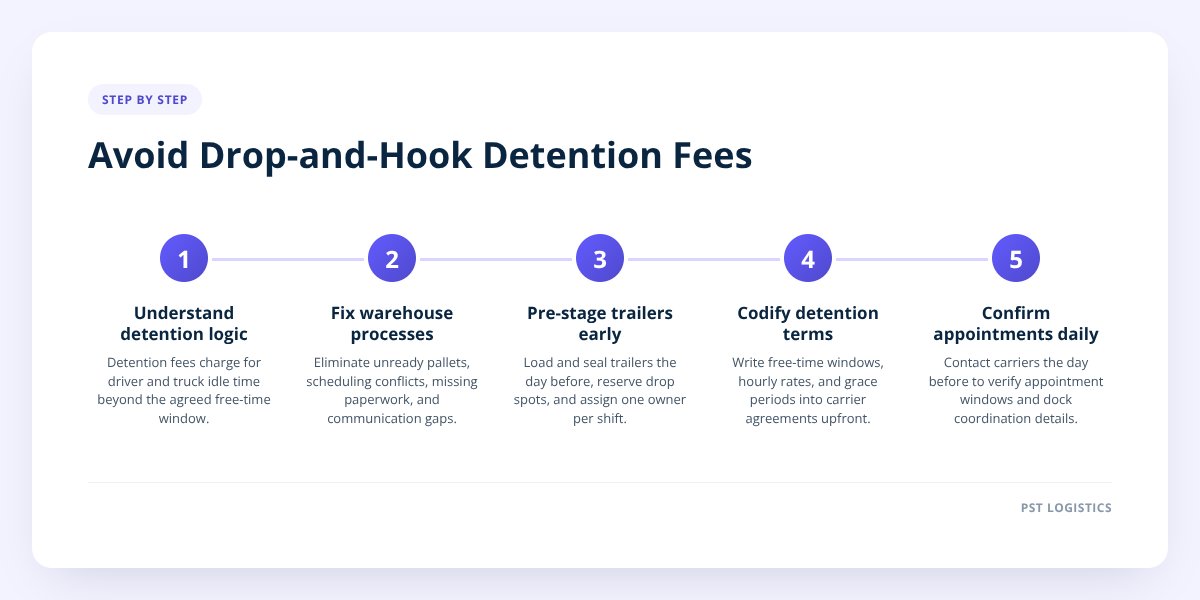
Step 1: Understand What You're Actually Being Charged For
Detention is the fee a carrier bills when its truck and driver are held at a shipper or receiver's facility longer than the agreed free time. On drop-and-hook loads, this isn't about waiting for a live unload — it's about the swap itself taking too long because the trailer being picked up isn't ready, sealed, or where it's supposed to be.
The logic is simple from the carrier's side. A truck sitting at your dock isn't earning miles, and the driver's hours-of-service clock is still running under the FMCSA's hours-of-service rules. Every hour lost to a slow swap is an hour that driver can't spend moving freight toward the next pickup.
Drop-and-hook is supposed to be the fast option — the driver drops an empty or loaded trailer and hooks to one that's already staged, no live loading involved. When that trailer isn't actually ready, you lose the entire point of choosing drop-and-hook in the first place, and the carrier still has to account for the dead time.
We've covered the broader mechanics of detention and demurrage charges in Avoid Detention and Demurrage Fees in Freight Shipping — this guide focuses specifically on what makes drop-and-hook loads different and how to structure your operation around it.
Step 2: Identify the Mistakes That Actually Cause Holds
Detention rarely comes from one dramatic failure. It comes from small, repeatable gaps between what the shipping schedule says and what's actually happening on the dock.
The most common triggers:
- Unready pallets. The outbound trailer is physically at the dock, but it's half-loaded, unwrapped, or missing a BOL when the driver arrives to hook it.
- Warehouse backups. A receiving delay earlier in the shift pushes every outbound trailer behind schedule, and nobody updates the appointment system.
- Scheduling conflicts. Two trailers are booked for the same dock door at overlapping times, so one driver waits regardless of how ready their load is.
- Missing paperwork. The trailer is sealed and staged, but the seal number, weight ticket, or BOL isn't ready for the driver to sign and go.
- No empty trailer to drop. The driver arrives to swap, but there's nowhere to leave the trailer they're dropping, so the whole exchange stalls.
- Nobody at the gate who knows the plan. The driver checks in, but the security or dock staff on duty wasn't told a drop-and-hook was scheduled, and they have to track someone down.
Notice that almost none of these are about the carrier. They're warehouse-side process gaps — which is exactly why they're fixable without renegotiating anything with your carrier. Fixing them is also cheaper than paying for them repeatedly on every lane you run.
Step 3: Pre-Stage Loads So the Swap Actually Takes 15 Minutes
A clean drop-and-hook swap should take a driver roughly 15 to 30 minutes from arrival to departure. If your facility is routinely running longer than that, the fix starts well before the truck shows up.
Build this sequence into your warehouse routine:
- Load and seal the trailer the shift before it's needed, not the morning of. This gives you a buffer if anything on the dock runs behind.
- Confirm the BOL and seal number are printed and attached to the trailer paperwork, not sitting in someone's inbox waiting to be generated.
- Reserve a specific drop spot for the trailer the driver is leaving behind, so the swap doesn't stall because there's nowhere to put it.
- Assign one person per shift who owns drop-and-hook readiness — not a shared responsibility that nobody actually tracks.
- Walk the trailer before the appointment window opens. A five-minute visual check catches a missing seal or a pallet that shifted before the driver is standing at the door waiting on it.
If your freight runs on predictable, repeating lanes — the same shipper to the same receiver, week after week — this kind of staging gets much easier to standardize. That's the core argument for dedicated freight services: the same driver and truck running your lane consistently means both sides learn each other's dock rhythm, and surprises drop off fast. We've also broken down the signs that a shipper has outgrown ad-hoc booking in 5 Signs You Need Dedicated Freight Services.
Step 4: Put Detention Terms in Writing Before the First Load Moves
Don't skip this: verbal understandings about "we'll work it out" on detention almost always favor whoever has more leverage in the moment — usually not the shipper with a dock full of trailers. Get the free-time window, grace period, and hourly rate written into the carrier agreement before freight starts moving.
Specific terms to negotiate upfront:
| Term | What to pin down |
|---|---|
| Free time | How many hours after scheduled appointment or arrival before detention starts |
| Grace period | Any buffer beyond free time before the clock officially begins |
| Hourly rate | The dollar amount charged per hour (or fraction) once detention starts |
| Cap | Whether there's a maximum detention charge per load |
| Notification rule | How and when the carrier must notify you that the clock has started |
| Drop-and-hook specifics | Whether swap time is treated differently than live-load detention |
Every carrier structures these terms a little differently, and the numbers above are things you negotiate — not figures to assume. What matters is that you ask for them explicitly and get them in writing rather than discovering the policy after an invoice lands. For a broader rundown of what else to vet before you sign with any carrier, see What to Check Before Booking a Freight Carrier.
Step 5: Use Appointment Windows and Same-Day Communication to Catch Problems Early
A tight appointment window only works if someone checks in on it before the truck is already en route. Confirming the window the day before — not just booking it weeks out — is what catches a backed-up dock in time to actually fix it.
Build this into your routine:
- The day before pickup, confirm the appointment window is still accurate with both the dock and the carrier's dispatch.
- The morning of, verify the trailer is physically staged and sealed, not just marked "ready" in a system.
- Give the carrier a direct line to your dock contact — not a general office number — so a driver running early or late can get a real answer fast.
- If a delay is unavoidable, notify the carrier as soon as you know, not when the driver is already at the gate. Early notice sometimes buys flexibility that last-minute notice won't.
A carrier with 24/7 dispatch makes this loop faster, because a driver running into a snag at 6 a.m. or on a Saturday still has someone answering the phone on the other end. PST Global runs dispatch around the clock out of Naperville, Illinois, with a single driver assigned from pickup to delivery on every load — no cross-docking, no handoffs, which also means one point of contact if a drop-and-hook appointment needs to shift.
What to Do Next
Detention on drop-and-hook freight is almost always a timing problem, not a carrier problem — which means it's a problem you can engineer out of your operation. Start with the loads you run most often, tighten the staging process on those first, and get your detention terms written down before you negotiate anything else.
If you're setting up a new lane or want to lock in appointment-friendly terms from the start, request a rate quote from PST Global and talk through your pickup schedule with a dispatcher directly — not a call center reading from a script.
Checklist: Preventing Detention on Drop-and-Hook Loads
- Load and seal outbound trailers the shift before pickup, not the morning of.
- Print and attach the BOL and seal number to the trailer before the appointment window opens.
- Reserve a specific drop spot for the trailer the driver is leaving.
- Assign one named dock contact per shift responsible for drop-and-hook readiness.
- Confirm the appointment window with the carrier the day before pickup.
- Verify trailer readiness with a physical walk-through before the driver arrives.
- Write free time, grace period, and hourly detention rate into the carrier agreement.
- Notify the carrier immediately if a delay is unavoidable, rather than waiting for the driver to arrive.