Prepare Perishable Freight for Interstate Shipping
Quick answer: Perishable freight is ready to ship when the reefer unit is pre-cooled to setpoint before loading, pallets are arranged to allow airflow on all sides, temperature probes are placed and verified, and you have a logging system — digital or paper — running before the trailer doors close. Documentation should travel with the load and match what the receiver expects: continuous temperature records, a pre-trip inspection note, and a signed bill of lading with setpoint noted. Skipping any one of these is the most common reason a load gets flagged or rejected at delivery.
Key takeaways
- A reefer trailer should be pre-cooled to setpoint before the doors open for loading — loading into a warm box creates a temperature gap that the unit may never fully recover.
- Setpoint range for most temperature-controlled freight runs from -20°F to 70°F, covering everything from frozen goods to delicate produce that needs to stay cool but not cold.
- Pallet arrangement matters as much as the reefer unit itself — blocked airflow channels are a leading cause of uneven temperatures inside an otherwise properly set trailer.
- Temperature logs should run continuously from pickup to delivery, not just during inspections, since receivers and auditors typically want an unbroken record.
!Prepare Perishable Freight for Interstate Shipping
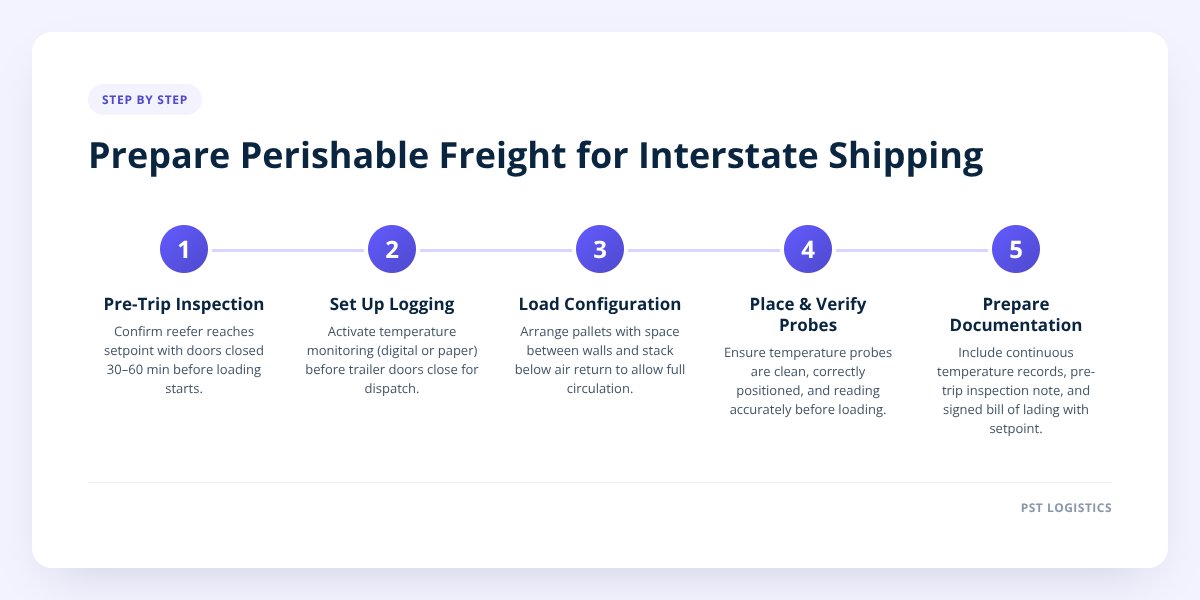
Step 1: Pre-Trip Inspection — Reefer Function, Probes, and Backup Power
Before any pallet goes on the trailer, the reefer unit itself needs to prove it's working. This isn't a formality — a unit that looks fine on the yard can fail an hour into a 12-hour run if nobody checked it first.
Run through these checks before loading begins:
- Confirm the reefer reaches and holds setpoint with doors closed, ideally 30-60 minutes before loading starts.
- Check fuel level on the reefer's independent tank — this runs separately from the truck's diesel supply.
- Inspect door seals and gaskets for cracks or gaps that let warm air in during transit.
- Verify temperature probes are clean, properly placed, and reading accurately against a calibrated reference.
- Test backup power or standby capability if the unit has one, especially for long hauls where a mechanical failure mid-route is costly.
- Confirm the trailer floor is clean and the air chute or bulkhead (if equipped) isn't damaged.
Pre-cooling matters more than most shippers realize. A trailer that starts at 55°F and gets loaded with frozen product sitting at 0°F forces the reefer to fight a 55-degree gap from the moment the doors close — and in many cases, the unit never fully catches up before delivery. Carriers that pre-cool before the door opens, which is standard practice for reefer loads at PST Global, avoid this problem entirely.
Don't skip this: a reefer unit that's merely running isn't the same as one that's at setpoint. Always confirm the actual box temperature — not just that the compressor is on — before loading starts.
Step 2: Set Up Temperature Logging Before the Doors Close
Temperature logging should be running and verified before the first pallet loads, not started after the trailer is already on the road. The U.S. Department of Agriculture (USDA) and the Food and Drug Administration (FDA) both expect verifiable, continuous temperature records for food products moving in interstate commerce, particularly under the FDA's Sanitary Transportation of Human and Animal Food rule, which covers temperature control during transport. Confirm current requirements for your specific product category directly with the FDA, since rules vary by commodity.
Shippers generally have two options:
| Logging method | How it works | Common weak point |
|---|---|---|
| Digital / electronic monitoring | Continuous or cycle-sentry sensors record temperature at set intervals, often downloadable or cloud-synced | Device battery failure or sensor placement errors |
| Paper logs | Driver or carrier manually records temperature at checkpoints | Gaps between checkpoints, illegible entries, lost paperwork |
Digital systems have become the default for a reason — they create an unbroken record without relying on someone remembering to write a number down every few hours. Continuous or cycle-sentry monitoring with logged records, which comes standard on reefer loads at PST Global, gives the receiver a complete temperature history rather than a handful of spot checks.
The most common documentation gap isn't a missing log — it's an incomplete one. A receiver who gets a temperature record with a six-hour blank spot in the middle of the route will often question the entire shipment, even if the product arrived fine. Before dispatch, confirm:
- The logging device or system is active and recording before the trailer leaves the dock.
- Setpoint is documented on the bill of lading, not just programmed into the unit.
- The carrier can produce the full log on request, not just a summary.
- Any manual entries are legible and time-stamped.
Step 3: Load Configuration — Why Pallet Arrangement Controls Airflow
Reefer units cool air, not product directly — the cold air has to circulate around every pallet to do its job. This is why load configuration inside the trailer matters almost as much as the reefer setting itself.
Most reefer trailers rely on an air chute along the ceiling or a bulkhead at the nose to push cold air down the length of the box and back along the floor. If pallets are stacked solid against the walls or packed floor-to-ceiling with no gaps, that circulation gets blocked, and product in the middle or rear of the load can sit several degrees warmer than product near the door.
Good load configuration generally follows these principles:
- Leave space between the load and the side walls so air can travel the full length of the trailer.
- Avoid stacking pallets past the air return channel at the rear doors.
- Keep product of the same temperature category together — don't mix frozen and refrigerated loads in a single trailer unless the setpoint and airflow plan account for both.
- Use pallet blocking and bracing to prevent shifting, which can crush product or block vents mid-transit.
- Load floor-level airflow channels last, after confirming nothing obstructs the return path.
This is also where drop-and-hook arrangements can create blind spots. If a shipper loads a trailer without a carrier representative present, there's no second check on pallet placement before the doors seal. Live loads, where the driver or a carrier rep is present during loading, give an extra opportunity to catch a blocked air chute before it becomes a mid-route temperature problem.
Step 4: The Handoff — What to Confirm Before the Trailer Leaves
The handoff to your carrier is the last checkpoint before the load is out of your hands, and it's worth treating as a formal step rather than a formality. Before the driver pulls away, confirm:
- Setpoint matches what's written on the bill of lading and what the reefer is actually programmed to.
- The logging system is running and the carrier has access to pull records on request.
- Seal numbers (for sealed loads) are recorded and match the paperwork.
- The driver has emergency contact information for both the shipper and the receiver.
- A protocol exists for what happens if the reefer alarms or a temperature excursion is detected en route.
That last point deserves attention. A temperature excursion — a period where the cargo temperature moves outside the setpoint range — doesn't automatically mean the load is ruined, but how it's handled matters. A driver who notices an alarm and contacts dispatch immediately gives everyone a chance to assess the situation before delivery; a driver who doesn't notice, or doesn't report it, turns a recoverable issue into a dispute at the dock.
This is one reason an asset-based carrier with a single driver for the full run has an advantage over a load that changes hands multiple times. There's no cross-dock or transload step where a handoff gap can hide a temperature problem, and the driver who picked up the load is the same one who delivers it and can speak directly to what happened in between. We cover the broader case for this approach in Owner-Operators vs. Fleet Carriers for Shippers.
For a full pre-shipment rundown that applies to dry van freight as well, see Prepare Freight for Interstate Trucking: Checklist.
Step 5: Know the Corridor You're Shipping Through
Interstate perishable freight doesn't move through a single uniform regulatory environment — state-level agricultural inspection stations, weigh stations, and commodity-specific rules can vary by corridor, and a shipment that clears one state without issue can get flagged in the next. Dairy, produce, and frozen goods each carry different documentation expectations depending on the states involved.
Shippers moving freight through the Midwest-to-Southeast corridor, the Texas triangle, or I-80 westbound should confirm state-specific requirements with the relevant state department of agriculture or transportation agency before dispatch, since these rules change and vary by commodity and state. A few practical points to keep in mind:
- Some states operate agricultural inspection stations that can stop and check produce or livestock-adjacent freight at the border.
- Documentation requirements for dairy products often reference both state dairy regulations and federal standards, so having both sets of paperwork on hand avoids delays.
- Frozen goods generally face fewer inspection checkpoints than fresh produce but still need continuous temperature logs to satisfy receiver requirements at delivery.
Rather than trying to track every state's rules independently, many shippers rely on a carrier with established lanes through a given corridor, since that carrier has likely already encountered the relevant checkpoints and documentation expectations. PST Global runs these lanes regularly between Naperville and reload markets including Atlanta, Dallas, Laredo, and Savannah, which means the dispatch team has firsthand familiarity with the corridor realities shippers are navigating.
What to Do Next
Perishable freight is unforgiving of shortcuts — a missed pre-cool, a blocked air chute, or a logging gap can turn a routine shipment into a rejected load at the dock. The good news is that every one of these steps is checkable before the trailer ever leaves your facility.
If you're planning a reefer shipment and want a carrier that pre-cools before the doors open, logs temperature end to end, and keeps the same driver on the load from pickup to delivery, request a rate from PST Global's dispatch team. They answer the phone 24/7, including weekends, and can talk through setpoint and lane details before you book.
Checklist: Prepare Perishable Freight for Interstate Shipping
- Pre-cool the reefer trailer to setpoint 30-60 minutes before loading begins.
- Check the reefer's independent fuel tank and inspect door seals for gaps or cracks.
- Verify temperature probes are clean, properly placed, and calibrated.
- Confirm the logging system — digital or paper — is active before the first pallet loads.
- Arrange pallets to leave airflow space along the side walls and rear air return channel.
- Keep product of the same temperature category grouped together in the trailer.
- Record setpoint and seal numbers on the bill of lading before the driver departs.
- Confirm the carrier's protocol for reporting and handling a temperature excursion en route.
- Check state-specific agricultural and dairy documentation requirements for your shipping corridor.