What Drives Full Truckload Shipping Costs

Quick answer: Full truckload shipping costs break down into six main factors: distance and lane direction, fuel prices, equipment type, weight and load specs, seasonal demand, and accessorial fees like detention or appointment scheduling. Distance and fuel typically make up the largest share of the rate, but an imbalanced lane or a reefer requirement can add just as much. Most shippers can estimate a realistic price range by checking these six factors against their specific load before requesting a quote.
Key takeaways
- Fuel surcharges are calculated separately from the base linehaul rate and move with diesel prices, so a quote can shift week to week even on the same lane.
- Reefer freight (temperature-controlled) generally costs more than dry van because of added fuel for the reefer unit, monitoring, and pre-cooling time.
- Lane direction matters as much as distance — a "backhaul" lane with less freight demand can run cheaper than the same mileage in the opposite direction.
- Accessorial charges (detention, layover, extra stops) aren't padding — they're documented fees tied to specific delays, and a clear rate confirmation should spell them out before the truck moves.
!Full Truckload Shipping Cost Drivers
The Six Factors That Set a Full Truckload Rate
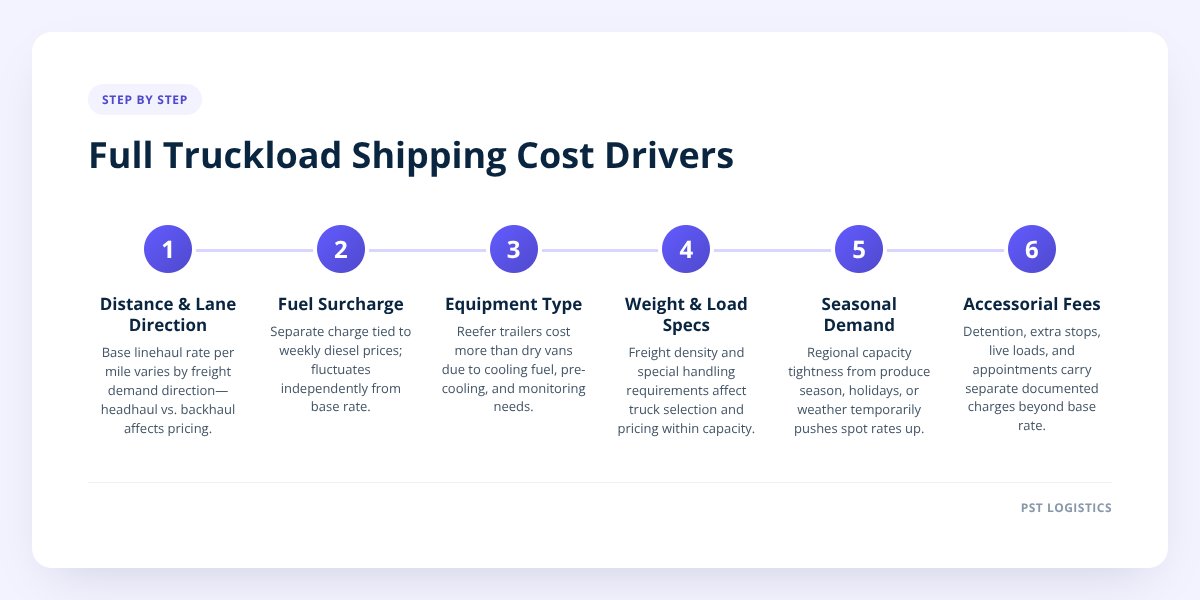
Full truckload pricing isn't one number pulled from a chart — it's the sum of several variables that shift independently. Here's the breakdown, in the order they usually matter most:
- Distance and lane direction. Base linehaul rate is calculated per mile, but the direction you're shipping matters — a lane with heavy freight demand one way and light demand the other (a "headhaul" vs. "backhaul") can price differently even at identical mileage.
- Fuel cost. Carriers apply a fuel surcharge on top of the linehaul rate, tied to national diesel price averages published weekly by the U.S. Energy Information Administration.
- Equipment type. Standard 53' dry van trailers cost less to run than temperature-controlled (reefer) trailers, which need continuous power for the cooling unit and pre-cool time before the doors even open.
- Weight, density, and load specs. A dry van truckload maxes out around 45,000 lbs and 26 standard pallets — freight near that ceiling, or freight that requires special handling, can affect pricing and truck selection.
- Seasonal and regional demand. Produce season in the Southeast, holiday retail surges, and weather events all tighten truck capacity in specific regions, pushing spot rates up temporarily.
- Accessorial fees. Detention time, extra stops, live loads vs. drop-and-hook, and appointment scheduling all carry separate, documented charges beyond the base rate.
We go deeper on how these pieces combine into an actual number in Estimate Freight Hauling Costs for Shipping — this post focuses on what each factor is and why it moves.
Why Does Lane Direction Change the Price on the Same Route?
Lane direction changes price because truck supply and freight demand aren't balanced in both directions on most routes. If a lane has heavy outbound freight demand but few loads coming back, carriers price the return trip lower just to avoid running empty.
This is why a load from Naperville to Atlanta might cost noticeably more — or less — than the reverse trip, even though the mileage is identical. PST Logistics' reload markets, including Atlanta, Dallas, Laredo, Savannah, Newark, and Los Angeles, exist specifically because balanced freight in both directions keeps rates more predictable for shippers on those corridors.
If you're shipping on an unfamiliar lane, ask your carrier or broker whether it's a headhaul or backhaul direction. It's a fair question, and a straight answer tells you a lot about why the quote landed where it did.
Dry Van vs. Reefer: What's the Real Cost Difference?
Reefer (temperature-controlled) freight costs more than dry van freight, mainly because of fuel, pre-cool time, and monitoring requirements. Here's how the two compare side by side:
| Factor | Dry Van | Reefer |
|---|---|---|
| Typical use | Palletized or floor-loaded general freight | Produce, dairy, frozen goods |
| Fuel needs | Standard tractor fuel only | Tractor fuel plus continuous reefer unit fuel |
| Pre-load prep | Minimal | Trailer pre-cooled to setpoint before doors open |
| Setpoint range | Not applicable | Commonly -20°F to 70°F |
| Monitoring | Not required | Continuous or cycle-sentry temperature logging |
| Payload capacity | Up to 45,000 lbs, 26 standard pallets | Slightly less due to reefer unit weight |
| Documentation | Bill of lading, standard paperwork | Bill of lading plus temperature log and washout records |
The pre-cooling step matters more than most shippers realize. A reefer trailer that isn't brought to setpoint before the doors open can compromise the load in the first few minutes, which is why carriers that specialize in temperature-controlled freight build pre-cool time into the schedule rather than treating it as optional.
How Much Does Fuel Actually Add to a Truckload Rate?
Fuel typically adds a separate line item — the fuel surcharge — on top of the base linehaul rate, and it's recalculated regularly against national diesel prices. The U.S. Energy Information Administration publishes weekly average diesel prices, and most carrier fuel surcharge tables are indexed to that published number.
That means the same lane can quote differently two weeks apart with nothing else changing. If diesel prices climb $0.30 a gallon regionally, expect the surcharge portion of your rate to climb with it — not because the carrier changed its pricing philosophy, but because the underlying cost did.
Don't skip this: Ask any carrier or broker for their fuel surcharge table and how often it updates. A rate confirmation that separates linehaul from fuel surcharge is far easier to audit than one flat number — and it protects you if fuel prices drop mid-contract too.
What Are Accessorial Fees, and Are They Avoidable?
Accessorial fees are charges for anything outside standard pickup-to-delivery service — detention, extra stops, liftgate use, or live loading instead of drop-and-hook. They're not hidden costs when a carrier documents them upfront; they're standard charges tied to specific, verifiable delays or services.
Common accessorials to know before you book a load:
- Detention — charged when a truck is held at a facility beyond the agreed free time, often after two hours.
- Layover — charged when a driver is held overnight awaiting a load or delivery window.
- Extra stops — charged per additional pickup or drop beyond the original stop count.
- Live load/unload fees — charged when a driver must wait while freight is loaded or unloaded, versus a drop-and-hook.
- Appointment scheduling fees — some facilities require scheduled dock times, which can affect routing and cost.
These fees are avoidable in the sense that clear communication upfront — accurate dock hours, realistic loading windows, advance notice of extra stops — keeps them from triggering in the first place. We cover how to spot carriers who itemize these fairly versus those who don't in How to Vet a Freight Carrier and Avoid Hidden Costs.
A Pre-Quote Checklist for Full Truckload Shippers
Before you request a quote, gather the details that actually change the price. This saves you from getting a rough estimate that shifts once the full picture comes in.
- Confirm exact pickup and delivery zip codes, not just city names.
- Know your total weight and pallet count (dry van tops out around 45,000 lbs and 26 standard pallets).
- Identify whether the freight needs temperature control, and at what setpoint.
- Check whether pickup or delivery requires a scheduled appointment.
- Note whether it's a live load or drop-and-hook at each stop.
- Flag any multi-stop requirements before requesting the quote, not after.
- Ask whether the carrier separates linehaul rate from fuel surcharge on the confirmation.
- Confirm insurance certificate turnaround if your receiver requires proof before delivery.
Regulatory shifts add another layer worth tracking. FMCSA's recent enforcement actions on non-domiciled CDLs and driver qualification, along with court challenges to those rules, are actively affecting carrier capacity in some regions — which can ripple into rates on tight lanes. We break down how FMCSA rules translate into cost and timeline pressure in How FMCSA Rules Shape Your Freight Costs and Timeline.
Full truckload pricing will never be a single fixed number, because too many of these factors move independently — fuel, direction, season, equipment. But once you know what's driving each line on the quote, it stops looking arbitrary.
PST Logistics runs 53' dry van and reefer truckload freight out of Naperville with the same truck and same driver from pickup to delivery — no cross-docking, no transloading, and rate quotes that separate out exactly what you're paying for. If you need a quote broken down by factor, not just a number, reach out to PST Logistics and ask for one.