Planning a Multi-Stop Full Truckload Run

Quick answer: A multi-stop full truckload run from Naperville to the Southeast works when you sequence drops in reverse load order, build dock appointments around realistic drive segments under Hours of Service limits, and confirm detention terms at every stop 24 hours out. A typical Naperville-to-Atlanta run with three drops takes two full driving days plus a mandatory rest break; the complexity is manageable if the load plan and the paperwork are done before the truck leaves the dock.
Key takeaways
- A three-stop Naperville-to-Atlanta run covers roughly 720 miles and typically needs two driving days once a 10-hour reset is factored in under federal Hours of Service rules.
- Loading the last-delivered pallets first (nearest the nose of the trailer) keeps earlier stops from requiring a full unload-and-reload at the dock.
- Most shippers allow two hours of free time at a dock before detention charges apply — confirm the exact number with the receiver in writing, since it varies by facility.
- Full truckload shipping with multiple drops costs less per stop than booking three separate full truckload loads, but only if the sequencing avoids wasted dwell time.
!Planning a Multi-Stop Full Truckload Run
Why Shippers Think Multi-Drop Freight Is Riskier Than It Is
Multi-stop truckload freight gets a reputation for cost overruns and missed appointments, but the risk is almost always a planning problem, not a routing problem. A single load with three delivery points touches three different dock schedules, three sets of paperwork, and three chances for a late appointment to cascade into the next one. Shippers who've been burned by one bad multi-stop experience often default back to booking separate full truckloads for every destination, which costs more per mile moved.
The real issue is that a multi-drop load has zero margin for sequencing mistakes. If the pallets going to the second stop are buried behind the pallets going to the third stop, the driver either reloads the trailer at stop one — burning an hour or more — or the receiver at stop two waits while product gets shuffled around on the dock.
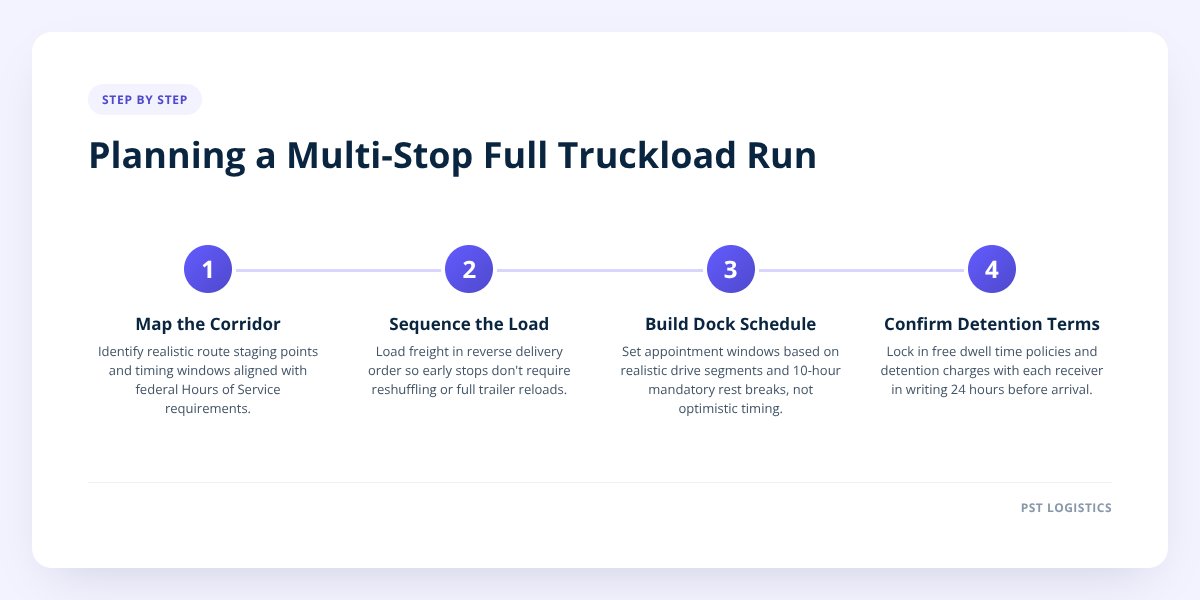
None of that is inherent to multi-stop freight. It's inherent to not planning the load before it's built. A well-planned three-drop run from Naperville to Atlanta or Memphis moves freight to three customers for less than three dedicated full truckloads would cost, without any more actual risk than a single-stop run — as long as four things happen in order: the route is mapped with real timing windows, the trailer is loaded in reverse delivery sequence, the dock appointments are built around Hours of Service limits instead of wishful thinking, and detention terms are nailed down before the truck ever leaves Naperville.
Step 1: Map the Corridor and Build Realistic Timing Windows
Start by laying out the actual route and marking where a driver can legally and physically stop, not just where the destinations sit on a map. From Naperville, the standard path east and south runs I-80 to I-39 or I-65, picking up I-70 or I-74 toward the Southeast, then splitting onto I-75 for Atlanta or I-55/I-40 for Memphis.
A Naperville-to-Atlanta run covers about 720 miles. Naperville-to-Memphis is shorter, around 530 miles. Neither distance fits in one duty day once you account for loading time, fuel stops, and the mandatory 30-minute break and 10-hour rest period required under the Federal Motor Carrier Safety Administration's Hours of Service rules.
That means the route plan has to identify staging points in advance — truck stops or rest areas with enough capacity for a 53-foot trailer, ideally positioned so the driver's mandatory rest break lands within striking distance of the first delivery window the next morning. Good staging points along this corridor cluster around Indianapolis, Louisville, and Nashville, depending on which leg of the route the load is running.
Building the corridor map before booking appointments does two things: it tells you which cities can realistically host a mid-route delivery, and it tells the dispatcher exactly where the driver should be sleeping on night one so the morning appointment isn't a guess.
Step 2: Sequence the Load So Early Stops Don't Block Later Ones
Load the trailer in reverse order of delivery — the last stop's freight goes in first, nearest the nose, and the first stop's freight goes in last, nearest the doors. This is the single most common mistake on multi-drop full truckload shipping, and it's entirely avoidable with a load plan built before the truck arrives at the shipper's dock.
Picture a Naperville load with three drops: Nashville, then Birmingham, then Atlanta. If the Atlanta freight — the last stop — gets loaded last, it sits at the very back of the trailer, blocking the doors. When the driver reaches Nashville first, he has to physically move or restack the Birmingham and Atlanta pallets to reach the Nashville order, which can turn a 45-minute live unload into a two-hour ordeal.
Loaded correctly, the Atlanta pallets go in first and sit at the nose. Birmingham goes in next, Nashville goes in last, right at the doors. The driver opens the trailer at the first stop and the correct pallets are right there — no reshuffling, no delay, no risk of damaging freight that isn't even being delivered yet.
This same logic applies to pallet counts and weight distribution, not just stop order. A dry van full truckload holds up to 45,000 pounds and 26 standard pallets, so a three-stop load also needs weight balanced across the trailer axle groups, not just stacked by delivery sequence. We cover the pallet-level mechanics of this in more detail in How to Plan and Load Pallets for Full Truckload Shipping.
Step 3: Build the Dock Schedule Around Hours of Service, Not Around Wishful Thinking
Set appointment windows based on where the driver will actually be after legally required breaks, not based on when the receiver would prefer the truck show up. This is where most multi-stop plans fall apart before the truck ever leaves the yard.
Here's a realistic timeline for a three-stop Naperville-to-Atlanta run:
| Day | Activity | Approximate Timing |
|---|---|---|
| Day 1, morning | Load at Naperville shipper | 6:00 AM – 8:00 AM |
| Day 1, driving | Naperville to Nashville staging area | 8:00 AM – 7:00 PM (with required break) |
| Day 1, evening | 10-hour mandatory rest period | 7:00 PM – 5:00 AM |
| Day 2, morning | Stop 1: Nashville delivery | 7:00 AM appointment |
| Day 2, midday | Drive to Birmingham | 9:00 AM – 12:30 PM |
| Day 2, afternoon | Stop 2: Birmingham delivery | 1:00 PM appointment |
| Day 2, afternoon/evening | Drive to Atlanta | 2:00 PM – 5:30 PM |
| Day 2, evening | Stop 3: Atlanta delivery | 6:00 PM appointment |
This schedule assumes every dock appointment holds and every unload stays inside the agreed free time. In practice, build a 30- to 60-minute buffer into each leg, because a late delivery at stop one pushes every appointment behind it. We go deeper into building these buffers in Planning Multi-Stop Freight Routes Within HOS Limits and in Plan Freight on Tight Windows Without Driver Delays.
Don't skip this: never schedule back-to-back appointments with less than 90 minutes of drive-and-buffer time between them on a multi-stop run — one slow forklift at stop one is all it takes to blow the whole day's schedule.
Step 4: Lock Down Detention Terms at Every Stop, Not Just the Last One
Confirm free time, appointment windows, and detention rates with every receiver on the run — not just the final drop — because detention charges accrue per stop, and a shipper focused only on the last delivery can lose money on the first two without realizing it. Most receiving docks allow a set amount of free time, often around two hours, before detention fees kick in, but this varies by facility and needs to be confirmed in writing rather than assumed.
What to communicate upfront, before the load is even dispatched:
- Confirm each receiver's standard free-time allowance and hourly detention rate in writing.
- Share the full multi-stop itinerary with each receiving dock, so they know this isn't a dedicated single-stop truck.
- Flag any live-unload versus drop-and-hook expectation at each location — a sealed load with drop-and-hook at one stop and a live unload at another changes the timeline significantly.
- Get a direct contact name and phone number for each dock, not just a general receiving line.
Then, 24 hours before each stop, confirm the appointment is still valid and nothing has shifted:
- Verify the appointment time hasn't been bumped by the receiver's own dock schedule.
- Re-confirm the door number or check-in procedure for that facility.
- Check that the previous stop's delivery is still on schedule, since a delay there shifts every window after it.
- Make sure the driver has updated paperwork for each stop, especially on a sealed load where the seal number has to match the bill of lading at every delivery.
We've written in more detail about the mechanics of detention charges and how to avoid them in How to Prevent Detention Fees on Full Truckload Shipping and Avoid Detention and Demurrage Fees in Freight Shipping.
What to Do Next
A multi-stop Naperville-to-Southeast run isn't more complicated than a single-stop load — it just has less room for error at every step. Map the corridor with real staging points, load in reverse delivery order, build the dock schedule around Hours of Service limits instead of convenience, and confirm detention terms with every receiver before the truck rolls.
PST Global runs 53-foot dry van and temperature-controlled full truckload freight out of Naperville, Illinois, across the Midwest-to-Southeast corridor with the same driver and same truck from pickup to final delivery — no cross-docking, no handoffs between carriers mid-route. Appointment pickups and multi-stop delivery are standard, and dispatch answers the phone 24/7 to adjust a schedule if a dock appointment slips. Request a rate for your next multi-stop lane through PST Global's quote request.
Checklist: Planning a Multi-Stop Full Truckload Run
- Map the full corridor and mark legal staging points for mandatory rest breaks.
- Calculate total drive time for each leg, including required Hours of Service breaks.
- Build the load plan in reverse delivery order before the truck arrives at the shipper.
- Balance pallet weight across axle groups, not just by stop sequence.
- Set dock appointment times based on realistic arrival windows, not preferred times.
- Add a 30- to 60-minute buffer between each stop's appointment.
- Confirm free-time allowance and detention rate with every receiver in writing.
- Share the full multi-stop itinerary with each dock ahead of time.
- Re-confirm each appointment and door number 24 hours before arrival.
- Verify seal numbers and paperwork match the bill of lading at each stop.