How to Prevent Detention Fees on Full Truckload Shipping

Quick answer: Detention fees on full truckload shipping come from one thing: a driver sitting at your dock longer than the free time allowed, usually two hours. You prevent them by estimating load or unload time accurately before you book, locking a firm appointment window with your carrier, having the dock staffed and the paperwork ready before the truck arrives, and choosing drop-and-hook over live load whenever the lane and equipment allow it. Most detention is shipper-caused, not carrier-caused, which means most of it is preventable.
Key takeaways
- Standard detention-free time in truckload shipping is commonly two hours from check-in; most carriers start billing in 30- or 60-minute increments after that.
- A 26-pallet dry van load typically takes 45–90 minutes to unload with one dock worker and a pallet jack — fewer workers or no forklift access can double that.
- Drop-and-hook loads remove the driver's wait time almost entirely, since the tractor swaps a loaded trailer for an empty one instead of waiting through a live unload.
- The Midwest-to-Southeast corridor and I-80 both carry heavy freight volume, which means receiving docks in those lanes run behind schedule more often — build extra cushion into appointments on those routes.
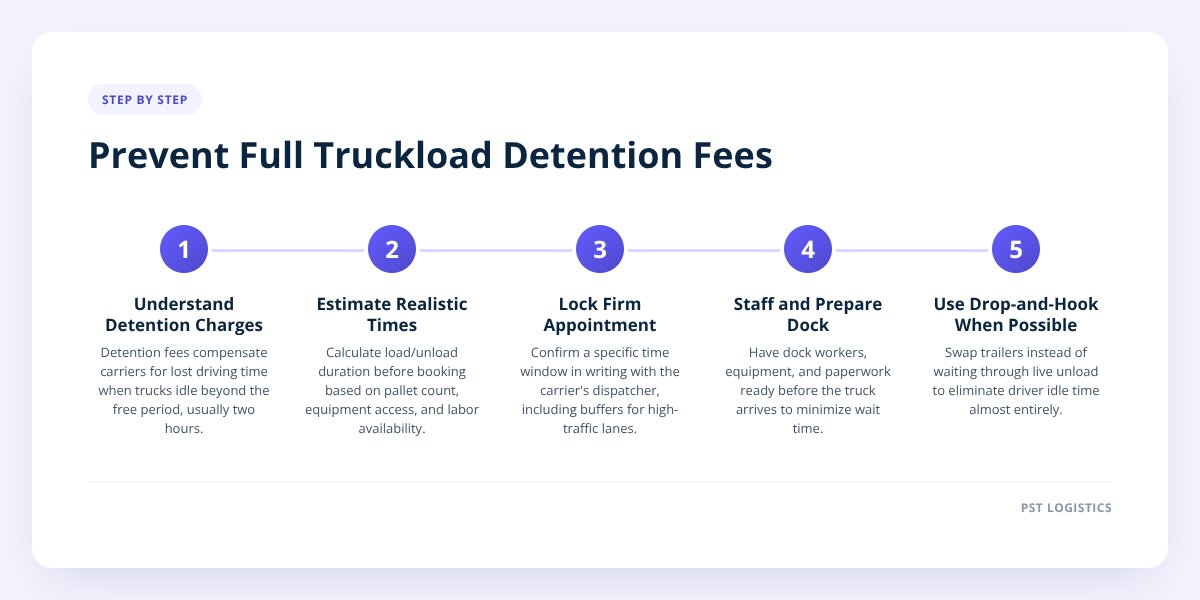
!Prevent Full Truckload Detention Fees
Step 1: Understand What You're Actually Being Charged For
Detention fee is the charge a carrier bills when its truck and driver are held at a shipper or receiver's facility beyond the agreed free time. It exists because a driver sitting at a dock isn't just idle — under Federal Motor Carrier Safety Administration hours-of-service rules, that driver's clock is still running, which eats into the hours they have left to drive that day.
Carriers charge detention to recover the cost of that lost driving time. A driver stuck for three hours at a pickup may lose the ability to make a delivery appointment later that day, or burn into the 14-hour window they're allowed to be on duty at all. The fee isn't a penalty for being slow — it's compensation for a resource (the truck, the driver's clock, the trailer) that sat unused.
Most detention falls into three buckets:
- Dock delays — the facility doesn't have a bay open, or the truck ahead of yours is still being worked.
- Labor shortages — nobody's available to load or unload when the truck arrives.
- Shipper-caused holds — paperwork isn't ready, the order isn't staged, or the appointment time was unrealistic to begin with.
The third bucket is the one shippers have full control over, and it's usually the biggest one.
Step 2: Estimate Realistic Load and Unload Times Before You Book
Before you book a truck, work out how long your freight will actually take to load or unload — don't guess, and don't assume every dock moves at the same speed. Three factors drive this number: pallet count, equipment access, and labor availability.
A rough benchmark for a dry van full truckload: a 26-pallet load with a forklift and one experienced dock worker typically takes 45 to 90 minutes to unload. That number climbs fast when any of those conditions change:
| Condition | Effect on unload time |
|---|---|
| Floor-loaded freight instead of palletized | Adds 1–3 hours — hand-stacking is far slower than forklift work |
| Single dock worker instead of two | Can nearly double the time on a full 26-pallet load |
| No forklift, pallet jack only | Adds significant time, especially on heavier pallets |
| Multiple stops on one trailer | Each stop needs its own realistic window, not a shared guess |
| Receiver running behind on prior trucks | Adds queue time before the unload even starts |
If you're shipping floor-loaded freight rather than palletized pallets, tell your carrier before booking — it changes both the time estimate and, often, the detention conversation if something runs long. We covered pallet configuration and how it affects load time in more detail in How to Plan and Load Pallets for Full Truckload Shipping.
Don't skip this: If your dock has historically run behind on appointments, say so when you book — a carrier working from accurate information can plan around it, but a carrier blindsided by a three-hour wait has every right to bill detention for it.
Step 3: Lock a Firm Appointment Window With Your Carrier
A firm appointment means a specific time window both sides have confirmed in writing, not a loose "sometime in the morning" understanding. Verbal or vague scheduling is the single most common cause of avoidable detention, because the driver and the dock end up working from different expectations.
To coordinate this properly:
- Confirm the appointment time in writing with your carrier's dispatcher, not just the broker or a general contact.
- Build in a buffer for the lane — a route through Atlanta or Chicago during peak hours needs more cushion than a rural stop.
- Tell the carrier about multi-stop requirements up front, since each stop needs its own window, not a shared guess across the whole run.
- Flag any facility-specific rules — driver check-in procedures, PPE requirements, or restricted hours — before the truck is dispatched.
- Confirm who the driver should call if they're running early or late, so nobody is sitting outside a gate for 45 minutes before anyone knows.
A dispatcher who answers the phone matters here more than people expect. If a driver hits traffic on I-80 and is going to miss a tight window, the carrier needs to reach someone at the receiving dock fast enough to adjust — not leave a voicemail and hope. At PST Logistics, dispatch runs 24/7, including weekends, specifically because schedule problems don't wait for business hours.
We walked through the appointment-coordination side of this in more depth in Plan Freight on Tight Windows Without Driver Delays, including how to handle a window that's already too tight before the truck leaves.
Step 4: Decide Between Drop-and-Hook and Live Load
Drop-and-hook means the driver drops a loaded trailer and picks up an already-loaded or empty one, instead of waiting while the trailer is loaded or unloaded in front of them. It is the single most effective way to eliminate detention risk, because the truck's time at your facility is measured in minutes, not hours.
Live load means the driver waits at the dock while the trailer is loaded or unloaded in real time. It gives you more flexibility — you don't need a second trailer sitting on-site — but it ties the driver's schedule directly to your dock's speed on that day.
| Factor | Drop-and-hook | Live load |
|---|---|---|
| Detention risk | Very low — driver isn't waiting | Higher — driver waits through the full load/unload |
| Trailer pool needed | Yes — a spare trailer must be on-site or nearby | No — one trailer handles the whole cycle |
| Best for | High-volume shippers with regular dock traffic | Lower-volume or occasional shippers |
| Scheduling flexibility | Less precise timing needed | Requires a tighter, confirmed window |
| Driver's day | Frees the driver to move to the next load quickly | Driver's hours-of-service clock keeps running while waiting |
If your volume supports keeping a trailer on-site, drop-and-hook is worth the conversation with your carrier — it removes most of the timing risk discussed in this guide entirely. PST Logistics offers both drop-and-hook and live load, along with sealed loads and appointment pickups, on its dry van truckload service.
Step 5: Know the Specific Triggers on Midwest-to-Southeast and I-80 Runs
Detention risk isn't evenly distributed across the country — it concentrates on certain high-traffic corridors where dock congestion and appointment backlogs are more common. The Midwest-to-Southeast corridor and I-80 westbound are two of the busiest freight lanes in the country, and both carry specific, well-documented detention triggers:
- Receiving docks near Atlanta and other Southeast distribution hubs often run multiple trucks through a single appointment slot, so arriving even slightly early doesn't guarantee an early start.
- I-80 traffic through Chicago, Cleveland, and the Pennsylvania corridor regularly runs behind projected drive times, which pushes arrival into a receiver's busiest check-in hours.
- Weather delays in winter months on I-80 westbound can shift an on-time appointment into a late-afternoon arrival, right when a dock's queue is longest.
- Reload markets like Dallas, Savannah, and Laredo see heavy inbound and outbound volume simultaneously, which strains dock labor on both ends of a run.
- Multi-stop deliveries scheduled too tightly cause a delay at stop one to cascade through every stop after it.
None of these are reasons to avoid the lanes — they're reasons to build realistic time cushions into appointments on these specific routes rather than scheduling back-to-back windows with no slack. We go deeper on lane-specific planning in Planning a Naperville-to-Southeast Full Truckload Run, and detention mechanics generally in How to Avoid Detention Fees on Interstate Freight Runs.
What to Do Next
Detention prevention comes down to information the carrier doesn't have unless you give it: real pallet counts, honest dock speed, and a firm appointment window confirmed before the truck rolls. PST Logistics runs full truckload dry van and temperature-controlled freight across all 48 states, with the same driver covering the load from pickup to delivery and a dispatcher who answers the phone around the clock to adjust a window when something changes mid-route. If you're planning a run through the Midwest-to-Southeast corridor, the Texas triangle, or I-80, request a rate and talk through the appointment details before you book.
Checklist: Preventing Detention Fees on a Full Truckload Shipment
- Calculate realistic load/unload time based on pallet count, floor-loading, and dock labor availability.
- Confirm whether the receiving dock has a forklift or only pallet jacks before setting the appointment.
- Lock a specific appointment window in writing with your carrier's dispatcher, not a general time of day.
- Flag multi-stop requirements separately, with its own window for each stop.
- Tell your carrier about any facility-specific check-in rules before dispatch.
- Decide between drop-and-hook and live load based on your trailer availability and dock speed.
- Build extra time cushion into appointments on I-80 and Southeast-corridor runs.
- Confirm who the driver should call if they're running early or late.
- Have paperwork, staging, and dock staff ready before the truck's scheduled arrival time.