FMCSA Training Provider Purge: What It Means for You

Quick answer: The FMCSA's removal of more than 10,000 driver training providers from its training registry means some carriers may have hired or onboarded drivers through programs that no longer meet federal standards. For shippers, this is a reason to confirm — not assume — that a carrier's drivers are trained through a currently registered provider, hold a clean CDL and MVR, and go through documented ongoing qualification checks. Ask directly, and favor carriers that can show you their compliance record without hesitation.
Key takeaways
- The FMCSA maintains a public Training Provider Registry (TPR) that entry-level drivers must use to meet federal training requirements before taking a CDL skills test.
- A carrier whose new drivers trained through a removed or non-compliant provider may face qualification gaps that affect insurance, safety scores, and reliability.
- Shippers can verify a carrier's safety standing directly through the FMCSA's SAFER system and ask for proof of driver qualification files during vetting.
- An asset-based carrier that runs its own drug and alcohol testing consortium and in-house maintenance program — like PST Logistics in Naperville, Illinois — can usually answer these questions on the spot.
!Verify Carrier Driver Training Compliance
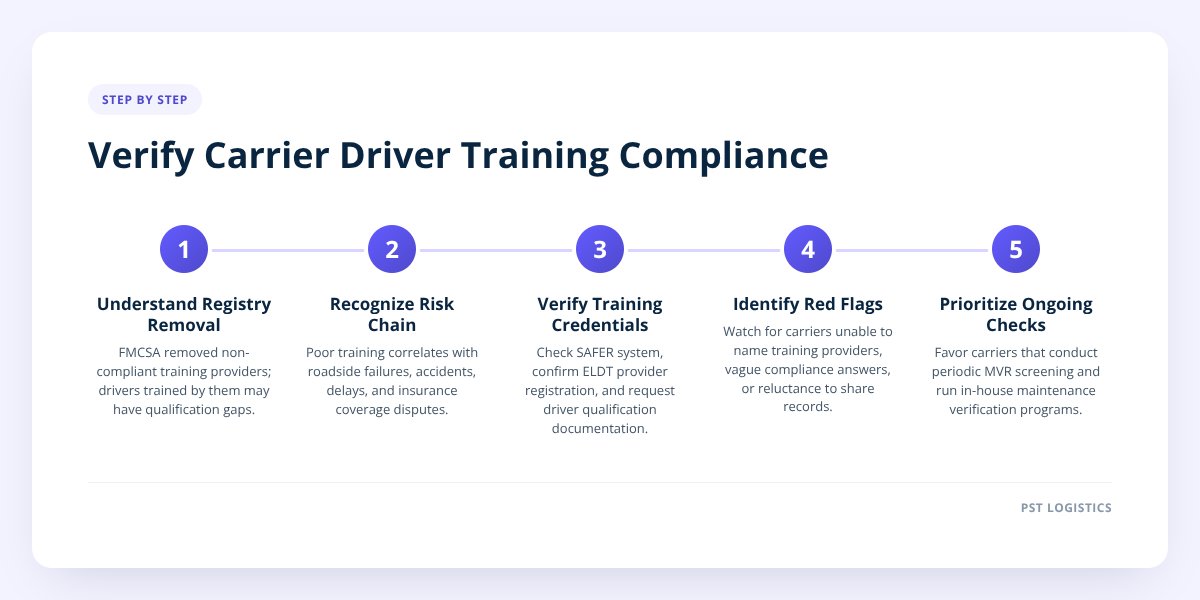
Step 1: Understand what actually happened with the FMCSA training registry
The FMCSA's Entry-Level Driver Training (ELDT) rule requires anyone getting a new CDL, upgrading their license, or obtaining certain endorsements to complete training through a provider listed on the agency's Training Provider Registry. Over time, the FMCSA found that a large number of listed providers were not meeting the training and documentation standards the registry requires, and it removed them in a broad compliance sweep.
For shippers, the headline number matters less than the mechanism. A driver who trained under a provider that gets pulled from the registry may have a qualification record that doesn't hold up if it's ever audited or questioned after an incident. That's a liability question for the carrier — but it becomes your problem too if that driver is the one hauling your freight when something goes wrong.
This isn't a one-time event you can check off and forget. The FMCSA updates the registry on an ongoing basis, which means a provider that's compliant today could be removed next quarter. Carriers that take driver qualification seriously build in a recheck, not a one-time hire-day verification.
Step 2: Know why this matters more to you than it might seem
Unvetted driver training doesn't just raise accident risk in the abstract — it shows up in roadside inspections, claims history, and missed delivery windows. A driver who was rushed through training or certified by a non-compliant provider is statistically more likely to make the kind of error that triggers an out-of-service violation or a preventable accident.
Here's the chain reaction for a shipper:
- Inspection failures delay freight. A driver pulled for a roadside inspection due to documentation gaps can sit for hours, blowing your appointment window.
- Accidents trigger claims, not just delays. A collision involving an under-trained driver can tie up your freight in an investigation, sometimes for days.
- Insurance gaps surface at the worst time. Carriers with weak qualification files sometimes discover coverage disputes only after a claim is filed.
- Safety scores drop, and so does your leverage. A carrier with a declining CSA score has less room to prioritize your freight when capacity gets tight.
None of this means every carrier using an affected training provider has unsafe drivers. It means the registry removal is a signal worth checking, the same way you'd check a safety rating before booking a load. We covered how to read that broader safety picture in How to Read a Freight Carrier's FMCSA Safety Rating.
Step 3: Check a carrier's driver training credentials before you book
You verify this the same way you'd verify authority or insurance — by asking for documentation, not taking a sales pitch at face value. Start with what's public, then follow up with direct questions.
- Look up the carrier in the FMCSA's SAFER system. This shows active authority, insurance status, and basic safety scores — the foundation before you dig into training specifics.
- Ask whether new drivers trained through a currently registered ELDT provider. A carrier that hires recent CDL graduates should know this answer immediately.
- Request confirmation of drug and alcohol testing through a certified consortium. The FMCSA requires this for all CDL holders, and a carrier should be able to name theirs without delay.
- Ask about MVR (motor vehicle record) screening frequency. Carriers that only check at hire, rather than periodically, have less visibility into a driver's current record.
- Confirm whether the carrier runs its own preventive maintenance and DOT inspections. In-house inspection programs tend to correlate with tighter overall compliance culture.
Don't skip this: a carrier's willingness to answer these questions quickly and specifically tells you more than the answers themselves. Hesitation, vague reassurances, or "we'll get back to you" on a compliance question is itself a red flag.
If you haven't already confirmed the basics — active authority and current insurance — do that first. We laid out exactly how in Verify a Trucking Company's Authority and Insurance First.
Step 4: Watch for red flags in recruitment and training practices
Some warning signs show up before you ever ask a direct question — they're visible in how a carrier talks about its drivers and hiring process.
| Red flag | Why it matters |
|---|---|
| Can't name a training provider or testing consortium | Suggests no formal vetting process exists |
| High driver turnover reported or implied | Often linked to rushed hiring and weaker screening |
| No mention of ongoing MVR or safety monitoring | Qualification checked once, never revisited |
| Reluctant to share certificates of insurance same-day | May signal disorganized or outdated records |
| Uses only owner-operators with no onboarding standard described | Harder to confirm consistent training across the fleet |
| Safety rating listed as "Conditional" or missing entirely | Direct signal of unresolved compliance issues |
A carrier that mixes company drivers and owner-operators isn't automatically a problem — PST Logistics does both — but the carrier should describe a consistent qualification standard that applies either way, not a patchwork. We go deeper on spotting these patterns in 8 Red Flags That Signal an Unreliable Trucking Company.
Step 5: Ask the right questions during your vetting call
A short, direct conversation will tell you more than any website claim. Bring these questions to your first call with a prospective carrier:
- Do your drivers train through a provider currently listed on the FMCSA Training Provider Registry?
- How do you verify a driver's MVR and CDL status after they're hired, not just at onboarding?
- Who runs your drug and alcohol testing, and is it a certified consortium?
- Is the same driver with my freight from pickup through delivery, or does it change hands?
- What's your current CSA safety rating, and can you send a certificate of insurance the same day I ask?
That last point is worth pushing on. PST Logistics, an asset-based dry van and temperature-controlled carrier based in Naperville, Illinois, sends certificates of insurance the same business day they're requested and runs ELD-monitored hours of service, in-house preventive maintenance, and drug and alcohol testing through a certified consortium on every unit — because a shipper asking these questions deserves a fast, specific answer, not a delay.
What to Do Next
Run this check before your next load tender, not after a problem forces the question. A few minutes of verification now costs far less than a missed delivery window or a claims dispute later.
If you're planning freight on the Midwest-to-Southeast corridor, the Texas triangle, or I-80 westbound, and want a carrier that keeps one driver with your load from pickup to delivery with a documented safety record, request a rate from PST Logistics and ask the dispatcher any of the questions above — they're built to answer on the spot.
Checklist: Vetting a Carrier's Driver Training and Qualification Standards
- Look up the carrier's safety rating and authority status in the FMCSA's SAFER system.
- Ask whether new-hire drivers trained through a currently registered FMCSA ELDT provider.
- Confirm the carrier's drug and alcohol testing runs through a certified consortium.
- Request a sample of how often MVRs are rechecked after initial hire.
- Ask who performs preventive maintenance and DOT inspections — in-house or outsourced.
- Request a certificate of insurance and note how quickly it arrives.
- Ask whether one driver stays with your load from pickup to delivery.
- Flag any hesitation or vague answers as a reason to keep shopping.