How to Read a Freight Carrier's FMCSA Safety Rating

Quick answer: A freight carrier's FMCSA safety rating comes from the Safety Measurement System (SMS), which scores performance across seven BASIC categories — including Unsafe Driving, Hours-of-Service Compliance, and Vehicle Maintenance — using roadside inspection and crash data from the past 24 months. To vet a carrier before booking, pull their SMS profile and SAFER record, check for an active safety rating of Satisfactory, and look for any BASIC score that sits above the FMCSA's intervention threshold for that category. A clean record across all categories, paired with active authority and insurance on file, is the baseline for a carrier you can trust with your freight.
Key takeaways
- The Federal Motor Carrier Safety Administration (FMCSA) scores carriers across seven BASIC categories using roadside inspection data from the trailing 24 months.
- A carrier's safety rating — Satisfactory, Conditional, or Unsatisfactory — comes from a full compliance review, not from the SMS percentile scores alone.
- SMS percentile scores above the FMCSA's published intervention thresholds flag a carrier for agency follow-up, even if their overall rating is still Satisfactory.
- The SAFER system (ask.fmcsa.dot.gov) and the SMS website are both free and public — no account or fee required to check a carrier before you book a load.
!Reading a Freight Carrier's FMCSA Safety Rating
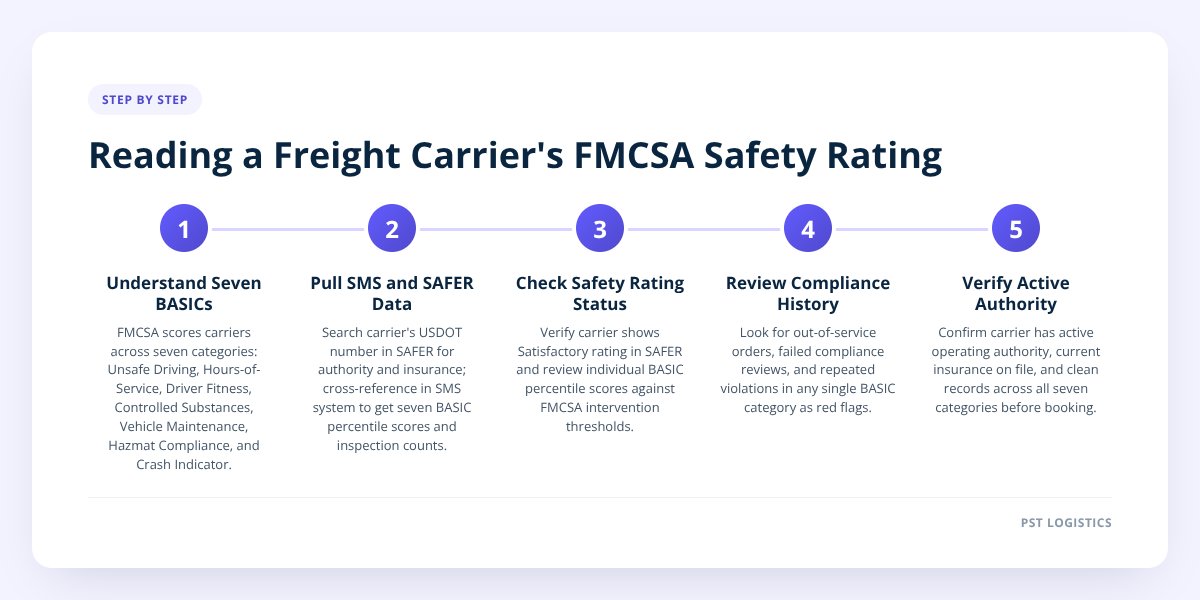
Step 1: Understand What the Seven BASIC Categories Actually Measure
The FMCSA's Safety Measurement System scores motor carriers across seven Behavior Analysis and Safety Improvement Categories, known as BASICs. Each one tracks a different type of risk, and each one matters differently depending on what you're shipping.
- Unsafe Driving — speeding, reckless driving, improper lane changes, and similar violations found during roadside inspections.
- Hours-of-Service (HOS) Compliance — violations of federal drive-time and rest-break rules, a strong predictor of fatigue-related incidents. We covered the underlying rules in detail in How FMCSA Hours-of-Service Rules Affect Freight Delivery.
- Driver Fitness — whether drivers hold valid, properly endorsed commercial licenses and meet medical certification requirements.
- Controlled Substances/Alcohol — violations related to drug and alcohol testing and use.
- Vehicle Maintenance — brake, tire, lighting, and other equipment defects found during inspections.
- Hazardous Materials (HM) Compliance — violations tied to the packaging, marking, and handling of hazmat loads. This one only applies to carriers that haul hazmat freight.
- Crash Indicator — a carrier's history of being involved in crashes, based on state-reported data.
Each category produces a percentile score, not a raw number. A carrier at the 80th percentile for Vehicle Maintenance has worse maintenance violation rates than 80% of carriers in its peer group, based on vehicle miles traveled or number of inspections. Higher percentile means worse performance — that trips people up the first time they look at a profile.
For a shipper moving dry van freight, Vehicle Maintenance and Unsafe Driving tell you the most about whether your freight will arrive on time and undamaged. For temperature-controlled loads, those same two categories matter even more, since a breakdown on a reefer unit can mean a spoiled load, not just a late one.
Step 2: Pull the Carrier's SMS Profile and SAFER Record
Start with two free, public FMCSA tools: the SAFER System (ask.fmcsa.dot.gov) for basic company data, and the Safety Measurement System website for the detailed BASIC scores. Both are run directly by the FMCSA and don't require an account.
Here's what to do with each:
- Search the carrier's USDOT number or legal name in SAFER to confirm active operating authority, insurance on file, and total power units and drivers.
- Check the "Safety Rating" field in SAFER — it will read Satisfactory, Conditional, Unsatisfactory, or Unrated.
- Cross-reference the USDOT number in the SMS system to pull the seven BASIC percentile scores.
- Note the date each score was last updated — SMS data refreshes monthly and reflects a rolling 24-month window.
- Check the number of inspections behind each score. A score built on three inspections carries far less statistical weight than one built on 300.
Don't skip this: A carrier can show "Satisfactory" in SAFER's main safety rating field while still carrying an elevated percentile score in one or more BASIC categories. The overall rating and the individual BASIC scores answer different questions — check both.
Unrated doesn't mean unsafe. It usually means the FMCSA hasn't performed a full compliance review on that carrier, which is common for newer or smaller fleets. In that case, lean more heavily on the BASIC percentile scores, inspection counts, and the carrier's own documentation.
Step 3: Know What Counts as a Red Flag in Audit History
A red flag isn't a single late delivery or one minor inspection note — it's a pattern that shows up in the carrier's compliance review and inspection history. The FMCSA publishes three things worth checking beyond the BASIC scores: compliance reviews, out-of-service orders, and inspection violation trends.
- Out-of-service orders — when an inspector pulls a vehicle or driver off the road on the spot because of an immediate safety defect. A high out-of-service rate compared to the national average (published annually by the FMCSA) signals systemic maintenance or compliance gaps, not a one-off.
- Failed compliance reviews — a full audit that results in a Conditional or Unsatisfactory rating means FMCSA investigators found the carrier's safety management systems inadequate, not just a bad week of inspections.
- Repeated violations in one BASIC category — one HOS violation is a mistake; a pattern of them across multiple inspections points to a scheduling or dispatch problem that will eventually hit your freight.
- A rating downgrade — if SAFER shows a Conditional rating after a previously Satisfactory one, something changed in the carrier's operation. Ask about it directly.
- A recent spike in crash involvement — even if the overall Crash Indicator percentile looks moderate, a sudden jump in the last few months of data is worth a direct question.
None of these automatically disqualify a carrier — but they're exactly the kind of thing worth asking about before you sign a rate confirmation, not after a load goes sideways. We laid out a broader pre-booking checklist in What to Check Before Booking a Freight Carrier.
Step 4: Compare Two Carriers' Profiles Side-by-Side
When you're choosing between two carriers for the same lane, line up their SMS percentile scores, inspection counts, and safety rating status in one view rather than reading two separate reports. The comparison only means something if you weigh score differences against sample size and category relevance.
| Factor | Carrier A | Carrier B | What it tells you |
|---|---|---|---|
| Safety rating (SAFER) | Satisfactory | Unrated | A completed, no the absence of a rating isn't a negative mark on its own |
| Unsafe Driving percentile | 42nd | 68th | Carrier A has a stronger violation record relative to peers |
| Vehicle Maintenance percentile | 35th | 71st | Carrier B's equipment issues are a real concern for on-time delivery |
| Number of inspections (24 mo.) | 310 | 18 | Carrier A's scores are statistically far more reliable |
| Active insurance on file | Yes | Yes | Both meet the baseline requirement |
| Out-of-service rate vs. national average | Below | Above | Carrier B is pulling more vehicles/drivers off the road per inspection |
A carrier with 18 inspections and a high percentile score isn't necessarily worse than one with 300 inspections — the sample is just too small to draw a firm conclusion. Weight the score by how many inspections sit behind it, and treat a single bad inspection in a small sample very differently from the same violation buried in hundreds of clean ones.
Step 5: Ask the Carrier These Questions Before You Book
Documents only tell you half the story — the other half comes from how a carrier answers direct questions about their own record. A carrier confident in its operation will answer these without hesitation.
- Ask for their USDOT number and MC number up front, so you can verify everything independently rather than relying on a screenshot.
- Ask whether any BASIC category has crossed the FMCSA intervention threshold in the past 12 months, and if so, what changed in their operation afterward.
- Ask for a current certificate of insurance — a carrier that sends one the same day you request it is signaling an organized back-office operation, not just good paperwork.
- Ask who performs their vehicle maintenance and how often — in-house preventive maintenance with scheduled DOT inspections is a stronger signal than reactive repairs.
- Ask whether their hours-of-service are tracked through ELDs on every unit, not just a subset of the fleet.
- Ask directly about any rating downgrade or compliance review finding, and request a plain explanation of what corrective action followed.
A carrier that answers these questions with specifics — not vague reassurance — is one worth trusting with a repeat lane.
At PST Global, we keep this simple for shippers who want to check our record rather than take our word for it: active authority, insurance on file, CSA basics all clear, and a Satisfactory safety rating, all documented on our compliance page. We run dry van and temperature-controlled truckload freight out of Naperville, Illinois, across all 48 states, with ELD-monitored hours of service on every unit and in-house preventive maintenance so equipment failures don't become your problem. If you're planning a lane and want to see the numbers yourself before you commit, start with our compliance record or request a rate directly from dispatch.
Checklist: Vetting a Carrier's FMCSA Safety Record
- Look up the carrier's USDOT number in FMCSA's SAFER system to confirm active authority and insurance.
- Pull the carrier's SMS profile and note all seven BASIC percentile scores.
- Check how many inspections back each score — treat scores under roughly 20 inspections with caution.
- Compare each BASIC score against the FMCSA's published intervention threshold for that category.
- Review the carrier's out-of-service rate against the national average for their vehicle class.
- Ask the carrier directly about any Conditional or Unsatisfactory rating in their history.
- Request a current certificate of insurance and confirm the policy is active, not expired.
- Confirm hours-of-service are tracked through ELDs across the full fleet, not a partial rollout.