How to Avoid Detention Fees on Interstate Freight Runs

Quick answer: Detention charges start once a truck sits at a dock past the free time written into the rate agreement — typically after the first one to two hours — and they add up fast on multi-stop or cross-country runs. The fix is mostly procedural: firm appointment times, dock-ready freight before the truck arrives, status updates 24–48 hours out, and detention language locked into the rate confirmation before the load ever moves. Shippers who do these four things consistently see detention charges drop to a rare exception instead of a monthly line item.
Key takeaways
- Most carriers' free time runs 1–2 hours per stop before detention accrues, often billed in 30- or 60-minute increments after that.
- Multi-stop runs on corridors like Midwest-to-Southeast or I-80 westbound compound the risk — one late stop can trigger detention at every stop behind it.
- Detention rates and free-time terms should be written into the rate confirmation before the load is booked, not negotiated after the invoice arrives.
- A dispatcher who gets a heads-up 24–48 hours before pickup or delivery can usually resolve a scheduling conflict before it turns into a billed delay.
!Avoid Interstate Freight Detention Fees
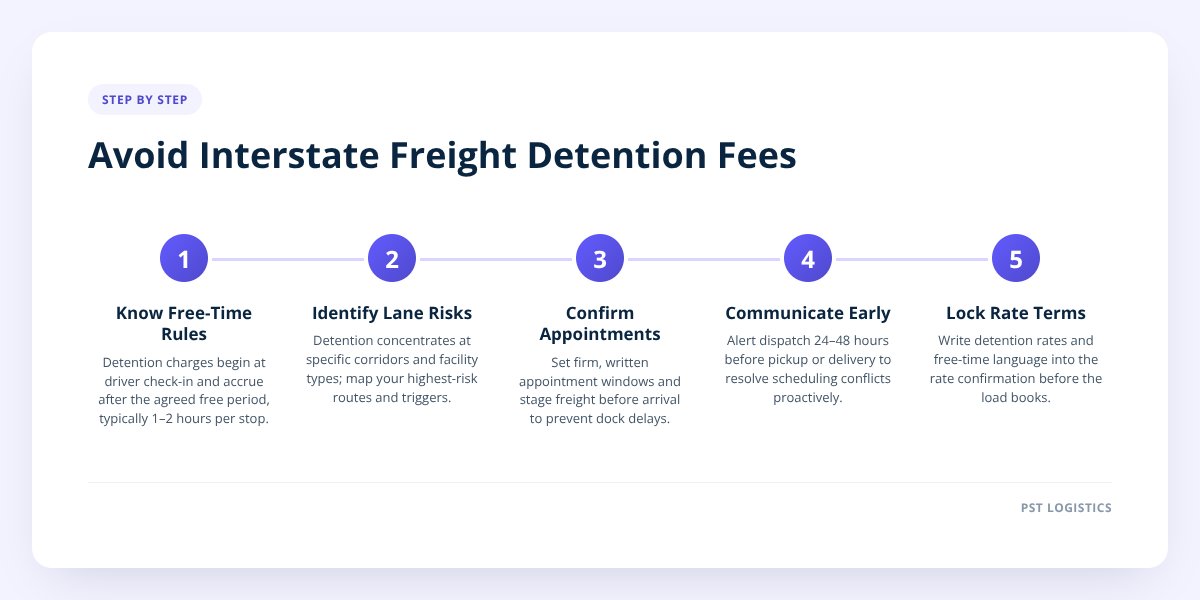
Step 1: Know exactly when the clock starts
Detention time begins when the driver arrives at the facility and checks in — not when the truck is actually loaded or unloaded. That distinction matters because a driver who arrives on time but waits in a receiving line for 90 minutes is still racking up time against the free-time allowance, even though nothing was "late" on paper.
Detention refers to charges billed when a truck is held at a shipper or receiver's facility longer than the agreed free time. Demurrage is a related but distinct term — it originally applied to ocean freight and rail, where it covers extra days a container or railcar sits before pickup, but shippers sometimes use it loosely to describe extended hold time at a warehouse or intermodal yard. On most interstate truckload moves, "detention" is the term that actually applies to your invoice.
Free time is set in the rate agreement, and it typically runs one to two hours per stop before a per-hour or per-30-minute detention rate kicks in. A few things to check on any load:
- Confirm whether free time is measured from arrival or from the scheduled appointment time — those are not always the same thing.
- Check whether detention is billed in 15-, 30-, or 60-minute increments after the free period ends.
- Ask whether detention resets at each stop on a multi-stop route or accrues cumulatively across the whole run.
- Verify who is responsible for signing the driver's time log at the dock — unsigned logs are the most common reason a detention claim gets disputed.
We covered the mechanics of this in more detail in Avoid Detention and Demurrage Fees in Freight Shipping, including how carriers typically structure the billing increments.
Step 2: Identify where your specific lanes create risk
Detention risk isn't evenly spread across a network — it concentrates at specific facility types and specific corridors. On Midwest-to-Southeast runs, the most common trigger is a receiving dock in Atlanta or another Southeast distribution hub that's running behind schedule because of its own inbound volume, leaving an on-time truck waiting in a queue it didn't create.
On I-80 westbound lanes, the pattern is different: long day-drive segments mean a driver often arrives at a delivery window with very little slack left in their hours-of-service clock, so even a short dock delay can force a decision between waiting for the next available slot or running up against FMCSA drive-time limits. That interaction between detention and hours-of-service is worth understanding on its own — see How FMCSA Hours-of-Service Rules Affect Freight Delivery for how the two rules intersect.
Multi-stop routes carry a compounding risk that single-stop loads don't: a 45-minute delay at stop one can push every appointment behind it, and if each of those receivers also has tight dock windows, detention can accrue at two or three stops on the same run from a single upstream delay.
| Route pattern | Most common detention trigger | Who typically controls the fix |
|---|---|---|
| Midwest to Southeast | Receiver dock congestion at destination | Receiver scheduling / shipper coordination |
| I-80 westbound | Dock delay colliding with driver's remaining hours | Carrier dispatch + shipper appointment accuracy |
| Texas triangle, short-haul | Live load with freight not staged in time | Shipper's dock crew |
| Multi-stop regional | One late stop delaying all downstream stops | Shipper's route sequencing |
Step 3: Lock in appointment practices that prevent overages
The single biggest lever a shipper controls is appointment accuracy — a firm, confirmed window that both the dock and the driver are actually working toward. Loose scheduling, like "anytime Tuesday" or windows that get reshuffled the morning of pickup, is where most avoidable detention originates.
Practices worth building into your scheduling process:
- Set firm appointment windows, not open-ended pickup or delivery days, and confirm them in writing with both the facility and the carrier.
- Stage freight and paperwork before the truck arrives — a live load with pallets still being built when the driver checks in is one of the most common causes of billed detention.
- Use drop-and-hook where the facility supports it, since it removes dock wait time from the equation entirely. We go deeper on this specific setup in How to Avoid Detention Fees on Drop-and-Hook Loads.
- Build in buffer between back-to-back appointments on multi-stop runs so one delay doesn't cascade through the rest of the route.
- Track actual dock performance by facility over time — if one receiver consistently runs 45 minutes behind its own appointments, that's a pattern worth raising with them directly, not something to keep absorbing as a cost of doing business.
Don't skip this: if a facility's own congestion is the real cause of recurring detention, fix the appointment process with that facility before you fix the rate language — a better detention rate doesn't solve a dock that's structurally behind schedule.
Step 4: Communicate with your carrier 24–48 hours out
A short call or message to dispatch 24 to 48 hours before pickup or delivery is the cheapest insurance against detention charges that exists. It gives the carrier time to flag a driver's hours-of-service position, confirm the appointment is still accurate, and raise any changes before a truck is already rolling toward a dock that isn't ready.
What that communication should cover:
- Confirm the appointment window is still accurate and hasn't shifted since booking.
- Flag any known delays at the facility — if receiving told you they're backed up, tell the carrier before the truck leaves, not after it arrives.
- Verify dock door assignment and any facility-specific check-in requirements (badge, appointment number, specific entrance).
- For reefer loads, confirm the setpoint and whether the dock requires the trailer pre-cooled before the door opens.
- Give a direct contact who can answer the phone if the driver hits a problem at the gate.
This is exactly the kind of exchange a carrier with 24/7 dispatch is built to handle — a dispatcher who already knows the lane and the load can resolve a scheduling conflict in a five-minute call instead of letting the driver sit at the dock while someone tracks down an answer.
Step 5: Put detention terms in writing before the load books
Detention disputes almost always trace back to one thing: the rate confirmation didn't spell out the terms clearly enough to settle the question when it came up. Negotiate this before the truck is dispatched, not after the invoice arrives.
Specific terms worth nailing down in every rate agreement:
- Free time per stop — get the exact number of hours in writing, and confirm whether it starts at the scheduled appointment or at actual arrival.
- Detention rate — the per-hour or per-increment dollar amount once free time expires.
- Multi-stop handling — whether free time and detention reset at each stop or accumulate across the whole route.
- Documentation requirements — what counts as proof of detention (signed BOL timestamps, driver logs, dock receipts) so a claim isn't disputable after the fact.
- Caps or thresholds — some shippers negotiate a maximum detention charge per load regardless of how long the delay runs.
Shippers who run the same lanes repeatedly have more leverage here than one-off spot shippers, which is part of why a dedicated freight service agreement often includes cleaner detention language than a spot-market booking — the terms get set once and apply to every run instead of being renegotiated load by load.
What to Do Next
Detention is largely a scheduling and communication problem, not a rate problem — the cheapest fix is almost always tightening up appointment accuracy and giving dispatch enough lead time to work the load, not arguing over the invoice after the truck has already left the dock. PST Global runs dry van and temperature-controlled truckload freight across all 48 states with a single driver from pickup to delivery, no cross-docking or transloading, and a dispatcher who answers 24/7 to work through appointment issues before they become detention charges. If you're planning a run through the Midwest-to-Southeast corridor, the Texas triangle, or I-80 westbound, request a rate on your lane and talk through the appointment and detention terms up front.
Checklist: Preventing detention charges on an interstate run
- Confirm free-time hours and whether they start at arrival or scheduled appointment time.
- Get the detention rate and billing increment written into the rate confirmation.
- Stage freight and paperwork before the truck is due at the dock.
- Set firm appointment windows instead of open pickup or delivery days.
- Build buffer time into multi-stop routes so one delay doesn't cascade downstream.
- Contact your carrier 24–48 hours before pickup or delivery to confirm the appointment still holds.
- Flag any known facility delays to dispatch before the truck leaves for the dock.
- Require signed BOL timestamps or driver logs as proof if detention time does occur.
- Review dock performance by facility periodically to catch recurring bottlenecks early.