How to Load a Dry Van Truckload for Maximum Stability

Quick answer: A stable dry van load keeps roughly 60% of its weight forward of the trailer's center and distributes weight evenly side to side, with pallets blocked, braced, and strapped so nothing shifts more than an inch during transit. Skipping this invites axle weight violations, cargo claims, and rejected deliveries. The steps below walk through planning the load before it's built, securing it correctly, and knowing what a carrier will check before the trailer doors close.
Key takeaways
- Federal Bridge Formula rules cap steer, drive, and trailer axle weights regardless of total payload, so a legal 45,000-lb load can still be illegal if it's loaded wrong, according to the Federal Motor Carrier Safety Administration.
- Freight should generally sit 55-60% forward of the trailer's midpoint to keep enough weight on the drive axles without overloading the steer axle.
- A standard 53-foot dry van holds up to 26 standard pallets, and every pallet needs blocking, bracing, or strapping — empty floor space is where shifting starts.
- Carriers inspect load distribution, securement, and seal integrity at pickup; a load that fails that check can be rejected before it ever leaves the dock.
!Loading a Dry Van for Maximum Stability
Why Weight Distribution Matters Before You Even Start Loading
Weight distribution isn't about keeping boxes from toppling — it's about keeping the truck legal and controllable. The Federal Bridge Formula, enforced by the Federal Motor Carrier Safety Administration, sets maximum weights for each axle group based on the distance between axles, independent of the truck's total gross weight. A driver can be well under the 80,000-lb federal gross limit and still get flagged at a weigh station because too much freight sits over the rear axles.
Uneven distribution also changes how the truck handles. A nose-heavy or tail-heavy trailer affects braking distance, trailer sway, and how the truck responds in a hard stop. Side-to-side imbalance is worse on curves and highway ramps, where an off-center load raises rollover risk.
This matters for the shipper, not just the carrier. If a load arrives out of axle compliance, the driver may have to stop and get the freight reworked, which eats into transit time and can trigger detention charges back to the shipper. We covered the mechanics of this in more detail in Pallet Counts and Weight Distribution for Truckloads — worth a read if you're building load plans regularly.
Don't skip this: Even a fully legal total weight can produce an illegal axle weight if the load isn't positioned correctly front-to-back. Always plan distribution before loading, not after.
Step 1: Plan Front-to-Back Placement Before Anything Goes on the Truck
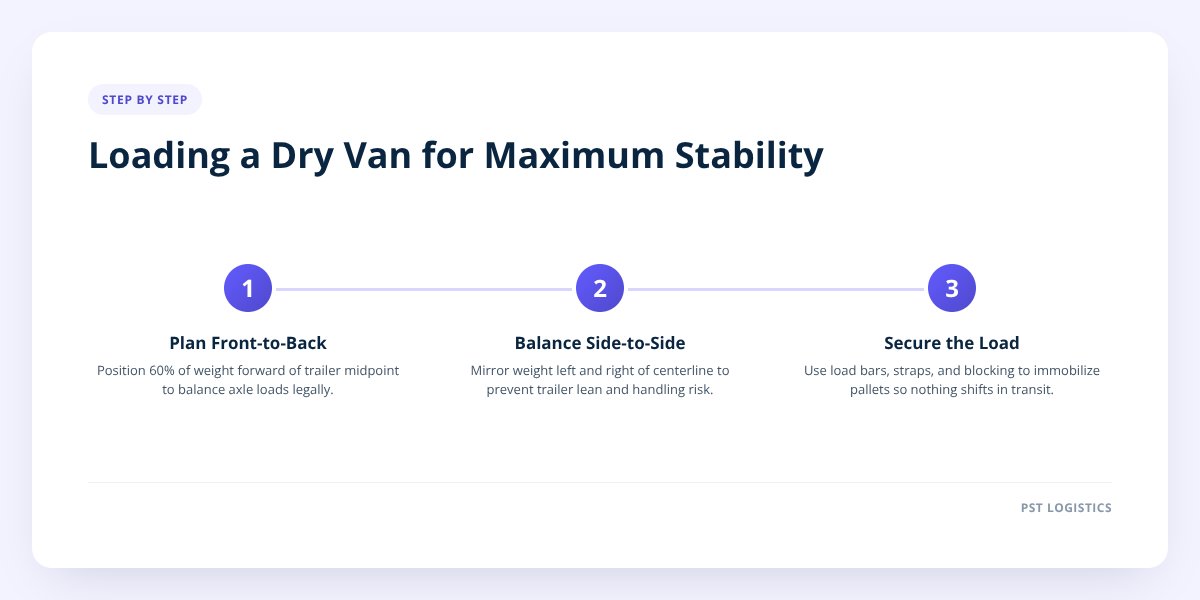
Decide where freight sits in the trailer before the forklift makes its first pass. For a standard 53-foot dry van, the general target is to keep around 60% of total weight forward of the trailer's midpoint, which keeps enough load on the drive axles without pushing the steer axle under its minimum or the trailer axle over its maximum.
Working through this step means:
- Identify your heaviest pallets first and assign them to the forward-to-middle section of the trailer.
- Reserve the last 8-10 feet near the rear doors for lighter freight, since too much weight back there pulls weight off the drive axles.
- Account for the tractor's position relative to the trailer — sliding the trailer tandems can help rebalance axle weight after loading if the plan shifts.
- Calculate estimated axle weights before dispatch if you have scale access, rather than finding out at the first public scale.
If you're running mixed-weight freight — some pallets at 2,200 lbs, others at 400 lbs — don't just load heaviest-to-lightest in sequence. Alternate placement so weight builds evenly rather than creating a sharp front-heavy or back-heavy section. A load that's 70% weight in the front third and empty in the back third is a common cause of steer-axle overload, even when the total weight is fine.
Step 2: Balance Side-to-Side Weight, Not Just Front-to-Back
Side-to-side imbalance causes trailer lean and uneven tire wear, and it's the piece shippers overlook most often. The fix is straightforward: stack pallets so weight is mirrored on the left and right sides of the centerline, not stacked heavier on one wall of the trailer.
This is especially easy to get wrong with floor-loaded freight or mixed pallet sizes, where it's tempting to push everything against one wall for loading convenience. A trailer that's 500 lbs heavier on the driver's side than the passenger's side won't trip a scale violation on its own, but combined with a curve, a crosswind, or a hard lane change, it adds real handling risk.
For palletized freight, keeping two columns down the trailer — one against each wall — with roughly matched weight in corresponding positions is the simplest way to stay balanced. We go step by step through building that pallet map in How to Plan and Load Pallets for Full Truckload Shipping.
Step 3: Secure the Load So Nothing Moves in Transit
Once placement is right, securement is what keeps it that way for 500 or 1,500 miles of highway driving. A dry van load should be immobilized enough that a hard brake at highway speed doesn't shift pallets more than an inch or two.
The standard securing toolkit includes:
- Load bars — adjustable metal bars wedged between trailer walls to pin pallets in place, used in rows to prevent forward or backward sliding.
- Straps — ratchet straps anchored to the trailer's E-track or logistics rails, run over or around pallets to hold them down and together.
- Blocking and bracing — wood blocks, airbags, or dunnage wedged into gaps between pallets or against trailer walls to eliminate empty space where freight could shift.
- Edge protectors — corner guards placed under straps where they cross pallet edges, preventing the strap from cutting into packaging or cardboard.
- Corner boards and stretch wrap — used on the pallet itself before it's loaded, keeping individual cartons from sliding off a pallet even if the pallet itself doesn't move.
Floor-loaded freight (cartons stacked directly on the trailer floor rather than on pallets) needs tighter blocking since there's no pallet structure holding individual units together. Stack floor-loaded freight in interlocking patterns rather than straight columns, and brace every open gap — a 6-inch void between stacks is enough room for freight to shift and damage itself over a few hundred miles.
For drop-and-hook loads, where the trailer sits pre-loaded and the driver simply hooks up and goes, the shipper is fully responsible for securement since there's no live oversight during loading. For live loads, where the driver waits at the dock, most drivers will do a visual check of blocking and bracing before signing the bill of lading — but the shipper's crew is still the one doing the physical securing work in almost all dry van operations.
Common Loading Mistakes That Cause Rejects, Damage, or Delay
The most frequent dry van loading errors aren't exotic — they're basic oversights that are easy to catch with a second look before the doors close.
| Mistake | What It Causes | Fix |
|---|---|---|
| All heavy pallets loaded at the nose | Steer axle underweight or trailer axle overweight | Distribute heavy freight across the forward 60%, not just the front wall |
| Freight loaded against one trailer wall | Side-to-side lean, uneven tire wear | Mirror weight across both walls |
| No blocking between pallet rows | Shifting during braking or turns | Use load bars or airbags to eliminate gaps |
| Straps run without edge protectors | Torn packaging, product damage claims | Add corner guards at every strap-to-edge contact point |
| Mixed pallet heights stacked without bracing | Toppling, crushed lower cartons | Separate by height or brace taller stacks independently |
| Overloading rear axles to maximize cube space | Scale violations, forced reloads | Calculate axle weight distribution before the last pallets go on |
Any one of these can trigger a rejected load at pickup, a scale ticket on the road, or a damage claim at delivery. We've broken down the overweight-specific risks in Avoid Overweight Fines on Freight Runs, since axle fines and cargo damage often come from the same root cause — an uneven load plan.
What a Carrier Checks Before Accepting Your Load
A carrier's driver or safety team typically reviews four things before signing off on a load: axle weight distribution, securement, seal integrity (for sealed loads), and documentation match between the bill of lading and what's physically on the trailer. A load that fails any of these can be refused at pickup or flagged for rework, which delays the run before it starts.
At PST Logistics, every driver runs a single truck from pickup to delivery with no cross-docking or transloading in between, so the load that leaves your dock is the load that arrives — nothing gets re-handled or re-stacked at a terminal along the way. That matters for stability: a load secured correctly once stays secured, instead of being disturbed at a transfer point.
Checklist: What a Carrier Will Inspect Before Accepting Your Load
- Confirm total weight is under the trailer's rated payload — 45,000 lbs is standard for a 53-foot dry van.
- Verify heavy pallets sit forward of the trailer's midpoint, roughly 55-60% of total weight.
- Check that weight is balanced side to side, not stacked against one wall.
- Inspect blocking and bracing between every pallet row or floor-loaded stack.
- Confirm straps are tensioned and routed with edge protectors at pallet corners.
- Match the bill of lading piece count and weight against what's actually loaded.
- Verify the trailer seal number if running a sealed load, and record it before departure.
- Walk the load visually for leaning stacks, loose dunnage, or exposed pallet edges.
Getting this right before the truck leaves your dock is the difference between a clean, on-time delivery and a reload, a fine, or a damage claim. If you're planning a full truckload run and want a carrier that keeps the same driver and trailer on your freight from pickup to delivery, PST Logistics runs 53-foot air-ride dry vans across all 48 states from our Naperville base, with a dispatcher who answers the phone around the clock. Request a rate quote and tell us your lane and pallet count — we'll tell you what fits.
Checklist: Load a Dry Van for Maximum Stability
- Calculate total freight weight and confirm it's under 45,000 lbs for a 53-foot dry van.
- Map heavy pallets to the forward 55-60% of the trailer before loading begins.
- Assign mirrored pallet positions on the left and right sides to balance weight.
- Install load bars or airbags between pallet rows to eliminate shifting room.
- Strap each pallet or stack to the E-track with edge protectors at every corner.
- Brace floor-loaded cartons in interlocking patterns rather than straight columns.
- Cross-check the bill of lading against the physical load count before sealing.
- Record the trailer seal number if running a sealed load.
- Walk the finished load visually for leaning stacks or loose strapping before closing the doors.