How to Set Up a Dedicated Freight Service Agreement
Quick answer: A dedicated freight service agreement works by committing a set volume of loads on a defined lane to one carrier in exchange for guaranteed capacity and stable pricing. To set one up, confirm your volume justifies it (generally multiple loads per week on a repeating lane), vet the carrier's equipment and safety record, agree on a pricing model, and put pickup windows, detention terms, and communication expectations in writing before the first load moves.
Key takeaways
- Dedicated service typically makes financial sense at a minimum of 2–3 loads per week on the same lane; below that, spot-market or broker-sourced truckload shipping usually costs less.
- Pricing structures include a flat weekly or monthly minimum, a per-load rate, or a mileage rate with a fuel component — each shifts risk differently between shipper and carrier.
- An asset-based carrier running the same truck and driver from pickup to delivery avoids the handoffs that happen with cross-docking or transloading, which matters for appointment-sensitive freight.
- The written agreement should specify detention thresholds, free time, communication windows, and what happens if either side misses a committed load — verbal understandings break down under volume.
!Set Up a Dedicated Freight Agreement
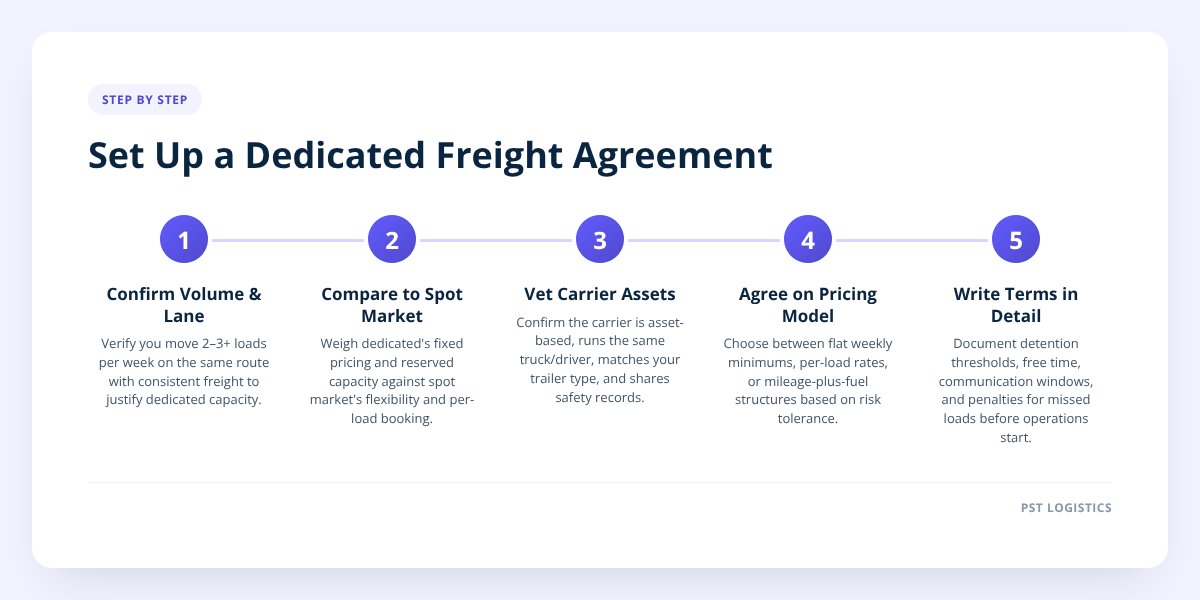
Step 1: Confirm Your Volume and Lane Pattern Actually Support It
Dedicated service pays off when you have enough freight, on a repeating enough lane, to keep a truck and driver productive without long gaps. If a carrier commits a truck to your lane and you only fill it two weeks out of the month, that truck sits idle or the carrier has to backfill with spot freight — and your rate will reflect that uncertainty.
Before you call a carrier, pull your own shipping data and look at three things:
- Frequency. Are you moving loads on the same origin-destination pair at least two to three times a week, on a consistent schedule?
- Consistency. Does the freight look similar load to load — same trailer type, similar weight, similar pallet count — or does it swing wildly?
- Predictability. Can you forecast volume two to four weeks out, or does it depend on orders that come in last minute?
A shipper running pallets from Naperville to Southeast distribution centers three or four times a week, every week, is a strong candidate. A shipper moving one truckload a month to the same place is better served by booking spot-market full truckload capacity as needed — we walked through how to plan that kind of single run in Planning a Naperville-to-Southeast Full Truckload Run.
If your volume is borderline, consider a hybrid approach: commit the carrier to a smaller guaranteed number of loads per week (say, two) and move the overflow through the spot market. That gives you a capacity floor without overcommitting on freight you can't guarantee.
Step 2: Compare Dedicated Service to Spot-Market Booking
Dedicated freight service means a carrier commits specific equipment and drivers to your lane on a recurring schedule, in exchange for a negotiated rate and a volume commitment from you. Spot-market full truckload shipping means you book each load individually, at the rate available that day, with no ongoing commitment on either side.
The practical differences show up in four places:
| Factor | Dedicated Service | Spot-Market FTL |
|---|---|---|
| Capacity | Reserved truck(s) for your lane | Subject to market availability each time |
| Pricing | Negotiated rate, often fixed for a term | Fluctuates with market conditions |
| Driver/equipment | Often the same driver and trailer repeatedly | Varies load to load |
| Commitment | Both sides commit to a minimum volume | No ongoing obligation either way |
Spot-market booking gives you flexibility with no long-term commitment, which suits shippers with irregular volume. Dedicated service trades that flexibility for predictability — you know your rate and your truck is coming, which matters most when a missed pickup would blow up a retail appointment or a production schedule downstream.
Step 3: Vet the Carrier's Equipment and Operating Model Before You Negotiate
Ask these questions before you discuss pricing, because the answers determine whether the carrier can actually deliver on a dedicated commitment:
- Is this carrier asset-based, or will my freight move through a broker to someone else? An asset-based carrier owns or leases the trucks and employs or contracts the drivers directly, which means fewer parties between you and your freight.
- Will the same truck and driver run my lane, or does freight get cross-docked or transloaded along the way? Transloading introduces handling points — and handling points introduce delay and damage risk.
- What trailer types do they run, and do those match my freight? A shipper moving palletized dry goods needs a 53' dry van; a shipper moving dairy or produce needs a reefer with a documented temperature range.
- What's their on-time delivery track record, and will they share it? Ask for a number, not a general assurance.
- What's their safety rating and insurance coverage? Confirm active operating authority, a current certificate of insurance, and their FMCSA safety rating before you sign anything — we cover this vetting process in more depth in What to Check Before Booking a Freight Carrier.
- How is dispatch structured? A small fleet with dispatchers who know individual drivers and lanes responds differently than a large network routing your load through a call center.
PST Global, an asset-based dry van and temperature-controlled carrier based in Naperville, Illinois, runs the same truck and driver from pickup to delivery on every load — no cross-docking, no transloading. The fleet stays narrow on purpose: dry van and reefer only, nothing else, which keeps equipment and drivers specialized rather than spread thin.
Don't skip this: confirm the carrier's safety rating, active authority, and insurance certificate before you commit volume to them — a dedicated agreement locks you into that carrier's reliability for months, not just for one load.
Step 4: Choose a Pricing Model and Know What You're Trading
Dedicated freight pricing generally takes one of three shapes, and each shifts risk differently between you and the carrier.
- Monthly minimum. You guarantee a minimum number of loads (or minimum revenue) per month at an agreed rate. If you fall short, you may owe a shortfall fee; if you exceed it, extra loads may be billed at the same or a tiered rate. This gives the carrier revenue certainty and gives you rate certainty.
- Per-load flat rate. Each load is billed at a fixed rate regardless of small variations in weight or exact mileage, as long as it stays within the agreed lane and parameters. Simple to administer, but less precise if your loads vary significantly in distance.
- Mileage rate. You pay per mile, sometimes with a separate fuel component layered on top. This ties cost directly to the actual run but requires more invoice-checking on your end.
When comparing quotes across these models, convert everything to a per-load or per-mile equivalent so you're comparing apples to apples. A $2,400 flat rate and a $2.10-per-mile rate on a 1,150-mile lane land in roughly the same place — the difference shows up when distance or stops vary. We broke down the cost drivers behind these rates in more detail in What Drives Full Truckload Shipping Costs.
Ask every carrier quoting a dedicated lane the same question: what's included, and what's billed separately? Detention, multi-stop fees, and appointment-scheduling fees often live outside the base rate — get those itemized before you compare numbers side by side.
Step 5: Put Expectations in Writing — Pickup Windows, Detention, and Communication
A dedicated agreement is only as good as the operational details written into it. The rate matters, but the clauses that govern what happens when something goes sideways are what actually protect the relationship over months of repeated loads.
Cover these points explicitly in the agreement:
- On-time pickup and delivery windows. Define the appointment window the carrier is expected to hit, and what counts as "on time" — arriving within the window, or arriving and being loaded within it.
- Detention time and fees. Specify free time (commonly two hours is a starting point to negotiate, though terms vary by carrier) before detention charges begin, and the hourly rate after that.
- Load volume commitments and shortfall terms. State what happens if you don't hit your committed volume in a given week or month, and what happens if the carrier can't cover a committed load.
- Communication protocol. Name who contacts whom, how often, and through what channel if a load is running late, a truck breaks down, or a pickup needs to shift. A 24/7 dispatch line that actually answers the phone — rather than routing to voicemail — matters more here than almost any other clause, because dedicated freight problems tend to surface outside business hours.
- Equipment specifications. Confirm trailer type, age, and any special requirements (air-ride suspension, temperature range for reefer loads, food-grade trailer certification) in writing, not as a verbal assumption.
- Hours-of-service realities. Build pickup and delivery windows around what a single driver can legally run in a day — a dedicated lane that ignores FMCSA hours-of-service limits will fail appointments regularly. See How FMCSA Hours-of-Service Rules Affect Freight Delivery for how those limits shape realistic scheduling.
- Term length and renewal. Set an initial term (three to six months is common for a first dedicated agreement) with a review point before automatic renewal, so either side can adjust if volume or service doesn't match expectations.
Review the agreement after the first full month of actual loads, not just at signing. Volume patterns and detention issues that looked fine on paper often show up differently once real freight starts moving.
What to Do Next
Pull your last two to three months of shipping data on the lane you're considering, and confirm it hits a frequency that justifies dedicated commitment before you start carrier conversations. Then request quotes from carriers that run the equipment your freight actually needs — dry van or temperature-controlled — and ask each one the vetting questions above before comparing price.
PST Global runs dedicated dry van and reefer freight on the Midwest-to-Southeast corridor, the Texas triangle, and I-80 westbound, with the same truck and driver on every run and a dispatcher who answers the phone around the clock. If you're ready to discuss a dedicated lane, request a rate quote and talk through your volume and schedule directly with dispatch.
Checklist: Setting Up a Dedicated Freight Agreement
- Pull 2–3 months of shipping history to confirm your lane hits a consistent weekly frequency.
- Decide whether full dedicated commitment or a hybrid (guaranteed minimum plus spot overflow) fits your volume.
- Request proof of active operating authority, insurance certificate, and safety rating from each carrier you consider.
- Confirm whether the carrier is asset-based and whether your freight stays on one truck with one driver start to finish.
- Match trailer type and specs — dry van or temperature-controlled with documented setpoint range — to your actual freight.
- Convert every quote (monthly minimum, flat rate, mileage rate) to a per-load equivalent before comparing.
- Write detention free-time and hourly charges into the agreement, not just the base rate.
- Define pickup/delivery windows and what counts as on-time before the first load moves.
- Name a communication protocol and after-hours contact for delays or equipment issues.
- Set an initial term length with a scheduled review point before renewal.