Pallet Counts and Weight Distribution for Truckloads

Quick answer: A standard 53' dry van holds up to 26 standard pallets and 45,000 lbs of payload, but hitting both numbers at once depends on how weight is distributed across the trailer's axles, not just how many pallets fit inside. Plan pallet count by floor space first, then check axle weight against FMCSA's federal bridge formula before the truck leaves the dock — because a legally loaded trailer can still produce an illegal axle weight if freight is stacked unevenly.
Key takeaways
- A 53' dry van trailer from PST Logistics carries up to 26 standard pallets and a maximum payload of 45,000 lbs.
- Federal law caps gross vehicle weight at 80,000 lbs and steer axle weight at 12,000 lbs, with drive and trailer tandems limited to 34,000 lbs each under the federal bridge formula enforced by FMCSA.
- Weight shifted too far forward or back on the trailer — not just total load weight — is a leading cause of axle-weight violations at scale houses.
- Detention clocks often start the moment a driver checks in for a scheduled appointment, so a load plan that speeds up loading time directly reduces detention risk.
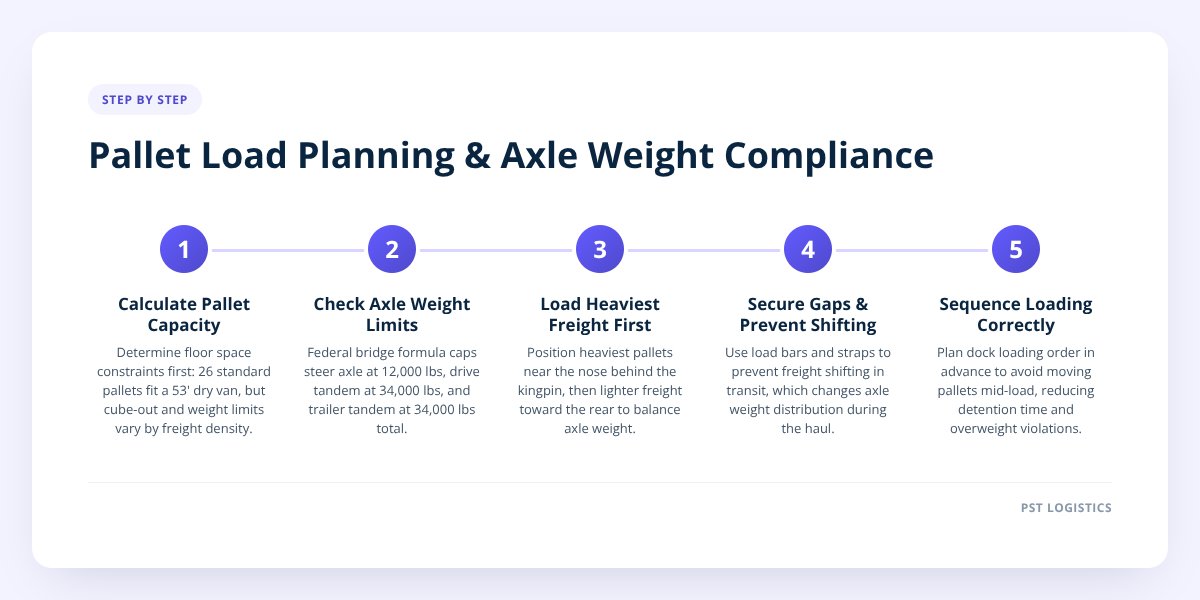
!Pallet Load Planning & Axle Weight Compliance
Step 1: Calculate Usable Pallet Capacity Before You Book
Start with floor space, not trailer length. A standard 53' dry van has roughly 420 inches of usable floor length and 100 inches of interior width, which is why 26 standard 48"x40" pallets loaded single-stacked is the common ceiling for floor-loaded freight.
Three things change that number:
- Pallet footprint. Standard 48"x40" pallets turned the efficient direction fit 26 to a trailer. Oversized or odd-shaped pallets reduce that count fast.
- Stacking height. Most dry vans offer about 110 inches of interior height. Stackable freight can double up and cut the pallet count on the floor while keeping total unit count the same.
- Commodity density. Light, bulky freight "cubes out" — fills the trailer — before it hits 45,000 lbs. Dense freight like canned goods or packaged beverages often hits the weight limit long before the floor is full.
Before you request a quote, know which constraint applies to your freight: cube or weight. A shipper moving 26 pallets of paper towels will cube out around 20,000 to 25,000 lbs. A shipper moving 20 pallets of bottled beverages may hit 45,000 lbs with floor space to spare. Knowing which one governs your load tells the carrier what kind of trailer utilization to expect and avoids a surprise at pickup.
Step 2: Understand the Axle Weight Limits That Actually Get Enforced
A truck can be under 45,000 lbs of payload and still get flagged at a scale house if weight sits unevenly over the axles. Under the federal bridge formula that FMCSA enforces, a fully loaded five-axle tractor-trailer combination is capped at 80,000 lbs gross vehicle weight, with individual axle groups limited separately:
| Axle group | Federal weight limit |
|---|---|
| Steer axle | 12,000 lbs |
| Drive axle tandem | 34,000 lbs |
| Trailer axle tandem | 34,000 lbs |
| Total gross vehicle weight | 80,000 lbs |
These numbers are federal baselines under FMCSA's bridge formula; some states set their own limits or bridge laws for specific roads, so confirm current limits for any state your route crosses.
Here's the part shippers miss: pallets loaded too far toward the nose or tail of the trailer shift weight onto one axle group and off another. A load can total 44,000 lbs — well under the 45,000 lb payload cap — and still put the trailer tandem over 34,000 lbs if the freight is bunched at the rear. That's an overweight citation on a load that was never actually too heavy, just loaded wrong. We cover the mechanics of this in more detail in Avoid Overweight Fines on Freight Runs.
Step 3: Build the Load From the Nose Back, Heaviest First
Distribute weight toward the front third of the trailer and work backward. As a general rule, placing the heaviest pallets closer to the nose (just behind the kingpin) and lighter freight toward the tail keeps weight on the drive tandem instead of overloading the trailer tandem.
- Heaviest pallets first, positioned just behind the nose of the trailer.
- Mixed-weight pallets next, spread evenly across the middle third.
- Lightest freight last, toward the rear doors.
- Never leave a gap between pallet rows — shifted freight in transit changes the axle weight distribution you planned for.
- Use load bars or straps on partial loads so freight can't slide during braking or turns.
Don't skip this: A load can be fully within the 45,000 lb payload limit and still fail a roadside inspection on axle weight alone. Always calculate axle distribution separately from total payload — they are two different checks, and both have to pass.
Step 4: Avoid the Loading Mistakes That Trigger Fines and Detention
Three mistakes account for most of the overweight violations and detention delays we see on dock visits.
Loading heavy freight last. When the last pallets loaded are the heaviest, they often end up stacked toward the rear doors for convenience, pushing weight onto the trailer tandem. Fix this by sequencing pallets at the dock in the order they need to load, not the order they arrive.
Mixing pallet sizes without a plan. A trailer loaded with a mix of 48"x40" and 48"x48" pallets without planning the layout in advance wastes floor space and can leave pallets improperly supported, which shifts weight in transit. Confirm pallet dimensions with the shipper before the truck arrives, not after.
Treating detention and loading speed as separate problems. They aren't. A load plan that requires the forklift operator to reposition pallets mid-load because the sequence wasn't thought through adds real minutes at the dock — and many carrier contracts start the detention clock a set number of minutes after the scheduled appointment time, regardless of why loading is slow. We go into how those clocks work in Avoid Detention and Demurrage Fees in Freight Shipping.
A fourth, less obvious mistake: assuming a drop-and-hook appointment removes the loading-sequence problem entirely. It doesn't — the trailer still has to be loaded correctly before it's dropped, and a driver who hooks to a trailer loaded off-axle inherits that violation risk the moment the truck moves. For shippers using drop trailers regularly, How to Avoid Detention Fees on Drop-and-Hook Loads covers the scheduling side of this in depth.
Step 5: Account for Route-Specific Weight Rules
Federal limits are the floor, not the whole picture — some states and specific roads impose their own weight rules on top of them. This matters most on two corridor types PST Logistics runs regularly: Midwest-to-Southeast freight and I-80 westbound lanes.
On Midwest-to-Southeast runs, drivers cross multiple state lines in a single day, and weight enforcement practices vary by state. A load legally distributed for Illinois roads should still meet the federal bridge formula everywhere, but shippers running frequent lanes into Georgia, Tennessee, or the Carolinas should confirm current state-specific weight rules with their carrier, since some states regulate bridge-sensitive routes differently. We laid out the lane-specific planning considerations for this corridor in Planning a Naperville-to-Southeast Full Truckload Run.
On I-80 westbound toward the coast, the concern is less about state-line variation and more about elevation and weigh station density — more scale houses along the route means more chances for an axle-weight problem to surface mid-run instead of at the destination. A load plan that passes a visual check at the dock in Naperville can still fail a scale check three states later if pallets shifted during a hard stop.
The practical takeaway: load planning isn't a one-time calculation done at pickup. It's a distribution that needs to hold for the entire route, across whatever roads and inspection points the lane crosses.
Pre-Load Checklist: What to Confirm Before You Book a Full Truckload
Run through this before the truck is dispatched, not after it's loaded.
- Confirm pallet count and dimensions match what the carrier's trailer can hold — standard 53' dry vans run up to 26 standard pallets.
- Confirm total payload weight against the 45,000 lb limit, not just trailer cube space.
- Request the carrier's load sequence plan if pallets vary in weight or size.
- Verify the loading dock has a forklift operator briefed on heaviest-pallets-forward sequencing.
- Ask whether the appointment is live load or drop-and-hook, since each changes who controls load sequencing.
- Confirm the carrier's trailer type matches your freight — standard dry van for palletized or floor-loaded general freight, reefer for anything temperature-sensitive.
- Check that straps or load bars are available for partial loads to prevent in-transit shifting.
- Get written confirmation of the detention policy and when the clock starts at your facility.
PST Logistics runs 53' air-ride dry vans built for exactly this kind of planning — same truck, same driver from pickup to delivery, with no cross-docking or transloading to introduce a second load plan mid-route. Our dispatchers answer the phone around the clock and can talk through pallet count, weight distribution, and lane-specific rules before the truck is booked, not after a scale house flags a problem.
If you're planning a full truckload run out of Naperville or anywhere along our Midwest-to-Southeast, Texas triangle, or I-80 westbound lanes, request a rate quote and get a dispatcher who'll talk through the load plan with you directly.
Checklist: Plan Pallet Counts and Weight Distribution for a Full Truckload
- Measure your pallet dimensions and confirm they match standard 48"x40" footprint.
- Calculate whether your freight will cube out or hit the weight limit first.
- Sequence pallets heaviest-to-lightest from the trailer nose to the rear doors.
- Verify total payload stays under 45,000 lbs for a standard dry van.
- Check axle weight distribution separately from total payload weight.
- Confirm any state-specific weight rules for every state your route crosses.
- Brief your dock crew on the load sequence before the truck arrives.
- Secure partial loads with straps or load bars to prevent shifting in transit.
- Ask your carrier for their detention policy and when the clock starts.