Avoid Overweight Fines on Freight Runs

Quick answer: Stay under 80,000 pounds gross vehicle weight on the federal baseline, but don't stop there — Tennessee, North Carolina, and several bridge-heavy stretches on the Midwest-to-Southeast corridor enforce tighter axle limits than the federal number suggests. Weigh your load before it leaves the dock, confirm axle distribution (not just total weight), and declare the actual weight to your carrier so they can plan the route and avoid known low-tolerance scales. Fines scale with how far over you are and which state writes the ticket, and repeat citations can draw scrutiny toward a carrier's safety rating.
Key takeaways
- The federal gross vehicle weight limit is 80,000 pounds under the Federal Bridge Formula, per the Federal Highway Administration, but individual states layer on tighter axle-spacing and bridge-weight rules that trucks must still follow.
- Tennessee and North Carolina are two states on the Midwest-to-Southeast route where shippers get caught off guard by axle weight limits even when total gross weight is legal.
- Overweight fines are typically calculated per pound or per thousand pounds over the limit, and the per-unit rate often increases the further over the load is.
- Certified CAT scales and truck stop scales let you verify weight before you ever hit a state weigh station, and it's far cheaper to fix a load at the dock than to eat a citation on the highway.
!Avoid Overweight Fines on Freight Runs
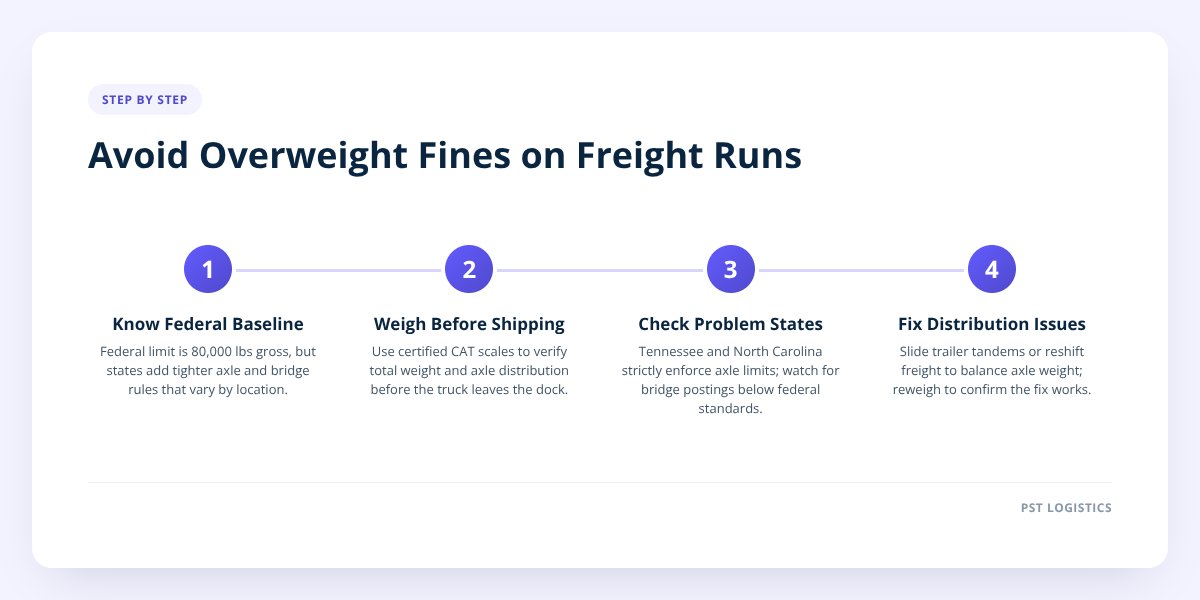
Step 1: Know the Federal Baseline, Then Learn Where States Deviate
The federal government sets the top-line number, but it does not control everything under it. The Federal Highway Administration's Federal Bridge Formula caps gross vehicle weight at 80,000 pounds, with single axles limited to 20,000 pounds and tandem axles limited to 34,000 pounds on the Interstate System. That formula also restricts how much weight can ride on any given axle group based on the distance between axles — so a truck can be under 80,000 pounds total and still violate the bridge formula if the weight isn't distributed correctly along the trailer.
That's the part shippers miss most often. A load can read "legal" on a total-weight basis and still draw a citation because too much weight sits on the drive axles or the trailer tandems. This matters more on multi-stop runs, where weight shifts after a partial delivery and the remaining freight isn't redistributed before the truck gets back on the highway.
States then add their own wrinkles:
- Bridge-specific postings — some older or weight-restricted bridges carry lower limits than the interstate standard, and GPS routing doesn't always flag them.
- Permit-based overweight allowances — certain states allow weights above 80,000 pounds with a permit, which doesn't help a standard truckload run but matters if you're moving something unusually dense.
- Seasonal or local restrictions — some states post reduced limits on secondary roads during specific conditions, separate from interstate rules.
None of this is exotic. It's just detail that a load planner has to check lane by lane, not assume is identical state to state.
Step 2: Weigh Before You Ship, Not After You're Stopped
Weigh the loaded trailer at a certified scale before it leaves for its first stop — this is the single most effective step in avoiding a citation. CAT scales, available at most major truck stops along Midwest-to-Southeast corridors, give a certified weight ticket that breaks the load down by steer axle, drive axle, and trailer axle group, not just gross weight. That breakdown is what actually matters at a state weigh station.
If the ticket shows an axle group over the limit, there are a few ways to fix it before it becomes a problem:
- Slide the trailer tandems forward or back to redistribute weight across the axle group — often the fastest fix on a dry van.
- Shift palletized freight toward the center or away from the heavy end, if the load configuration allows it.
- Reweigh after any adjustment. Don't guess; get a second certified ticket to confirm the fix worked.
- Call the carrier's dispatcher if the load can't be corrected on-site — sometimes the answer is rerouting around a known low-tolerance scale, not re-stacking a sealed trailer.
If a load is over on total gross weight rather than just axle distribution, the real fix is removing freight, not redistributing it. That's a conversation to have with the shipper or broker before the truck ever leaves the dock — not something to solve roadside. We covered load configuration in more depth in How to Plan and Load Pallets for Full Truckload Shipping, including how pallet placement affects axle weight on a 53-foot van.
Step 3: Check the States That Catch Shippers Off Guard
Tennessee and North Carolina are the two states on the Midwest-to-Southeast corridor most likely to cite a load that would pass without issue elsewhere. Both states enforce axle weight limits strictly at weigh stations, and both have stretches with older bridge infrastructure where posted limits run below the federal standard.
| State | What to watch for |
|---|---|
| Tennessee | Strict axle-group enforcement at weigh stations; bridge postings on some older spans below standard limits |
| North Carolina | Tight tandem-axle enforcement; several interstate bridges with reduced posted limits that don't match the 80,000-lb gross assumption |
| Michigan ("Wolverine" rules) | Permits higher gross weights on specific axle configurations under state law, which does not apply once the load crosses into neighboring states — a common source of confusion for carriers running mixed Midwest lanes |
| South Carolina (I-77 corridor) | Known for consistent weigh station enforcement on a heavily trafficked north-south route into the Southeast |
The Michigan entry above is worth sitting with for a second. Michigan allows configurations that run heavier than the standard federal limit under specific state axle rules — but that allowance is Michigan-specific. A truck loaded to a Michigan-legal weight that then crosses into Indiana, Ohio, or points south on a standard axle configuration can be overweight the moment it leaves Michigan's borders. This is one of the most common ways a Midwest-based shipment ends up with a citation hundreds of miles from where it was loaded.
Don't skip this: never assume a weight that's legal in the state where you loaded is legal in every state the truck will cross. Check axle limits state by state for the full route, not just the pickup state.
Step 4: Understand What a Citation Actually Costs
Overweight fines are generally calculated on a sliding scale, with the penalty per pound (or per thousand pounds) increasing as the load gets further over the limit — and the exact schedule varies by state, so a load 2,000 pounds over in one state can cost meaningfully more or less than the same overage in a neighboring state. Beyond the fine itself, a cited truck typically can't continue until the weight issue is resolved, which usually means finding a way to offload excess freight roadside or waiting for a corrected trailer — both of which blow past any delivery appointment window.
The costs that don't show up on the ticket matter just as much:
- Missed delivery appointments, which can trigger separate detention or rescheduling costs — something we break down in Avoid Detention and Demurrage Fees in Freight Shipping.
- Driver hours-of-service impact, since time spent resolving a citation still counts against the clock.
- Carrier safety record exposure. Repeated weight violations show up in a carrier's compliance history and can draw additional scrutiny during safety reviews — which is one more reason carriers that run their own equipment tend to be careful about this from the planning stage, not just at the scale.
For a shipper, the practical takeaway is that an overweight citation rarely costs just the fine. It costs the appointment, the detention clock, and sometimes the next load that truck was supposed to cover.
Step 5: Declare Actual Weight and Let Your Carrier Plan Around It
Give your carrier the real, total weight of the shipment before it's dispatched — not an estimate, not a rounded number. An asset-based carrier running its own equipment can check that weight against the planned route, flag any state with tighter axle rules or bridge postings along the way, and adjust the load plan before the truck ever gets near a scale.
This is where working directly with a carrier that owns its trucks makes a practical difference. At PST Logistics, loads run dry van and reefer with the same truck and same driver from pickup to delivery — no cross-docking, no transloading, and no handoffs where weight or load configuration can shift unnoticed between carriers. Dry van trailers are rated up to 45,000 pounds payload across 26 standard pallets, and dispatch plans routes with state-specific weight rules factored in from the start, not discovered at a weigh station.
A few things worth confirming with any carrier before the load moves:
- Confirm the carrier knows the full route, not just the origin and destination — state-by-state weight rules matter for every mile in between.
- Ask whether the quoted weight was based on an actual scale ticket or an estimate.
- Flag any multi-stop plan in advance, since weight distribution changes after each partial delivery.
- Confirm the trailer type and axle configuration match what the lane requires.
If you're still finalizing carrier details before booking, our post on What to Check Before Booking a Freight Carrier covers the broader list — active authority, insurance certificates, and safety rating — that belongs in that conversation alongside weight planning.
What to Do Next
Pull a certified weight ticket before the next load leaves the dock, check axle distribution against the states on the route, and have the actual total weight ready when you call your carrier. If you're shipping dry van or reefer freight on the Midwest-to-Southeast corridor and want a carrier that plans the route with state weight rules built in from the start, PST Logistics runs that lane with a single truck and driver from pickup to delivery. Request a rate quote and talk to dispatch about your lane before you book.
Checklist: Avoiding Overweight Fines on a Midwest-to-Southeast Run
- Get a certified scale ticket showing axle-by-axle weight, not just gross weight.
- Check state-specific axle and bridge-weight rules for every state on the route, not just the origin.
- Confirm Michigan-legal weight configurations are adjusted before the truck crosses into neighboring states.
- Slide trailer tandems or reposition pallets to fix axle imbalance, then reweigh to confirm.
- Declare actual total weight to your carrier before dispatch — never round down.
- Flag multi-stop routes in advance so weight gets rechecked after each partial delivery.
- Confirm your carrier's dispatcher has reviewed the route for known low-tolerance weigh stations.