Shipping Produce to the Southeast Without Losses

Quick answer: Protect a Midwest-to-Southeast produce load by locking a firm appointment window before pickup, confirming the reefer was pre-cooled to setpoint before loading starts, palletizing to leave airflow channels instead of floor-loading tight, and getting detention terms in writing before the truck is dispatched. Most spoilage and detention problems trace back to one of these four steps being skipped, not to the road itself.
Key takeaways
- A loaded trailer needs airflow gaps on all sides of the product, not just a tight wrap on the pallet — dead air pockets hold heat and accelerate spoilage faster than the road ever will.
- Reefer units need pre-cooling to setpoint before the doors open for loading; loading warm product into a warm trailer means the unit is chasing temperature for hours, not holding it.
- Most carriers' free time at a dock runs roughly two hours before detention charges start, so a shipper that doesn't confirm this number in writing has no leverage when a four-hour wait happens.
- Produce margins are thin enough that a single rejected load or a few hundred dollars in detention can wipe out the profit on the whole run — planning the load is cheaper than recovering from it.
!Shipping Midwest Produce Southeast Successfully
Why Illinois-to-Southeast produce loads carry more risk than other freight
Produce loads fail for reasons dry freight never has to deal with: a few degrees of temperature drift, a few hours of dock delay, or a pallet stacked wrong can turn a sellable load into a rejected one. The Midwest-to-Southeast corridor adds distance and climate variation on top of that — a load leaving a cool Illinois dock in October can hit warm, humid conditions well before it reaches Georgia or Florida.
That combination is why produce shippers can't treat this lane like a standard dry van run. A dry van shipment that sits an extra three hours at a receiving dock is an inconvenience. A reefer load of leafy greens sitting an extra three hours with the doors cracked for unloading is a quality claim waiting to happen.
The fix isn't more urgency on the road — it's tighter coordination before the truck ever leaves the dock. That means confirming appointment times, loading method, trailer readiness, and detention terms as a package, not as separate afterthoughts. The steps below walk through that process in the order it should actually happen.
Step 1: Lock appointment windows and loading method before pickup day
Confirm the exact appointment window and whether the load will be drop-and-hook or live load at least a day before pickup — not the morning of. A drop-and-hook setup, where a pre-loaded trailer is swapped for an empty one, keeps the truck moving and avoids tying up a driver's hours of service while product sits. A live load, where the driver waits while the trailer is loaded on site, only works smoothly when the shipper's dock crew is ready the moment the truck arrives.
Ask the receiving facility these questions before the load is booked:
- Confirm the appointment is a firm window, not a general "anytime that day" slot.
- Ask whether the dock requires a check-in call a set number of minutes before arrival.
- Clarify whether the load will be drop-and-hook or live, and whether that can change on short notice.
- Get the name and direct line of the dock contact, not just a general warehouse number.
- Confirm whether the facility has had recent delays on similar loads — ask the carrier if they know.
This single step prevents the most common failure point on this lane: a truck arriving on time to a dock that isn't ready, which starts the detention clock before the shipper even realizes there's a problem.
Step 2: Palletize to protect airflow, not just to maximize cube
Pack pallets to leave airflow channels around and between them — a trailer loaded for maximum cube with no gaps traps heat in the center of the load regardless of what the reefer unit is set to. Reefer trailers cool by circulating air around the product, not by refrigerating the box like a walk-in cooler. If pallets are floor-loaded wall-to-wall with no space for air to move, the center of the load can run several degrees warmer than the return-air sensor shows.
A few loading habits make the difference:
- Leave a consistent air gap between the last pallet row and the rear doors so return air can circulate.
- Avoid mixing product types with different optimal temperatures on the same trailer when possible.
- Keep pallets squared and stable — a leaning stack can block air chutes along the ceiling or floor.
- Don't exceed safe stacking height even if the trailer has room; crushed product at the bottom of a stack spoils faster and can block airflow from below.
We covered pallet planning for general truckload freight in more depth in How to Plan and Load Pallets for Full Truckload Shipping, and the same airflow principles apply even more strictly when the freight is perishable.
Step 3: Verify the reefer was pre-cooled and ask for the temperature log before booking
Ask the carrier to confirm the trailer was pre-cooled to setpoint before the doors opened for loading, and ask whether temperature is logged continuously or on a cycle-sentry basis for the whole run. Pre-cooling matters because a warm trailer loaded with cold product doesn't just lose a little efficiency — it forces the reefer unit to work against the mass of warm air already inside the box for hours before it ever reaches setpoint.
This is also the point to ask about documentation, not just equipment. A shipper should be able to request:
- A pre-trip confirmation that the trailer reached setpoint before loading began.
- Clarity on whether monitoring is continuous or cycle-sentry (which runs the unit only when needed to hold temperature).
- A temperature log covering the full run, from pickup to delivery, not just spot checks.
- Confirmation the trailer is food-grade with a documented washout history, especially if it previously hauled a different commodity.
At PST Global, every temperature-controlled load runs in 53-foot reefers pre-cooled before the door opens, with temperature logged end-to-end so the receiver has a record to point to if there's ever a dispute about condition on arrival. That record is often the difference between a disputed claim and a resolved one.
Step 4: Put detention terms in writing before the truck is dispatched
Detention is the fee a carrier charges when a truck is held at a shipper or receiver's dock beyond an agreed-upon free time, and it should be settled in the rate agreement before the load moves — not negotiated after the driver has already been sitting for four hours. Most carriers allow a window of free time, often around two hours, before detention charges begin accruing, but the exact number and rate vary by carrier and should always be confirmed directly.
Don't skip this: if detention terms aren't written into the rate confirmation before dispatch, the shipper has no agreed number to point to when a dock delay happens — and on produce loads, dock delays are also the moments most likely to cause temperature loss.
A few things worth negotiating into the agreement up front:
| Term | Why it matters for produce loads |
|---|---|
| Free time length | Shorter free time means detention starts sooner if the dock runs behind |
| Detention rate per hour | Should be agreed before the load, not estimated after |
| Live load vs. drop-and-hook | Drop-and-hook reduces driver wait time and HOS pressure |
| Reefer running during detention | Confirm the unit keeps running (and who absorbs that cost) while the truck waits |
| Notification timing | Agree on when the carrier must alert the shipper that detention has started |
We go deeper on how these fees work and how to push back on them in Avoid Detention and Demurrage Fees in Freight Shipping. For a Naperville-based produce shipper specifically, Planning a Naperville-to-Southeast Full Truckload Run walks through the lane-specific scheduling considerations in more detail.
What to do next for your next produce shipment
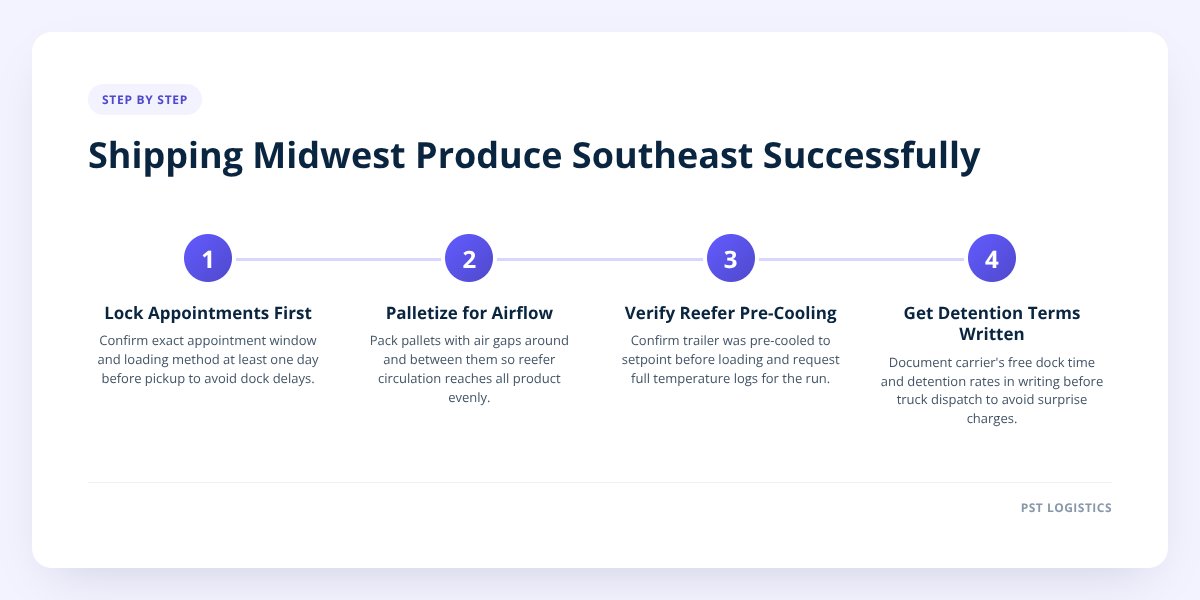
Run through appointment confirmation, pallet planning, reefer verification, and detention terms in that order — each step catches a different failure point, and skipping one doesn't just risk that step's problem, it removes your ability to prove what happened if a claim comes up later. Build this into a standing routine for every load rather than re-deciding it each time.
PST Global runs the Midwest-to-Southeast corridor as one of its core lanes, with the same single driver carrying the load from pickup to delivery — no cross-docking, no transloading, and no handoffs that introduce temperature risk along the way. Every reefer run includes pre-cooling before the doors open and a logged temperature record for the full trip, and dispatch answers the phone 24/7 if a dock delay turns into a detention question mid-route. Request a rate on your next lane and get the appointment, equipment, and detention terms settled before the truck is dispatched.
Checklist: Planning a produce shipment from Illinois to the Southeast
- Confirm the receiving dock's appointment window in writing at least a day before pickup.
- Clarify drop-and-hook versus live load status with both the shipper and carrier.
- Get the dock contact's direct line and confirmed check-in procedure.
- Pack pallets with air gaps on all sides — never floor-load wall-to-wall.
- Ask the carrier to confirm pre-cooling to setpoint before loading begins.
- Request the trailer's monitoring method (continuous or cycle-sentry) and washout history.
- Negotiate free time length and detention rate into the rate confirmation before dispatch.
- Agree on who's notified, and when, if the truck is held past free time.