How to Stop Temperature Excursions on Frozen Freight

Quick answer: A temperature excursion happens when frozen freight drifts out of its required range during transit, and it's preventable by booking a carrier that pre-cools the trailer before loading, logs temperature continuously, and runs the same driver and truck from pickup to delivery. The biggest risk points are a warm trailer at the dock, long dwell time at delivery, and multi-stop routes that open the doors repeatedly. Specify your setpoint, ask for logged proof, and confirm the carrier's equipment is rated for the lane length before you book.
Key takeaways
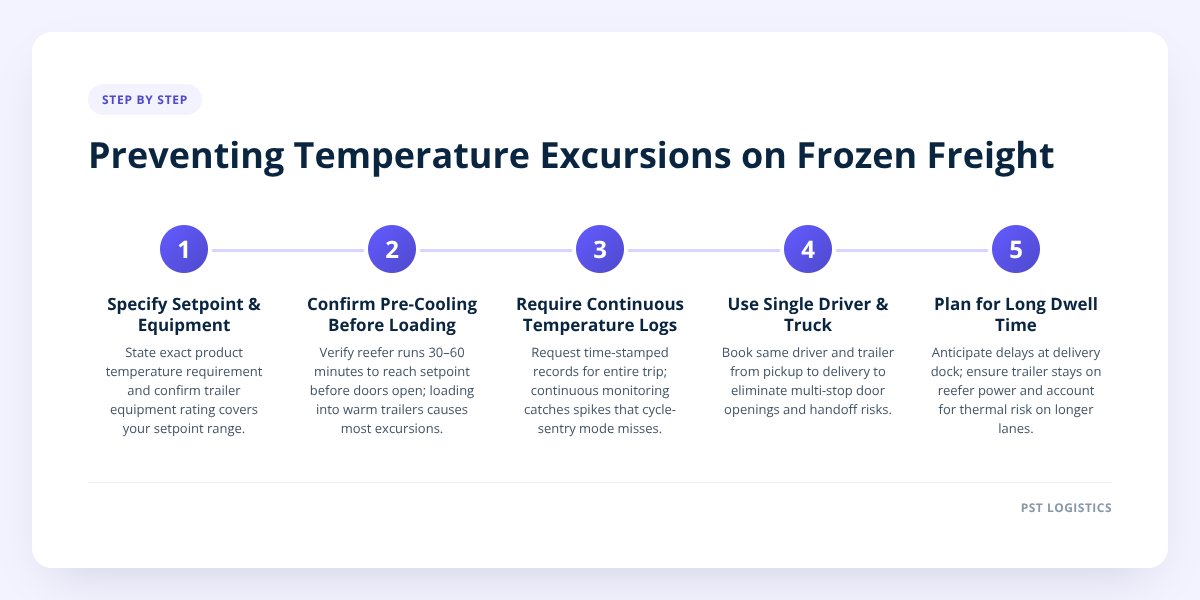
- A reefer trailer needs 30–60 minutes of pre-cooling to reach setpoint before the doors open for loading — loading into a warm trailer is one of the most common causes of excursions.
- Continuous temperature monitoring produces a time-stamped record for the entire trip; cycle-sentry monitoring only logs readings at intervals, which can miss short spikes.
- The USDA regulates temperature requirements for meat, poultry, and egg products under the Food Safety and Inspection Service, and many shippers also follow FDA guidance under the Food Safety Modernization Act's Sanitary Transportation Rule.
- Longer lanes carry more thermal risk simply from more hours on the road — a Midwest-to-Southeast run or a Texas triangle loop gives a failing reefer unit more time to let product drift before anyone notices.
!Preventing Temperature Excursions on Frozen Freight
Why Temperature Control Matters More Than Shippers Think
A single excursion on a full truckload of frozen product can mean the entire load gets rejected at the dock, not just the pallets nearest the door. Frozen goods that partially thaw and refreeze often can't be resold, and a receiver who finds out the product sat above setpoint for even part of the trip has grounds to refuse it.
The liability doesn't stop at the rejected load. If the product is meat, poultry, or egg-based, it falls under USDA Food Safety and Inspection Service rules, and temperature abuse during transport can trigger a compliance problem for the shipper, not just a financial loss. Dairy, produce, and other FDA-regulated foods fall under the Sanitary Transportation Rule issued under the Food Safety Modernization Act, which sets expectations for how refrigerated foods must be handled in transit.
This is the financial exposure in plain terms:
| Risk | Who typically absorbs it |
|---|---|
| Rejected load at delivery | Shipper, unless cargo claim is filed and approved |
| Spoiled product, no resale value | Shipper or broker, depending on contract terms |
| Compliance flag on a regulated food category | Shipper of record |
| Carrier's cargo insurance claim | Carrier, but only if the carrier can prove due diligence (logs matter here) |
That last row is why temperature logs aren't just a nice-to-have. If a carrier can't produce a log showing the trailer held setpoint, a cargo claim gets a lot harder to settle in the shipper's favor.
Step 1: Specify the Right Setpoint and Trailer Type When You Book
Tell the carrier the exact setpoint your product requires, not just "keep it frozen." Frozen meat, ice cream, and frozen vegetables don't all hold the same temperature, and a trailer set a few degrees warm can still read "frozen" on a dashboard while slowly degrading product quality.
When you request a quote, specify:
- State the required setpoint in degrees, not a general category like "frozen" or "chilled."
- Confirm the trailer is food-grade with a documented washout history, especially if the previous load was non-food freight.
- Ask whether the reefer unit runs continuous or cycle-sentry mode, and request continuous if your product is temperature-sensitive.
- Confirm the equipment's setpoint range covers your product — a reefer rated down to 0°F won't reliably hold -10°F for ice cream.
PST Logistics runs 53-foot reefers with a setpoint range of -20°F to 70°F, which covers deep-frozen product through chilled produce in the same fleet, so the equipment question has one answer regardless of what's moving.
Step 2: Confirm the Trailer Is Pre-Cooled Before Loading
Pre-cooling means running the reefer unit until the trailer interior reaches setpoint before the doors open for loading, and skipping this step is one of the most common causes of early-trip excursions. A trailer that sits in a hot yard all day and gets opened at 85°F ambient temperature forces the reefer unit to fight that heat load on top of cooling the product itself — and if the unit is only rated to maintain temperature, not pull a trailer down from ambient, the product never fully recovers.
Pre-cooling typically takes 30 to 60 minutes depending on ambient conditions and the trailer's insulation. Shippers sometimes skip asking about it because loading schedules are tight and nobody wants to explain a delay. But a trailer that isn't pre-cooled puts the warmest, most vulnerable period of the whole trip right at the start, before the driver has even left the dock.
Don't skip this: if a carrier can't confirm pre-cooling happens before the doors open, ask what temperature the trailer interior reads at the start of loading. If they can't answer that question, assume it isn't being done.
PST Logistics pre-cools every reefer before the door opens, which is standard practice on every temperature-controlled load we run, not an upsell. We covered more of what to prep on your end before the truck even arrives in Prepare Perishable Freight for Interstate Shipping.
Step 3: Get Temperature Logs, Not Just a Verbal Promise
A temperature log is a time-stamped record of the trailer's internal temperature throughout the trip, and it's the only real proof that a load held setpoint. Ask for this before you book, not after a receiver flags a problem.
Two monitoring approaches exist, and they're not equivalent:
| Monitoring type | What it captures | Best for |
|---|---|---|
| Continuous monitoring | Temperature logged at short, regular intervals for the full trip | High-value or highly sensitive product, long hauls |
| Cycle-sentry monitoring | Unit cycles on and off to save fuel; readings taken at wider intervals | Shorter hauls, less temperature-sensitive product |
Continuous monitoring catches a brief door-opening spike or a unit hiccup that cycle-sentry might miss between readings. For a three-day run across the Texas triangle, that gap matters more than it would on a same-day regional delivery.
A carrier's willingness to hand over the log without being asked twice tells you something too. If a carrier hesitates, gives you a summary instead of the actual data, or says the log "isn't normally shared," that's worth noting before your next booking. PST Logistics logs temperature end to end on every reefer load and provides that record to the shipper — it's part of how we document a clean delivery, not an extra request you have to push for.
Step 4: Account for Route and Timing Before You Book the Lane
Longer lanes mean more hours where something can go wrong, and the Midwest-to-Southeast corridor and Texas triangle each carry their own version of that risk. A Chicago-to-Atlanta run crosses several climate zones and can mean the truck leaves a 40°F morning and arrives in 85°F afternoon heat — the reefer unit has to work harder in the back half of the trip, right when driver fatigue and traffic delays are most likely to add dwell time.
The Texas triangle — Dallas, Houston, San Antonio, and back — stacks multiple stops into one loop, and each stop where the trailer doors open is a chance for warm air to flood in and setpoint to drift before the unit recovers. Multi-stop reefer loads need a driver who understands door-open discipline: get in, get out, keep the exposure window short.
I-80 westbound runs add a different variable — mountain grades and temperature swings between the Midwest and the coast mean a reefer unit is cycling harder for longer, and any existing mechanical weakness in the unit shows up fastest on a route like this.
A few practical scheduling moves cut thermal risk regardless of lane:
- Book appointment delivery windows instead of open delivery, so the trailer isn't sitting loaded and idle for hours waiting for a dock.
- Ask about multi-stop routing in advance if your load has more than one delivery point, so you know how many door-openings to expect.
- Build in a time buffer for regulated product crossing multiple climate zones, since weather and traffic delays compound thermal risk the longer a trip runs.
Detention at the delivery dock is its own thermal risk — a loaded reefer sitting at a dock for hours with the engine idling or shut off isn't the same as one rolling down the interstate. We go into the financial side of that problem in Avoid Detention and Demurrage Fees in Freight Shipping, but it's worth knowing detention is a cold-chain risk too, not just a billing dispute.
Step 5: Know the Red Flags Before You Book, Not After
A carrier that cuts corners on reefer maintenance usually shows warning signs during the booking call, before the truck ever shows up. Watch for these:
- Vague answers about pre-cooling — "it's usually fine" instead of a direct confirmation that the trailer hits setpoint before loading.
- Reluctance to share temperature logs, or offering a summary instead of the actual data record.
- No clear answer on whether the same driver and truck run the whole route, since a cross-dock or trailer swap adds a door-opening event you didn't plan for.
- Can't confirm the reefer's maintenance schedule or whether DOT inspections are done in-house versus outsourced.
- Pushback on specifying an exact setpoint, suggesting the carrier treats "frozen" as one generic category rather than a number to hold.
- No certificate of insurance available same-day on request — a carrier that's slow to produce basic paperwork is often slow to produce temperature records too.
We go deeper on general carrier vetting, including authority and insurance checks that apply to every load type, in What to Check Before Booking a Freight Carrier and 8 Red Flags That Signal an Unreliable Trucking Company.
PST Logistics runs the same truck and driver from pickup to delivery on every load — no cross-docking, no transloading — which means no mid-route trailer swap introduces an unplanned door-opening or a different unit with a different maintenance history. Every reefer is pre-cooled before the doors open, temperature is logged end to end, and preventive maintenance and DOT inspections are handled in-house rather than outsourced.
What to Do Next
If you have a frozen or temperature-sensitive load moving on the Midwest-to-Southeast corridor, the Texas triangle, or an I-80 westbound run, specify your setpoint and ask for the carrier's monitoring approach before you book — not after the product arrives. PST Logistics operates 53-foot reefers rated -20°F to 70°F out of Naperville, Illinois, with 24/7 dispatch that answers the phone and a 99% on-time delivery record. Request a rate on your lane through the quote form and get a dispatcher who can answer the pre-cooling and logging questions directly.
Checklist: Prevent Temperature Excursions on Frozen Freight
- State your exact required setpoint in degrees when requesting a quote.
- Confirm the trailer is food-grade with a documented washout history.
- Ask whether the carrier pre-cools the trailer before the doors open for loading.
- Request continuous temperature monitoring for long hauls or sensitive product.
- Get the temperature log as part of the delivery paperwork, not just on request.
- Confirm one driver and one truck run the full route with no trailer swap.
- Build appointment windows and time buffers into multi-stop or multi-zone routes.
- Verify the carrier's certificate of insurance is available same-day if you need it.