Drop-and-Hook vs. Live Load: Which Saves More Money?

Quick answer: Drop-and-hook saves time and lowers detention risk because the driver swaps a loaded trailer for an empty one and leaves, usually in under 30 minutes. Live load costs more driver-hours because the truck waits while freight is loaded or unloaded, but it needs fewer trailers and fits shippers who don't have trailer pools or yard space. The right choice depends on your shipping volume, how predictable your schedule is, and whether you have the trailer inventory to support a drop-and-hook pool.
Key takeaways
- Drop-and-hook typically takes a driver 15–30 minutes at a facility; live load can run 2 hours or more depending on dock speed and crew availability.
- Most carriers' contracts allow roughly 2 hours of free time for live loads before detention charges start — check your specific carrier agreement, since the exact free-time window varies.
- Drop-and-hook requires extra trailers sitting at your facility or a nearby yard, which is a real cost even though it's not a line item on the freight invoice.
- High-volume shippers with regional, repeatable lanes benefit most from drop-and-hook; low-volume or rural shippers often come out ahead with live load.
!Drop-and-Hook vs. Live Load Cost Comparison
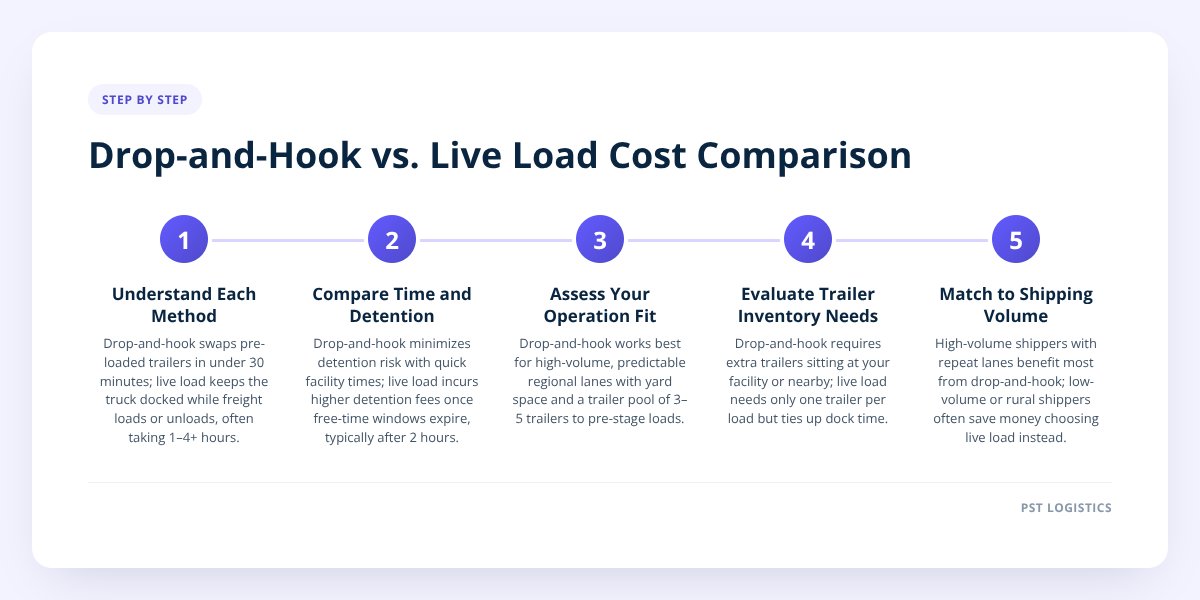
Step 1: Understand What Each Method Actually Involves
Drop-and-hook means the driver arrives with a loaded (or empty) trailer, disconnects it, hooks up a different trailer that's already loaded and ready, and leaves. No one waits at the dock. The trailer swap itself takes a few minutes; the whole stop, including paperwork, usually wraps up in under half an hour.
Live load means the truck and trailer stay put while your crew loads or unloads the freight. The driver is parked at the dock the entire time — sometimes 45 minutes for a fast, well-staffed facility, sometimes several hours if the dock is backed up or the load needs to be hand-stacked.
The difference sounds small on paper. It isn't. A driver who's tied up for three hours at one stop can't run that time toward the next pickup, and under federal hours-of-service rules, that clock doesn't pause for anyone. We've covered how those limits interact with delivery windows in FMCSA HOS Pilot Program and Delivery Windows, but the short version is: every hour a truck sits is an hour it's not driving, and drivers only have so many hours in a day to work with.
Drop-and-hook isn't available everywhere. It requires:
- A trailer pool — extra trailers staged at or near your facility
- A yard or drop lot with enough room to stage loaded and empty trailers
- A carrier willing to leave trailers on-site between runs, which ties up their equipment too
If you don't have the yard space or the trailer count to support a pool, live load is often the only practical option — not a worse choice, just the one that fits your facility.
Step 2: Compare Time, Cost, and Detention Risk Side by Side
The real cost difference shows up in detention fees and driver turn time, not in the base freight rate. Here's how the two stack up:
| Factor | Drop-and-Hook | Live Load |
|---|---|---|
| Typical time at facility | 15–30 minutes | 1–4+ hours, depending on dock speed |
| Detention risk | Low — little to no wait time | Higher — clock starts once free time expires |
| Trailer inventory needed | Yes — a pool of extra trailers | No — one trailer per load |
| Yard/dock space needed | Yes — room to stage trailers | Minimal — just a dock door |
| Best fit | High-volume, repeat lanes | Lower-volume, variable, or rural pickups |
| Driver flexibility | High — driver isn't locked to one dock schedule | Lower — driver's day depends on dock performance |
Don't skip this: Most carrier contracts spell out a free-time window — commonly around two hours for live loads — before detention charges apply. If your dock regularly runs freight past that window, you're likely paying detention fees without realizing it. Confirm the exact free-time terms in your own agreement rather than assuming a standard number.
Detention isn't just a carrier headache — it's a cost that eventually works its way back into your freight rates, because carriers price in the risk of getting tied up at slow-turning facilities. We go into the mechanics of this in How to Avoid Detention Fees on Drop-and-Hook Loads and, more broadly, in Avoid Detention and Demurrage Fees in Freight Shipping.
Step 3: Decide If Drop-and-Hook Fits Your Operation
Drop-and-hook makes the most sense when your shipping pattern is high-volume and predictable. Look for these signs:
- You ship the same lane or set of lanes regularly — daily or several times a week
- Your facility has yard space to stage trailers without blocking dock doors or traffic
- You can commit to a trailer pool, even a small one of 3–5 trailers
- Your freight is palletized and consistent in count, so trailers can be pre-loaded ahead of pickup
- You're running a regional corridor — think Midwest to Southeast or similar repeat routes — where the same carrier can cycle trailers efficiently
Regional corridors are where drop-and-hook really pays off, because the carrier can keep trailers moving in a loop instead of running empty miles to reposition. If you're regularly moving freight along a Midwest-to-Southeast route, we walked through how that kind of lane planning works in Planning a Naperville-to-Southeast Full Truckload Run.
One worked example: a distributor shipping five loads a week to the same three regional customers can set up a standing trailer pool — say, four trailers — and have them pre-loaded the night before pickup. The driver shows up, hooks the loaded trailer, drops the empty one, and is gone in 20 minutes. Over a month, that's roughly 20 stops saved from multi-hour live-load waits, which adds up to real driver-hours freed up for more freight.
Step 4: Decide If Live Load Is the Better Fit
Live load is worth it when your shipments are smaller, less frequent, or picked up from locations that can't support a trailer pool. This includes:
- Rural or farm pickups where there's no yard space for staged trailers
- Time-sensitive freight that's loaded fresh right before departure — produce coming straight off a harvest line, for example
- One-off or irregular shipments that don't justify tying up extra trailers for occasional use
- Smaller shippers without the volume to keep a trailer pool in rotation
- Appointment-based facilities where the dock schedule is tightly controlled and a live load fits neatly into a known window
Live load is also the default for most temperature-controlled freight, because the trailer often needs to be pre-cooled to the correct setpoint immediately before loading rather than sitting staged in a yard. For perishables — produce, dairy, frozen goods — that pre-cool step and continuous temperature logging matter more than shaving 20 minutes off the dock stop. We cover the specifics of prepping perishable freight for the road in Prepare Perishable Freight for Interstate Shipping.
The cost tradeoff for live load isn't necessarily worse — it's just different. You avoid the overhead of owning or leasing extra trailers, but you accept more exposure to detention if your dock runs slow.
Step 5: Build Your Preference Into the Carrier Agreement
Put your loading method, free-time expectations, and detention terms in writing before the first load moves — verbal agreements don't hold up when a dispute happens. Specifically:
- State the loading method per lane. If some pickups are drop-and-hook and others are live load, say so in the lane agreement or rate confirmation, not just on a phone call.
- Define free time explicitly. Don't rely on an industry-standard assumption. Write the number of hours into the contract so both sides know when detention charges start.
- Set the detention rate. Agree on a dollar amount per hour (or per increment) in advance, not after a dispute.
- Specify trailer pool terms if using drop-and-hook. Who owns the trailers, how many are staged, and who's responsible for trailer condition and cleanliness.
- Confirm appointment windows. A live load with a hard appointment time shifts dock performance risk onto your facility if you're the one running late.
- Review pallet count and load specs ahead of time. Mismatched expectations on pallet count or floor-loading slow down both drop-and-hook pre-loading and live-load dock time. We covered how to plan this properly in How to Plan and Load Pallets for Full Truckload Shipping.
An asset-based carrier that owns its own trailers and runs the same driver from pickup to delivery can usually accommodate either method without adding a layer of coordination. PST Global runs both drop-and-hook and live load across its dry van and reefer fleet out of Naperville, Illinois, with one driver assigned to the full run — no cross-docking, no handoffs between carriers. Dispatch is reachable 24/7 to confirm loading method and appointment details before the truck is booked, which cuts down on the kind of miscommunication that leads to detention disputes later.
What to Do Next
Start by looking at your own shipping pattern: how often you ship, whether your facility has yard space, and whether your freight is predictable enough to justify a trailer pool. From there, the choice between drop-and-hook and live load usually becomes obvious. If you're ready to move a load and want to talk through which method fits your lane, request a rate quote from PST Global and a dispatcher will walk through the details with you directly.
Checklist: Choosing and Setting Up Your Freight Loading Method
- Review your shipping volume and frequency on each lane.
- Check whether your facility has yard space to stage trailers.
- Decide if a trailer pool makes sense for your volume — even a small one.
- Confirm your carrier's free-time window for live loads in writing.
- Agree on a detention rate per hour before the first load moves.
- Specify the loading method (drop-and-hook or live load) on every rate confirmation.
- Set a clear appointment window for live loads and share it with your dock crew.
- Confirm pallet count and load specs with the carrier ahead of pickup.