Interstate Trucking Company or Broker: How to Choose

Quick answer: Choose a dedicated, asset-based interstate trucking company when you need predictable transit times, one point of accountability, and the same truck and driver on every run — brokers add value when you need overflow capacity or access to niche equipment you don't ship often. For regular Midwest-to-Southeast or I-80 lanes, shippers who book direct with a carrier typically get tighter communication and fewer cost surprises, because there's no second company marking up the rate or relaying information. The right choice depends on your shipment frequency, how much visibility you need mid-route, and whether your freight requires special handling like temperature control.
Key takeaways
- An asset-based carrier owns or leases its trucks and employs its drivers; a broker owns no trucks and instead finds a carrier to haul your load for a fee.
- Brokers add a markup between what the shipper pays and what the carrier is paid — a cost layer that doesn't exist when you book direct.
- With a dedicated carrier, the same driver typically stays with your freight from pickup to delivery, which matters most for temperature-controlled loads that need continuous monitoring.
- Before committing to either model for recurring freight, confirm active operating authority, current insurance certificates, and an FMCSA safety rating of Satisfactory.
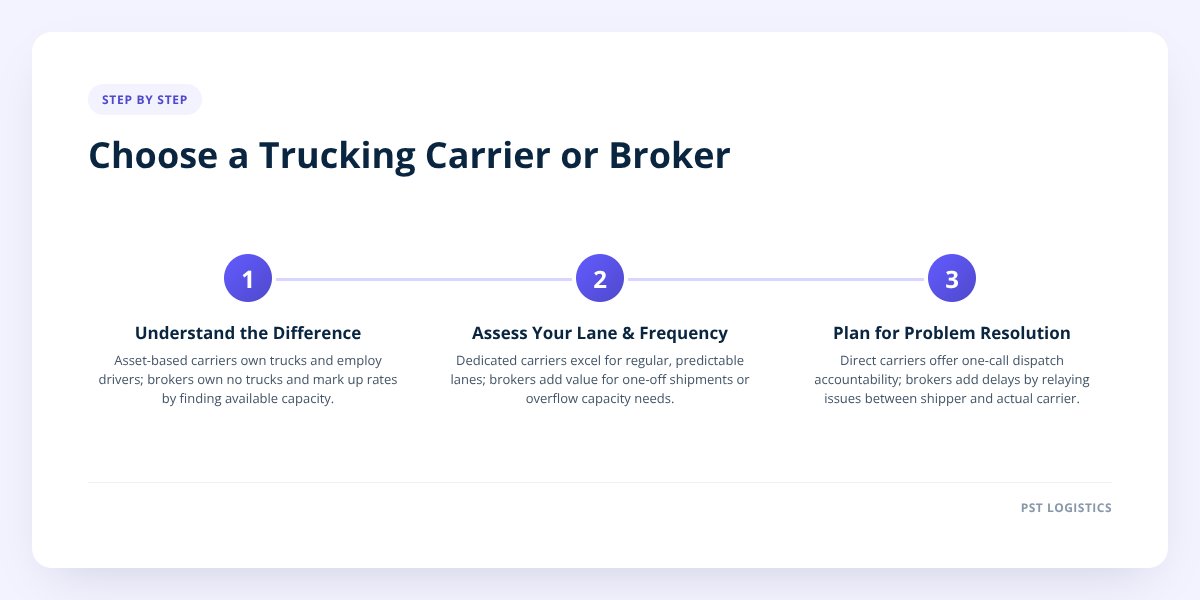
!Choose a Trucking Carrier or Broker
Step 1: Understand what you're actually comparing
An asset-based carrier and a broker are not two flavors of the same service — they're structurally different businesses. A carrier like PST Global owns its trailers, employs or contracts its drivers, and takes physical responsibility for your freight the moment it's loaded. A broker owns none of that. It's a matchmaking service: you give a broker your freight details, and the broker finds a carrier willing to haul it, then charges you a fee on top of what it pays that carrier.
Neither model is inherently wrong. Brokers exist because shipping demand is uneven — a company that ships five loads a year to five different states doesn't need a dedicated relationship with one carrier. But once your shipping becomes regular — say, weekly runs from the Midwest into Georgia or the Carolinas — the calculation changes, because the broker's value (finding *any* available truck) matters less than your need for a truck you can count on.
Here's the practical difference that shows up on your dock:
| Factor | Asset-based carrier | Broker |
|---|---|---|
| Who owns the truck | The carrier | A third-party carrier, unknown to you until booked |
| Who you call with a problem | Dispatch at the carrier | The broker, who then calls the carrier |
| Driver consistency | Often the same driver for the full run | Varies by load, often a different carrier each time |
| Rate transparency | You see the carrier's rate directly | You see the broker's price, not the carrier's cut |
| Capacity during tight markets | Guaranteed if you have a standing agreement | Subject to what's available that day |
Step 2: Weigh speed and reliability for your actual lanes
For Midwest-to-Southeast and I-80 corridor freight, the reliability gap between models usually shows up at pickup appointments, not on the highway. A dedicated carrier that runs these lanes regularly — PST Global's core lanes include Midwest to Southeast, the Texas triangle, and I-80 westbound to the coast — already knows the dock hours, the typical wait times, and the reload markets along the route, including Atlanta, Dallas, Laredo, Savannah, Newark, and Los Angeles.
A broker, by contrast, is reassigning your load to whichever carrier has a truck free that day. That carrier may never have run your lane before. Consider two scenarios:
- Scenario A — direct carrier, recurring lane. A shipper in the Chicago area moves palletized freight to Atlanta every week. The same truck and driver handle it each time. The driver knows the receiver's dock rules, dispatch already has the appointment windows on file, and on-time performance stays consistent — PST Global reports a 99% on-time delivery rate across its lanes.
- Scenario B — broker, spot-booked. The same shipper uses a broker instead. Each week, a different carrier picks up the load. One week it's a driver unfamiliar with the receiver's check-in process; the next week the assigned truck falls through and the broker has to re-source capacity, pushing pickup back a day.
Neither scenario is a guarantee of what will happen with every broker or every carrier — reliability depends on the specific company — but it illustrates why repetition and direct accountability tend to produce steadier results than a network model.
Step 3: Think through what happens when something goes wrong mid-route
This is where the two models diverge the most. With a dedicated carrier, you call one dispatcher who already knows your load, your lane, and your history. With a broker, you call the broker, who then has to call the carrier, get an update, and call you back — a relay that adds time exactly when you need an answer fast.
Don't skip this: if a load is delayed, damaged, or rejected at delivery, the number of phone calls between you and the truck is the single biggest factor in how fast the problem gets resolved. Every extra link in that chain adds time you don't get back.
This matters even more for temperature-controlled freight. A reefer carrying produce or dairy that loses its setpoint needs a decision in minutes, not hours — whether to divert, whether to reject, whether the load is still sellable. A carrier running continuous temperature logging end to end can tell you exactly when and where a deviation happened. We covered what shippers should prep for before a perishable run in Prepare Perishable Freight for Interstate Shipping, and a lot of that preparation only pays off if the carrier on the other end is answering the phone.
A carrier offering 24/7 dispatch that picks up on weekends is built for this exact situation. A broker's hours, and the carrier's hours they've booked for you, may not line up the same way.
Step 4: Compare pricing transparency, not just the bottom-line number
Dedicated carrier pricing and broker pricing look similar on an invoice but aren't built the same way. When you book direct, the rate you're quoted is the rate the truck is running for — there's no hidden layer between what you pay and what the carrier earns. When you book through a broker, the rate you pay includes the broker's margin, which you typically never see broken out.
That doesn't automatically make broker freight more expensive. In a loose capacity market, a broker can sometimes find a cheaper truck than a dedicated carrier's standing rate. But for regular, planned freight — the kind that runs on a known lane every week — a direct relationship tends to save money over time because:
- You're not paying a markup on every single load, only the carrier's actual rate.
- A consistent lane relationship lets a carrier plan backhauls and reloads more efficiently, which keeps rates more stable.
- You avoid the volatility of spot-market broker pricing, which can spike when capacity tightens.
If you're shipping multiple loads a week on the same lane, it's worth asking a dedicated carrier about a standing arrangement rather than booking load by load — we walked through how that agreement typically works in How to Set Up a Dedicated Freight Service Agreement.
Step 5: Verify authority, insurance, and safety rating before you commit
Whichever model you choose, this step is non-negotiable and it's the same checklist either way. The difference is who you're checking: with a broker, you're vetting the broker's bond *and* the underlying carrier they assign; with a direct carrier, you only have to vet one company.
- Confirm the carrier or broker has active operating authority registered with FMCSA — not suspended, not pending.
- Request a current certificate of insurance showing auto liability and cargo coverage; a reliable carrier sends this the same business day it's requested.
- Check the FMCSA safety rating — Satisfactory, Conditional, or Unsatisfactory — and review the CSA BASIC scores behind it.
- Ask whether drivers are enrolled in a drug and alcohol testing consortium as required by FMCSA regulations.
- Confirm hours-of-service compliance is tracked through ELDs on every truck, not self-reported.
- Ask about the carrier's preventive maintenance program — in-house maintenance with annual DOT inspections is a stronger signal than outsourced, as-needed repairs.
- If you're booking through a broker, ask them to name the underlying carrier and let you run the same checks directly.
We go deeper on reading the specifics of a safety rating in How to Read a Freight Carrier's FMCSA Safety Rating, and the full pre-booking checklist is in What to Check Before Booking a Freight Carrier. Given recent scrutiny from FMCSA around ELD compliance, asking directly how hours-of-service are tracked — not just whether they're tracked — is a reasonable question to put to any carrier or broker before you sign on.
What to do next
If your freight moves on a repeatable schedule — weekly pallets into the Southeast, regular reefer runs along I-80, recurring Texas triangle freight — a dedicated, asset-based carrier generally gives you more control over timeline, communication, and final cost than routing it through a broker every time. PST Global runs dry van and temperature-controlled truckload freight across all 48 states from its Naperville, Illinois base, with active authority, insurance on file, and a dispatcher who answers the phone around the clock. Request a rate for your lane and see what a direct relationship looks like on your next shipment.
Checklist: choosing between a carrier and a broker
- Map your shipping frequency — weekly or recurring lanes favor a dedicated carrier.
- List every lane you run regularly and note which carriers already service it.
- Request a certificate of insurance and confirm it's current, not expired.
- Look up the carrier's or broker's FMCSA operating authority status before booking.
- Pull the FMCSA safety rating and CSA BASIC scores for any carrier under consideration.
- Ask who you'll call if a load runs into trouble mid-route — one dispatcher or a relay through a broker.
- Compare the per-load rate against a standing agreement rate for your volume.
- Confirm temperature-controlled loads get continuous logging if you ship perishables.