Plan Freight on Tight Windows Without Driver Delays
Quick answer: A tight delivery window fails when it ignores the math of hours-of-service rules, dock scheduling, and loading method. To hit a short window reliably, book a confirmed appointment time (not a date range), give the carrier realistic drive-time math for the lane, choose drop-and-hook over live load when the window is truly tight, and tell your carrier the real contract deadline — not just "ASAP." Shippers who build their window around these four pieces see fewer detention charges and far fewer missed deliveries.
Key takeaways
- A driver under FMCSA hours-of-service rules gets 11 hours of drive time within a 14-hour on-duty window, then needs 10 consecutive hours off — a fact that determines how fast freight can legally move, regardless of what the shipper needs.
- A Naperville-to-Southeast run (roughly 700–900 miles) typically needs a 48–60 hour window to account for legal drive limits, not the 24 hours many shippers assume is enough.
- Detention charges commonly apply once a driver waits beyond a set grace period at a dock — often around two hours — and that clock usually starts at the appointment time, not on arrival.
- Live loads require more schedule buffer than drop-and-hook because the driver's HOS clock keeps running the entire time freight sits at the dock, loaded or not.
!Plan Freight on Tight Delivery Windows
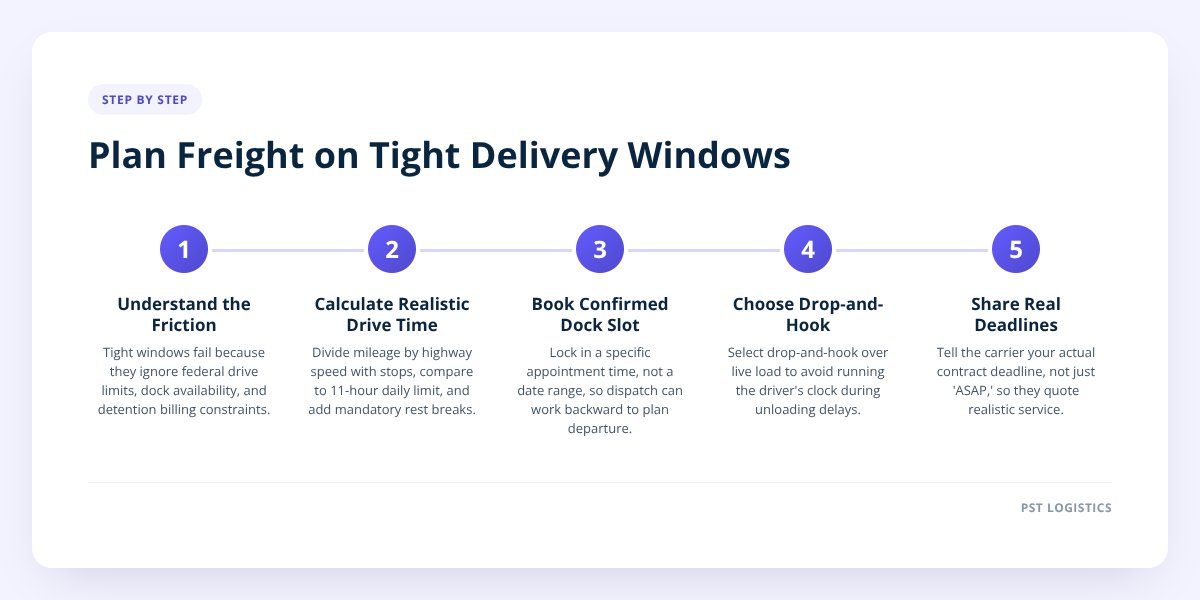
Step 1: Understand Why Tight Windows Create Friction in the First Place
A 24-hour delivery window sounds reasonable on paper and falls apart the moment it meets federal drive-time limits, dock scheduling realities, and detention billing — all three collide at once. Shippers who have never run a truck themselves often treat delivery time like a calendar problem. It's actually three separate constraints stacked on top of each other.
The first constraint is legal. Under Federal Motor Carrier Safety Administration rules, a property-carrying driver may drive up to 11 hours after 10 consecutive hours off duty, within a 14-hour on-duty window. Once that 14-hour window closes, the driver must stop — even with hours of drive time left — until another 10-hour break resets the clock. We covered the mechanics of this in detail in How FMCSA Hours-of-Service Rules Affect Freight Delivery.
The second constraint is physical. A receiving dock only has so many open appointment slots per day, and most warehouses stop receiving freight outside business hours. A driver who arrives at 6 p.m. for a dock that closes at 5 p.m. isn't getting unloaded that night, no matter how urgent the shipment is.
The third constraint is financial, and it's the one that catches shippers off guard: detention charges. This is the fee a carrier bills when a driver is held at a shipper's or receiver's facility beyond an agreed grace period — commonly around two hours past the scheduled appointment time. When a tight window forces a driver to wait, or forces dispatch to scramble for a last-minute dock slot, detention fees are often the result. We go deeper on how these charges get triggered in How to Avoid Detention Fees on Interstate Freight Runs.
Don't skip this: Once a driver's 14-hour on-duty clock starts, it does not pause for dock delays, traffic, or waiting at a shipper's yard. Every hour lost to a late appointment is an hour permanently gone from that day's available drive time.
Step 2: Calculate Realistic Drive Time for Your Lane
The math is simpler than most shippers expect: take the mileage, divide by average highway speed accounting for stops, and compare that to the legal 11-hour daily drive limit. A Naperville-to-Atlanta run, for example, covers roughly 700 miles. At realistic highway speeds with fuel and rest stops factored in, that's close to a full day's legal drive time — meaning the freight can't arrive the same day it departs unless it leaves at the start of a duty period with nothing else on the schedule.
Push the lane further south — Naperville to Florida, or to the Texas triangle — and the distance climbs past 900 or 1,000 miles. That requires two full driving days at minimum, plus the mandatory 10-hour reset in between. Add a tight pickup appointment, a few hours of loading time, or any delay at the dock, and a third day becomes likely.
Here's a rough framework for setting expectations:
| Route from Naperville | Approx. miles | Realistic delivery window |
|---|---|---|
| Midwest regional (Indiana, Ohio) | 200–350 | 24–30 hours |
| Southeast (Atlanta, Nashville) | 700–750 | 36–48 hours |
| Deep South / Texas triangle | 900–1,100 | 48–60 hours |
| West Coast via I-80 | 1,900–2,100 | 60–72 hours |
These ranges assume one driver running the full trip, normal dock availability, and no weather or traffic delays. PST Global runs a same truck, same driver model for every full truckload — meaning the freight never sits waiting for a relay driver or a swap, which is one of the biggest hidden causes of missed windows on long hauls.
A shipper who books a 24-hour window for a 900-mile run isn't asking for fast service — they're asking for something outside what federal rules allow. Carriers that quote these lanes honestly will tell you this upfront, and a shipper who pushes back on a realistic timeline is often setting up the load for a missed appointment before the truck even leaves the yard.
Step 3: Book a Confirmed Dock Slot, Not a Date Range
A date range like "deliver between Tuesday and Thursday" gives the driver nothing to plan against — a confirmed appointment time gives dispatch a fixed target to build the whole route around. The difference matters more than most shippers realize. When dispatch knows a load must be at a specific dock at a specific hour, they can work backward: calculate the exact departure time, build in the mandatory rest break, and account for the pickup appointment on the front end.
A date range forces the driver to guess, and guessing is how trucks arrive either too early (and get turned away) or too late (and trigger detention on the next load).
Good appointment scheduling looks like this:
- State a specific delivery time, not a day. "Thursday, October 29, between 8 a.m. and 10 a.m." beats "sometime Thursday."
- Confirm the appointment with the receiver before the carrier commits, not after the truck is en route.
- Build in a buffer for the pickup side too — a late pickup appointment eats into the same drive-time budget as a late delivery.
- Share dock hours and any facility-specific rules (check-in procedure, trailer size limits, lumper requirements) at the time of booking, not when the driver calls from the gate.
- Flag multi-stop loads clearly, since each additional stop adds loading, unloading, and drive time that eats into the same HOS clock.
Confirmed appointments also protect the shipper from detention disputes. If a driver shows up at the agreed time and still waits past the grace period, the detention charge is clearly the receiver's responsibility — not a gray area caused by a vague date range.
Step 4: Choose the Loading Method That Matches Your Window
Drop-and-hook loading protects a tight delivery window; live load requires more buffer built in. The difference comes down to what happens to the driver's clock while the trailer is being loaded or unloaded.
With drop-and-hook, the driver drops a loaded or empty trailer and hooks to a different one that's already prepped and ready. There's no waiting for freight to be loaded or unloaded — the driver is back on the road in minutes. This is the method that makes genuinely tight windows achievable, because it removes dock wait time from the equation almost entirely.
With a live load, the driver waits at the dock while the trailer is physically loaded or unloaded, and that wait counts against the 14-hour on-duty clock the entire time. A live load that's supposed to take 90 minutes but stretches to four hours because the dock is backed up doesn't just risk detention charges — it can burn enough of the day's legal on-duty window that the driver has to stop for the mandatory rest break before covering the planned mileage.
A practical rule: if your delivery window has less than a few hours of slack built in, drop-and-hook is the safer choice. If you're set on a live load, add extra time to the window to absorb dock delays, and confirm your facility can actually turn trucks around within the grace period before detention charges start. PST Global offers both drop-and-hook and live-load options along with sealed loads, and the right choice depends on how much margin your actual deadline allows.
Step 5: Tell Your Carrier the Real Deadline, Not Just "ASAP"
"ASAP" tells a carrier nothing useful — a hard delivery deadline tied to a contract, a retail chargeback, or a production line shutdown tells them exactly how to plan the route. These are two completely different instructions, and shippers often use the first when they mean the second.
When a dispatcher hears "ASAP," they may reasonably plan for the fastest *legal* delivery, which could still be 48 hours out on a Southeast run. When a dispatcher hears "this must be unloaded by Friday 6 a.m. or we're hit with a chargeback," they can prioritize that load differently — adjusting departure time, confirming the appointment earlier, and flagging the load as time-critical internally.
Be specific when you hand off a load:
- State the actual contract or chargeback deadline, including the exact time and time zone.
- Explain what happens if the deadline is missed — a chargeback, a line shutdown, a missed retail window — so the carrier understands the real stakes.
- Share any receiver-specific appointment rules, like required check-in windows or no-reschedule policies.
- Confirm whether the load is drop-and-hook, live load, or sealed, since that affects how much buffer the deadline needs.
- Flag temperature requirements immediately if the freight is perishable, since reefer loads need pre-cooling time before the trailer is even loaded — something we detail in Prepare Perishable Freight for Interstate Shipping.
PST Global runs dispatch around the clock — including weekends — specifically so a shipper with a real deadline can reach someone who can plan around it, rather than leaving a voicemail and hoping. A dispatcher who knows the actual delivery requirement can build a schedule that respects both the HOS rules and the business need, instead of discovering the conflict after the truck is already on the road.
What to Do Next
Realistic delivery windows aren't a compromise — they're the only way to get consistent, on-time freight without surprise detention bills. Before your next shipment, run the lane mileage against the drive-time math above, confirm a specific dock appointment instead of a date range, and tell your carrier the actual deadline driving the shipment.
PST Global runs dry van and temperature-controlled truckload freight out of Naperville across all 48 states, with a 99% on-time delivery rate and the same driver covering the load from pickup to delivery. If you're planning a shipment on a tight timeline, request a rate and talk through the window with dispatch before you book it.
Checklist: Plan a Freight Shipment on a Tight Window
- Calculate the lane mileage and compare it to realistic drive-time limits before setting a deadline.
- Request a confirmed dock appointment time from the receiver, not a date range.
- Communicate dock hours, check-in procedures, and any facility rules at booking time.
- Decide between drop-and-hook and live load based on how much buffer the deadline allows.
- State your actual contract or chargeback deadline to the carrier, with time zone included.
- Explain the consequence of a missed deadline so the carrier can prioritize the load correctly.
- Flag perishable or temperature-sensitive freight immediately so pre-cooling time is built in.
- Confirm the appointment with the receiver again 24 hours before pickup to catch last-minute changes.