General Freight Transportation: A Shipper's Guide
Quick answer: General freight transportation means moving palletized or floor-loaded goods by truckload, usually in a 53' dry van or a temperature-controlled reefer trailer, from one pickup point to one delivery point. Before booking, confirm the carrier's active authority, insurance certificates, and safety rating, know whether your load needs a live load or drop-and-hook, and get pallet count and weight right so the quote holds. In Naperville, the Midwest-to-Southeast corridor, the Texas triangle, and I-80 westbound lanes are the busiest routes, which affects truck availability and pricing.
Key takeaways
- A dry van truckload typically holds up to 45,000 lbs and 26 standard pallets in a 53' air-ride trailer.
- Reefer trailers run a setpoint range of -20°F to 70°F and should be pre-cooled before the doors open for loading.
- Always ask for a same-day certificate of insurance — a carrier with active authority should be able to produce one without delay.
- Naperville's position on the Midwest-to-Southeast corridor and I-80 westbound lane means more truck availability on those routes than on thin, one-off lanes.
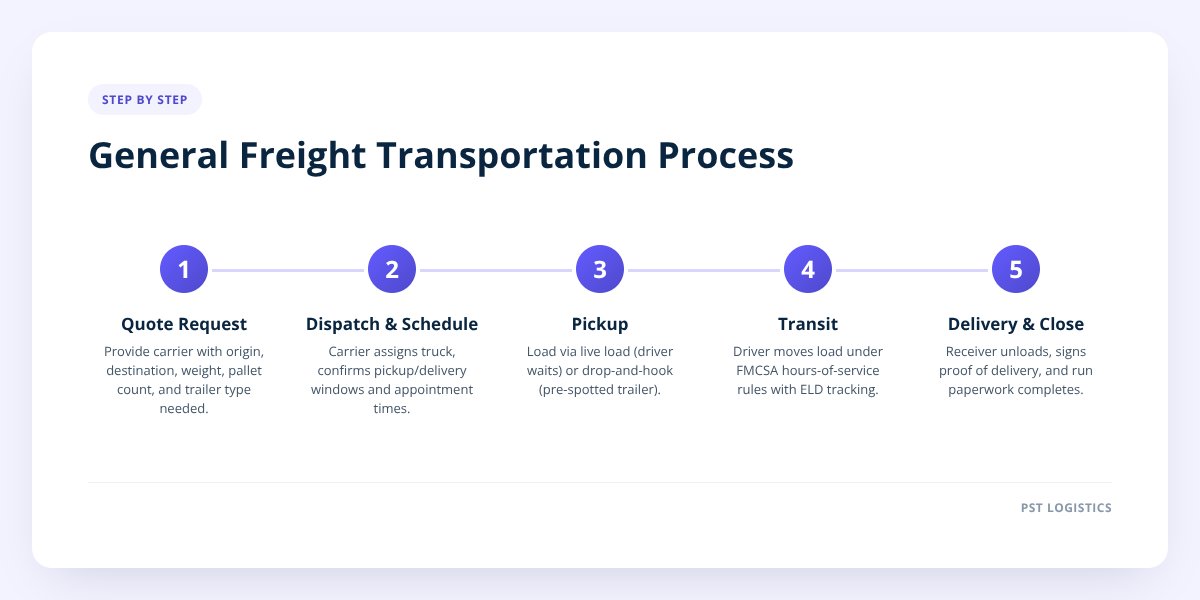
!General Freight Transportation Process
How Does General Freight Transportation Actually Work?
General freight transportation moves a full trailer of goods from one shipper to one receiver, without stopping to consolidate with other freight. This is different from less-than-truckload (LTL) shipping, where your pallets share trailer space with other shippers' freight and get transferred between trucks along the way.
With full truckload service, one truck and typically one driver handle the load from pickup to delivery. Nothing gets cross-docked or transloaded in between. That matters because every time freight changes hands or trailers, there's a chance for damage, delay, or a lost pallet.
The process usually breaks down into these steps:
- Quote request — you give the carrier your origin, destination, weight, pallet count, and trailer type needed.
- Dispatch and scheduling — the carrier assigns a truck and confirms pickup and delivery windows, including any appointment times.
- Pickup — either a live load (the truck waits while you load it) or drop-and-hook (a pre-spotted trailer you load on your own schedule, then the driver hooks up later).
- Transit — the driver moves the load under FMCSA hours-of-service rules, tracked through an electronic logging device (ELD).
- Delivery — the receiver unloads, signs the proof of delivery, and the paperwork closes out the run.
For temperature-sensitive freight — produce, dairy, frozen goods — the process adds a step: pre-cooling the trailer to setpoint before the doors ever open, then logging temperature continuously or through cycle-sentry monitoring so the receiver has a record if there's ever a dispute. We covered the mechanics of avoiding temperature problems in How to Stop Temperature Excursions on Frozen Freight.
What Does General Freight Transportation Cost?
Freight rates depend on distance, lane demand, trailer type, and how much flexibility you give the carrier on pickup and delivery timing — there's no flat per-mile number that applies everywhere. A few factors move the price more than people expect:
| Factor | How it affects cost |
|---|---|
| Lane direction | Backhaul lanes (away from freight-dense regions) often cost less than lanes into them |
| Trailer type | Reefer loads typically cost more than dry van due to fuel for the unit and monitoring |
| Appointment windows | Tight or non-negotiable windows can raise price versus flexible delivery dates |
| Multi-stop delivery | Each additional stop adds cost beyond a straight point-to-point run |
| Detention time | Hours beyond the free loading/unloading window usually bill back to the shipper |
| Load/unload type | Live loads can affect driver wait time versus a pre-spotted drop-and-hook trailer |
Weight and pallet count matter too. A dry van truckload maxes out around 45,000 lbs and 26 standard pallets — if your load is lighter but takes up all 26 pallet positions, you're still paying for a full truck because the space is gone even if the weight isn't.
Detention fees are one of the most avoidable cost surprises in freight. If your dock is slow to load or unload, you can get billed for the driver's extra wait time, and those charges add up fast on a recurring lane. We go into the specifics in How to Avoid Detention Fees on Interstate Freight Runs.
Don't skip this: Before you book any carrier, ask for a same-day certificate of insurance and confirm their FMCSA safety rating is Satisfactory. A carrier that can't produce proof of active authority and insurance quickly is a warning sign, not a formality you can skip for a better rate.
How Should You Prepare a Load Before Booking?
The biggest driver of a smooth pickup is accurate information given to dispatch before the truck is even assigned. Carriers plan trucks, drivers, and hours-of-service around what you tell them — if the numbers are wrong, the truck that shows up may not fit the job.
Here's what to have ready before you request a quote:
- Confirm exact weight and pallet count. Round numbers cause problems — if you say "about 20 pallets" and it's actually 24, that can change which trailer gets sent.
- Know your trailer requirement. Dry van for palletized or floor-loaded general freight; reefer with a specific setpoint for anything temperature-sensitive.
- Decide live load or drop-and-hook. This affects both scheduling and whether detention time applies.
- Set realistic pickup and delivery windows. Appointment times that are too tight for the mileage involved create missed windows before the truck even leaves.
- Flag multi-stop needs upfront. Don't add a second delivery address after the truck is already dispatched for a single stop.
- Have dock details ready. Note dock height, forklift availability, and any facility-specific check-in procedures the driver will need.
- Request the certificate of insurance in writing. A carrier with active authority should send this the same business day you ask.
For temperature-controlled freight specifically, also confirm the setpoint in writing and ask whether the trailer will be pre-cooled before loading begins. A trailer that isn't pre-cooled to setpoint before the doors open is already fighting an uphill battle to hold temperature for the rest of the run.
What Mistakes Do Shippers Make When Booking Freight?
The most common mistake is booking on price alone without checking whether the carrier is asset-based or a broker reselling the load to someone else. An asset-based carrier — one that owns its own trucks and employs or contracts its own drivers — gives you a direct line to the people actually moving your freight. A broker adds a layer between you and the truck, which can mean slower answers when something goes wrong mid-route.
Other frequent mistakes:
- Not verifying active authority and insurance before booking. A quote means nothing if the carrier's authority has lapsed or their insurance certificate is outdated.
- Underestimating or overestimating pallet count. This leads to either a truck that can't fit the load or paying for capacity you don't use.
- Skipping the safety rating check. The FMCSA publishes safety ratings publicly, and a quick check takes minutes — we explain how to read one in How to Read a Freight Carrier's FMCSA Safety Rating.
- Assuming any trailer works for temperature-sensitive goods. A dry van is not a substitute for a reefer, even for a short regional run.
- Not asking who answers the phone after hours. Freight problems don't stop at 5 p.m., and a carrier without 24/7 dispatch can leave you waiting until the next business day for an update.
- Treating recurring freight like a one-off booking every time. If you ship the same lane weekly, a dedicated service agreement can lock in a truck and driver instead of re-quoting every run — we outline how that works in How to Set Up a Dedicated Freight Service Agreement.
A newer shipper's instinct is often to collect three or four quotes and pick the cheapest. That's not wrong, but price alone doesn't tell you whether the truck will show up on time, whether the driver knows how to handle a reefer setpoint, or whether someone picks up the phone if a delivery window is about to be missed. We laid out the fuller pre-booking checklist in What to Check Before Booking a Freight Carrier.
Why Naperville's Location Matters for Freight Planning
Naperville sits on routes that feed the Midwest-to-Southeast corridor, the Texas triangle, and I-80 westbound toward the coast — all lanes with steady truck availability rather than thin, hard-to-cover routes. That matters because lane density affects both pricing and how quickly a carrier can get a truck to your dock. A shipper booking freight on a well-traveled corridor generally has more scheduling flexibility than one booking into a reload market with fewer trucks passing through.
PST Global runs dry van and temperature-controlled truckload freight out of Naperville across all 48 states, with core lanes through the Midwest to Southeast, the Texas triangle, and I-80 westbound, plus reload markets in Atlanta, Dallas, Laredo, Savannah, Newark, and Los Angeles. Every load runs with the same truck and same driver from pickup to delivery, active authority and insurance on file, and a dispatcher who answers the phone around the clock — including weekends. Reefer loads get pre-cooled before the doors open and temperature-logged end to end, so the paperwork matches what actually happened in transit. We go deeper on why the location itself is a planning advantage in Why Naperville Is a Strategic Hub for Freight Transportation.
If you've got a load to move — dry van or reefer, one-time or recurring — request a rate through PST Global's dispatch and get a dispatcher who knows the lane, not a call center reading a script.
Checklist: Booking Your First Truckload Shipment
- Confirm exact weight and pallet count before requesting a quote.
- Decide whether the load needs a dry van or temperature-controlled reefer trailer.
- Specify the setpoint in writing if the freight is temperature-sensitive.
- Choose live load or drop-and-hook based on your dock's schedule.
- Ask the carrier for a same-day certificate of insurance.
- Check the carrier's FMCSA safety rating before booking.
- Set realistic pickup and delivery appointment windows.
- Flag any multi-stop delivery needs before the truck is dispatched.
- Confirm who answers dispatch after hours in case of a delay.