How to Avoid No-Shows and Delays on Truckload Pickups

Quick answer: Most pickup delays trace back to one of three gaps: the shipper wasn't told exactly when the driver would arrive, the freight wasn't staged before the truck showed up, or paperwork wasn't ready for signature. A 48-hour confirmation call, a freight-readiness checklist, and clear notes on dock access close those gaps. Shippers who do this routinely see trucks loaded and gone inside their scheduled window, with no detention clock running.
Key takeaways
- A confirmation call made 48 hours before pickup — not the morning of — catches most scheduling conflicts while there's still time to fix them.
- Freight that isn't staged when the driver arrives is the single biggest cause of detention charges on full truckload shipping.
- Dock restrictions (forklift-only, restricted hours, security check-in) need to reach the driver before dispatch, not after the truck is parked outside.
- An asset-based carrier with one driver and dispatcher managing the load end to end can catch problems faster than a load that's passed through multiple hands.
!Avoiding Truckload Pickup No-Shows & Delays
Why an Unready Dock Costs More Than a Few Minutes
A driver standing at a locked dock isn't just losing time — he's losing hours that show up later as a bill. Most carriers, PST Logistics included, allow a set number of free hours for loading before detention charges start accruing, and that clock starts the moment the appointment time hits, not when the freight is actually ready.
Here's what stacks up when a pickup goes sideways:
- Detention fees charged hourly once the free time expires, often running well past $50–$100 an hour depending on the carrier's rate confirmation.
- Missed delivery appointments downstream, because a truck that leaves late almost never makes up that time on a multi-hour run.
- Driver hours-of-service burned sitting still — under the hours-of-service rules enforced by the Federal Motor Carrier Safety Administration, a driver's clock keeps running whether he's driving or waiting at your dock, which can force an unplanned overnight stop.
- Strained carrier relationships — drivers remember docks that waste their time, and dispatchers route future loads away from chronic problem locations.
We covered the fee side of this in detail in How to Prevent Detention Fees on Full Truckload Shipping. This guide focuses on the step before that — what to do in the 48 hours before the truck arrives so detention never becomes a conversation.
Don't skip this: the single most common cause of a stalled pickup isn't bad luck — it's a shipper who assumed the dock crew already knew the truck was coming. Confirm it directly, every time, even for repeat lanes.
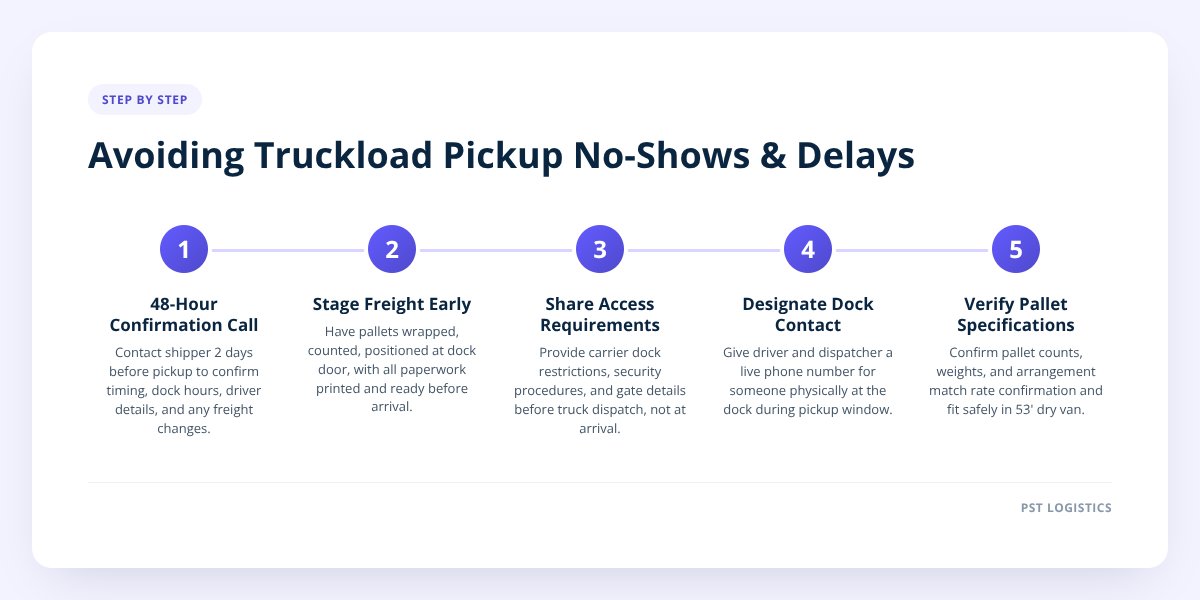
Step 1: Make the 48-Hour Confirmation Call
Call the shipper 48 hours ahead of the scheduled pickup, not the morning the driver is due to arrive. At that point there's still time to adjust the appointment, reassign a dock door, or pull staff in if the freight isn't going to be ready.
On that call, confirm:
- The exact pickup window — not just "Tuesday," but the hour range the dock expects the truck.
- Dock hours for that location, including lunch closures or shift changes that could strand a driver mid-window.
- A working contact name and phone number for someone physically at the dock, not just a front-office line that rolls to voicemail after 5 p.m.
- The driver's name and truck number, passed to the shipper's security or gate so there's no delay getting the truck checked in.
- Any changes to the freight since the order was booked — a different pallet count, a late-arriving component, or a packaging change that affects loading time.
If you're booking through a dispatcher, ask them to make this call rather than assuming the shipper and the trucking company are already talking. At PST Logistics, dispatch handles this confirmation directly with the shipper's dock contact because the same driver and the same dispatcher run the load from pickup to delivery — there's no handoff where a detail gets lost.
Step 2: Stage the Freight Before the Truck Arrives
Freight that isn't staged is the single fastest way to burn free loading time. A driver backing into a dock expects pallets wrapped, counted, and positioned for loading — not still being pulled from a warehouse shelf.
Run through this before the truck is due:
- Confirm all pallets are staged at the dock door, wrapped and stacked to the agreed height.
- Pull and print weight tickets if the load requires certified scale weights.
- Print the bill of lading and have it ready for driver signature — don't make the driver wait while someone tracks down a printer.
- Verify the pallet count matches what's on the rate confirmation; a mismatch discovered at the dock means a phone call that eats loading time.
- Check that freight is palletized correctly for a 53' dry van — loose or leaning pallets slow down a driver trying to load safely.
- Confirm any required paperwork beyond the BOL — packing slips, certificates of analysis, or customer-specific forms — is printed, not still being emailed.
If your freight regularly needs careful pallet arrangement to hit weight and cube limits, it's worth reading How to Plan and Load Pallets for Full Truckload Shipping — getting pallet counts right before the truck shows up prevents a lot of the last-minute scrambling that causes delays.
For temperature-controlled freight, staging means something more specific: product pulled from cold storage and ready to load the moment the reefer trailer is pre-cooled and backed in, not sitting on a dock losing temperature while paperwork gets sorted.
Step 3: Flag Special Access Requirements Before Dispatch, Not at the Gate
Tell your carrier about any dock restrictions when you book the load, not when the driver calls from the parking lot confused about why he can't get in. A driver who shows up to a facility requiring a security badge, a specific check-in procedure, or forklift-only unloading — without knowing it ahead of time — loses loading time figuring it out on the spot.
Flag these details at booking:
| Requirement | Why it matters | When to communicate it |
|---|---|---|
| Restricted receiving hours | Driver may arrive during a window the dock isn't staffed | At booking, confirmed again 48 hours out |
| Forklift-only or hand-unload only | Affects how long loading takes and whether driver assistance is needed | At booking |
| Security check-in or badge required | Driver needs ID, appointment number, or escort to reach the dock | At booking |
| Low clearance or tight yard | Affects whether a 53' trailer can maneuver safely | Before dispatch assigns the load |
| Drop-and-hook vs. live load | Changes whether driver waits at the dock at all | At booking |
If your facility runs drop-and-hook rather than live loads, the communication points are slightly different — we break those down in How to Avoid Detention Fees on Drop-and-Hook Loads. The core principle is the same either way: anything unusual about your dock needs to reach the driver before he's en route, not after.
What a Professional Carrier Does When the Shipper Isn't Ready
A carrier worth working with doesn't just sit and let the clock run — they call, document, and escalate before the delay turns into a missed delivery further down the line. When a PST Logistics driver arrives and freight isn't staged, the dispatcher is notified immediately, because the same dispatcher who booked the load is the one tracking it, with no third party in between.
What should happen in that situation:
- The driver notifies dispatch the moment he's checked in and waiting, with a timestamp.
- Dispatch contacts the shipper's dock contact directly to get a realistic estimate on readiness.
- Detention time is logged accurately from the start of the free period, so there's no dispute later if charges apply.
- If the delay threatens a downstream delivery appointment, dispatch notifies the receiver proactively rather than letting them find out when the truck is late.
For the shipper, the fix for next time is almost always the same: move the confirmation call earlier, and make staging a standing part of the receiving team's routine rather than something that happens only when someone remembers. If your freight regularly moves on tight delivery windows where a delayed pickup has a ripple effect, Plan Freight on Tight Windows Without Driver Delays goes deeper into building schedule buffer into the whole run, not just the pickup.
If you're planning an upcoming full truckload shipment and want a carrier that treats your pickup window as a commitment, not a suggestion, PST Logistics runs dry van and temperature-controlled freight across all 48 states with the same driver and dispatcher on the load from pickup to delivery — no layers, no handoffs, and a dispatcher who answers the phone around the clock. Request a rate for your next lane and get a dispatcher who already knows your dock's quirks before the truck leaves Naperville.
Checklist: Preparing a Shipper Location for Truckload Pickup
- Call the shipper 48 hours before the scheduled pickup to confirm the window and dock contact.
- Confirm dock hours and flag any shift changes or closures that fall inside the pickup window.
- Share the driver's name and truck number with the shipper's gate or security team.
- Stage all pallets at the dock door, wrapped and counted, before the truck is due.
- Print the bill of lading and any required weight tickets ahead of arrival.
- Verify the pallet count and weight match the booked order before the driver loads.
- Communicate any security badges, forklift requirements, or clearance restrictions at booking — not at the gate.
- Note whether the pickup is a live load or drop-and-hook so the driver's time at the dock is planned correctly.