What to Verify Before Booking a Trucking Company

Quick answer: Before booking a carrier, verify its FMCSA safety rating and four core safety metrics (crash, driver fitness, hours-of-service compliance, and vehicle maintenance), check its complaint and out-of-service history for patterns rather than one-off incidents, confirm active authority and insurance certificates, and ask for shipper references if it's an asset-based carrier. A low bid with a weak compliance record almost always costs more once you count damaged freight, missed pickups, and delivery delays.
Key takeaways
- The FMCSA's Safety Measurement System (SMS) scores carriers across seven categories called BASICs, but four — Unsafe Driving, Hours-of-Service Compliance, Vehicle Maintenance, and Crash Indicator — tell you the most about day-to-day reliability.
- A carrier can hold active operating authority and still have a concerning safety record; authority alone, per FMCSA, confirms only that a company is registered to operate, not that it operates well.
- Patterns matter more than single incidents — three damage complaints in six months from different shippers is a signal; one complaint over two years usually isn't.
- Asset-based carriers that own their trucks and employ their drivers can usually provide direct shipper references, while brokers can only speak to the carriers they've dispatched, not run their own fleet history.
!Verify Trucking Company Before Booking
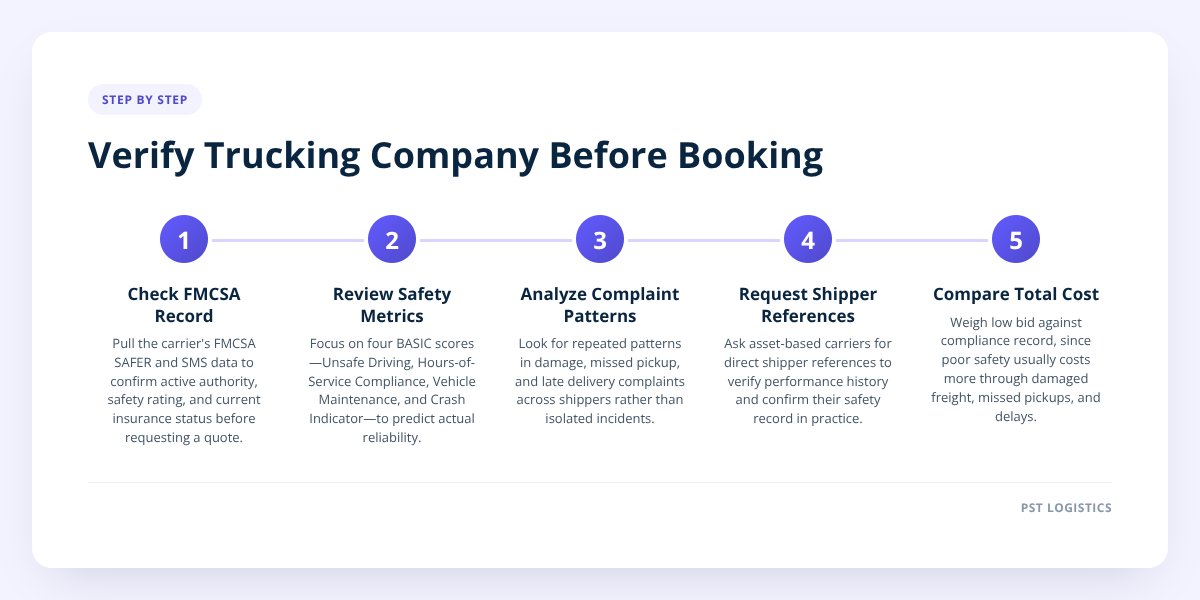
Step 1: Pull the Carrier's FMCSA Record Before You Request a Quote
Start with the FMCSA's SAFER system and Safety Measurement System before you ever talk price. Every motor carrier with active authority has a public record showing its safety rating, inspection history, and crash data — and it takes about five minutes to check.
Look for three things on that first pass:
- Safety rating. FMCSA assigns one of three ratings — Satisfactory, Conditional, or Unsatisfactory — based on a compliance review. Many carriers have no rating at all simply because they haven't been reviewed recently, which isn't automatically disqualifying but means you lean harder on the other metrics below.
- Active authority status. Confirm the carrier's operating authority is listed as active, not revoked or pending. We covered how to pull this correctly in Verify a Trucking Company's Authority and Insurance First.
- Insurance on file. FMCSA requires carriers to maintain minimum liability coverage, and that filing status is visible on the same record. A carrier should be able to send you a current certificate of insurance the same day you ask — if it takes days, that's worth noting.
This first pass takes minutes, but skipping it is how shippers end up locked into a contract with a carrier that looked fine on a rate sheet and fell apart on the road.
Step 2: Understand the Four Safety Metrics That Actually Predict Reliability
Authority and insurance confirm a carrier is legal to operate — they don't tell you whether it will show up on time with your freight intact. For that, you need the FMCSA's BASIC scores, specifically four of the seven:
| BASIC Category | What It Measures | Why It Matters to a Shipper |
|---|---|---|
| Unsafe Driving | Speeding, reckless driving, improper lane changes | High scores correlate with more roadside violations and higher accident risk |
| Hours-of-Service Compliance | Driver logbook violations, fatigue-related infractions | A carrier cutting corners here is more likely to miss delivery windows or run unsafe schedules |
| Vehicle Maintenance | Brake, tire, and mechanical defects found at inspection | Breakdowns mid-route are a leading cause of late delivery |
| Crash Indicator | Frequency and severity of reported crashes | Directly tied to freight damage and liability exposure |
FMCSA publishes these as percentile scores relative to other carriers in the same category, and each BASIC has its own intervention threshold. A carrier sitting above that threshold in multiple categories is one FMCSA itself flags for potential intervention — that's a carrier whose problems are documented, not speculative.
We go deeper on how to interpret percentile scores, peer groups, and thresholds in How to Read a Freight Carrier's FMCSA Safety Rating. It's worth the extra ten minutes if this is your first time pulling a BASIC report.
Step 3: Read Complaint History for Patterns, Not Isolated Incidents
One complaint doesn't disqualify a carrier — a repeated pattern of the same complaint does. FMCSA's National Consumer Complaint Database logs shipper and household-goods complaints, and while the detail varies by complaint type, the pattern is what matters.
When you're reviewing complaint history or asking a carrier directly about its record, sort what you find into three buckets:
- Damage complaints. A handful scattered over several years across different equipment types is close to unavoidable in trucking. Multiple damage complaints tied to the same lane, trailer type, or time window suggest a loading, securement, or trailer-condition problem that hasn't been fixed.
- Missed pickup complaints. This usually traces back to a dispatch or capacity problem — the carrier is overcommitting lanes it can't actually cover.
- Late delivery complaints. Look at whether these cluster around specific seasons, lanes, or equipment. A reefer carrier with repeated late deliveries in summer months, for example, may be struggling with unit reliability or driver turnover rather than a one-time weather delay.
Don't skip this: A carrier with no complaints on record isn't automatically a safer bet than one with a few — it may just mean fewer shippers have booked it recently, or its complaint history hasn't been indexed yet. Cross-check complaint data against the FMCSA safety metrics in Step 2 rather than relying on either one alone.
Step 4: Know Which Red Flags Should End the Conversation
Some findings are serious enough that no rate quote should override them. If you see any of the following, treat it as a stop sign rather than a negotiating point:
- Unsatisfactory safety rating. FMCSA reserves this for carriers found not to meet minimum safety standards during a compliance review — it is the agency's clearest possible warning.
- Authority recently reactivated after revocation. A carrier that lost its authority and got it back may be legitimate, but it warrants direct questions about what caused the revocation.
- Crash Indicator or Vehicle Maintenance BASIC above the FMCSA intervention threshold. These two categories correlate most directly with freight damage and delivery delay.
- Inconsistent or delayed certificates of insurance. A carrier that can't produce a current certificate within a business day either has a lapsed policy or a disorganized back office — neither is good for your freight.
- Refusal to share DOT number or safety record. Any legitimate carrier should hand this over without hesitation; reluctance is itself a signal.
If you're building out a broader pre-booking checklist beyond safety metrics, What to Check Before Booking a Freight Carrier walks through the full list shippers should run every time, not just for new carriers.
Step 5: Cross-Check References — and Know Why Asset-Based Carriers Answer Differently Than Brokers
Ask for references, then weigh the answer based on what kind of company you're calling. An asset-based carrier — one that owns its trucks and employs its drivers directly — can point you to shippers who've used that specific equipment and those specific drivers on repeated lanes. A broker can only speak to carriers it has dispatched in the past, which means the broker's reference is really a reference for someone else's fleet.
Neither model is automatically better for every shipper, but they answer different questions:
- Ask an asset-based carrier: "Which lanes have you run for this reference, and how many loads over what period?" A carrier with a real track record will have specific lanes and volumes to point to, not a vague "we've worked with them a few times."
- Ask a broker: "Which carrier actually hauled this reference's freight, and is that the same carrier you'd dispatch for me?" Brokers reassign loads between different carriers, so a good past experience doesn't guarantee the same truck or driver next time.
If you're weighing the two models for an upcoming contract, Interstate Trucking Company or Broker: How to Choose breaks down the tradeoffs in more depth.
This is also where same-truck, same-driver service matters for reliability tracking. When one driver runs a load from pickup to delivery — rather than freight changing hands at a terminal or getting reassigned between carriers — a shipper gets a cleaner picture of who's actually accountable for the condition of the freight and the timing of the delivery.
PST Logistics is built on that model: active authority and insurance on file, a Satisfactory safety rating, clear CSA basics, and a 99% on-time delivery rate across dry van and temperature-controlled truckload freight out of Naperville. Every load runs with the same truck and driver from pickup to delivery, and certificates of insurance go out the same business day they're requested. The full compliance picture — rating, coverage, and inspection record — is laid out at joinpst.com/#compliance.
If you're ready to put these checks to use on an actual lane, request a quote through PST Logistics and ask dispatch the same questions this guide walks through — a carrier confident in its record will answer all of them without hesitation.
Checklist: Verify a Trucking Company's Operational Record
- Pull the carrier's SAFER record and confirm active authority status.
- Request a current certificate of insurance and note how quickly it arrives.
- Check the carrier's FMCSA safety rating — Satisfactory, Conditional, or Unsatisfactory.
- Review the four key BASIC scores: Unsafe Driving, Hours-of-Service Compliance, Vehicle Maintenance, Crash Indicator.
- Search the FMCSA complaint database and sort findings by damage, missed pickup, and late delivery.
- Flag any BASIC score above the FMCSA intervention threshold as a serious concern, not a minor one.
- Ask whether the carrier is asset-based or a broker, and request references matched to that model.
- Confirm specific lanes and load volumes with any reference provided — not just a general endorsement.
- Ask directly about same-truck, same-driver continuity if delivery consistency matters for your freight.