Why Asset-Based Carriers Beat Brokers on Produce Freight

Quick answer: Asset-based carriers control the truck, the driver, and the temperature record from pickup to delivery, which means one accountable party instead of several layered markups and handoffs. For produce moving from the Midwest to the Southeast — where a few degrees or a few hours can wipe out a load — that control directly reduces spoilage risk, detention disputes, and the guesswork that comes with not knowing who's actually driving your freight. Brokers can still serve a purpose for overflow capacity, but for temperature-critical freight, fewer hands on the load generally means fewer places for something to go wrong.
Key takeaways
- Every layer between shipper and truck adds cost and reduces visibility — a broker-sourced load may change hands two or three times before a produce shipper ever sees a tracking update.
- Asset-based carriers like PST Global run the same truck and same driver for the entire haul, which eliminates the mid-route swaps that create temperature gaps.
- Continuous temperature logging from pre-cool through delivery gives the receiver a documented record — not a verbal assurance — if a dispute over condition comes up.
- Direct carrier relationships mean one phone call reaches the people who can actually fix a problem, instead of a broker relaying messages to a carrier they don't control.
!Asset-Based Carrier Advantage for Produce
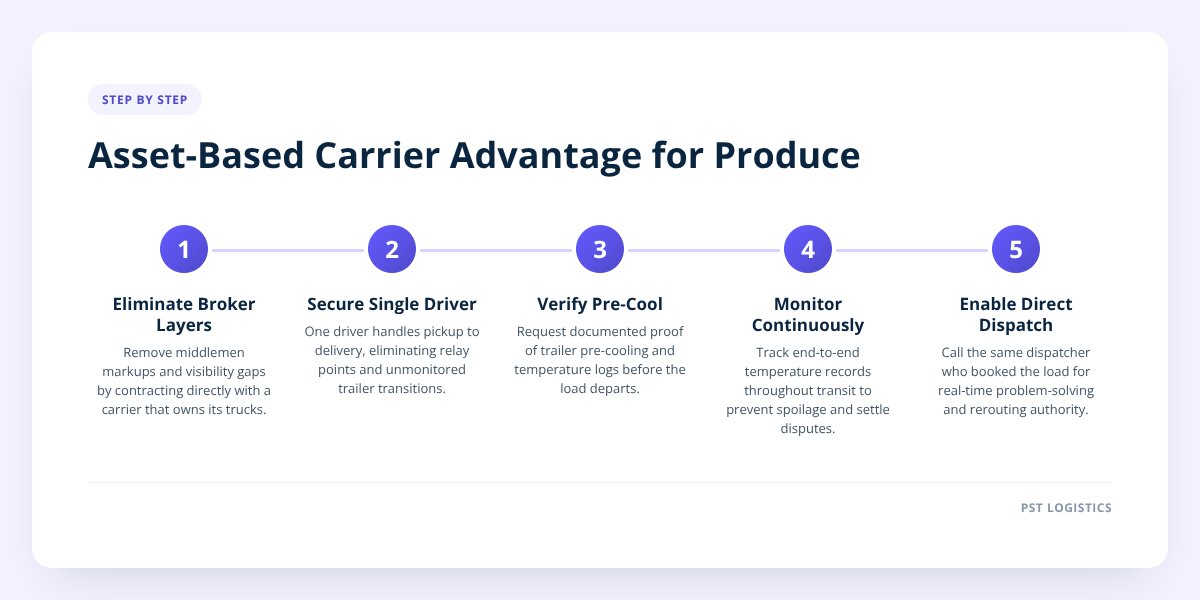
Why Do Produce Shippers Lose Money to Broker Layers?
Every broker transaction adds a markup between what the shipper pays and what the truck actually gets, and that markup buys the shipper nothing in terms of equipment quality or driver reliability. A broker's job is to find a truck, not to own one — so the shipper is trusting a company that has no direct control over the trailer's mechanical condition, the driver's experience with reefer freight, or whether the unit was pre-cooled before it hit the dock.
This matters more for temperature-controlled freight than for dry van. A pallet of canned goods that sits an extra two hours at a transfer point is an inconvenience. A pallet of strawberries or leafy greens that sits an extra two hours in a reefer that wasn't holding setpoint is a loss.
The visibility gap compounds the problem. When a broker books the load, the shipper often doesn't know:
- Which carrier is actually running the freight
- Whether that carrier specializes in reefer or just happened to have a truck available
- What the trailer's temperature history looked like before the shipper's product was loaded
- Who to call directly if the load is running late or the reefer alarms
Each of those unknowns is a place where a produce shipment can go wrong without anyone catching it until the receiver opens the doors.
What Does an Asset-Based Carrier Actually Control That a Broker Doesn't?
An asset-based carrier owns or directly operates the trucks, trailers, and employs or contracts the drivers who move the freight — meaning there's no third party between the shipper's phone call and the person behind the wheel. That direct ownership translates into specific, checkable advantages on a produce run.
| What matters for produce freight | Broker-sourced load | Asset-based carrier |
|---|---|---|
| Equipment type and condition | Varies by whichever truck is available | Known fleet, maintained on a set schedule |
| Driver for the full run | May change hands at a relay point | Same driver, pickup to delivery |
| Temperature monitoring | Depends on whichever carrier was booked | Continuous or cycle-sentry logging end to end |
| Who answers if something goes wrong | Broker relays to a carrier they don't control | Dispatcher who booked the load answers directly |
| Pre-cool verification | Often undocumented | Trailer pre-cooled before the door opens, logged |
PST Global runs 53-foot reefers set up specifically for produce, dairy, and frozen freight, with continuous or cycle-sentry monitoring and temperature logs that run from pre-cool through delivery. The trailers are food-grade with documented washouts, and the setpoint range covers -20°F to 70°F — wide enough for anything from frozen protein to fresh produce that needs a cooler, not frozen, environment.
Don't skip this: Ask any carrier — asset-based or broker-sourced — for proof of pre-cool and a copy of the temperature log before the load moves, not after a claim is filed. A log you request after delivery can't be verified against what actually happened in transit.
The single-driver, single-truck model also matters more than shippers often realize. When one driver runs the load from the Midwest pickup to the Southeast delivery, there's no relay point where the trailer sits unmonitored while a second driver takes over. Fewer handoffs means fewer windows for a reefer unit to be left running unchecked or a door to be opened without anyone logging it.
How Does Direct Carrier Control Cut Spoilage and Detention Losses?
Direct accountability shortens the time between a problem happening and someone fixing it, which is the entire game with perishable freight. If a reefer unit throws an alarm at 2 a.m. somewhere in Tennessee, the question that matters is: who gets that alarm, and how fast can they act on it?
With a broker, the chain usually runs driver to carrier to broker to shipper — three handoffs before the person who booked the load even knows there's an issue. With an asset-based carrier, the driver's dispatcher is the same team that quoted the rate, which means the person with the authority to reroute, troubleshoot, or get a mechanic involved is reachable in one call. PST Global's dispatch answers 24/7, including weekends, which matters most on exactly the kind of overnight run where a reefer problem is most likely to surface.
Detention works the same way. A produce shipper who gets stuck waiting at a receiver's dock for hours past the appointment window needs someone who can make a real-time decision — reroute the next pickup, extend the driver's hours within legal limits, or document the delay for a detention claim. A broker without direct authority over the driver has to relay every one of those decisions, and every relay adds delay of its own.
Here's a worked example. A load of bell peppers picked up in Illinois on a Monday morning for delivery to a Georgia distribution center hits unexpected congestion and misses its original appointment by four hours. With an asset-based carrier, the dispatcher who knows the lane can call the receiver directly, confirm a new appointment slot, and keep the driver's hours of service on track — all while the temperature log keeps running uninterrupted. With a broker, that same four-hour delay means a call to the broker, a call from the broker to the carrier, and a wait for the carrier to confirm back — time the pepper shipment doesn't have.
We cover the broader comparison of carrier types in Interstate Trucking Company or Broker: How to Choose, and the produce-specific loss points in more depth in Shipping Produce to the Southeast Without Losses.
When Does a Broker Still Make Sense for Perishable Freight?
A broker can still be the right call when a shipper has a one-time or irregular lane with no established carrier relationship, or needs overflow capacity during a volume spike that a direct carrier can't absorb on short notice. Brokers exist because capacity needs fluctuate, and not every shipper moves enough reefer freight to justify a dedicated relationship.
But for recurring Midwest-to-Southeast produce runs — the kind where a shipper is moving the same type of freight on a predictable schedule — an asset-based carrier relationship pays off faster the more often the lane repeats. The reasons:
- Consistency compounds. The same carrier learns the shipper's dock procedures, appointment preferences, and product sensitivities over repeated loads.
- Direct rate conversations cut out markup. Working straight with the carrier means the rate reflects the actual cost of running the lane, not a broker's margin on top of it.
- Accountability is traceable. When something goes wrong, there's one company with the insurance, the safety record, and the direct relationship to resolve it — not a broker pointing to a carrier they sourced.
Before booking any carrier for a produce run, confirm a few basics regardless of whether it's a broker or an asset-based operation. We laid out the full verification list in What to Verify Before Booking a Trucking Company, but the short version for a reefer load is below.
PST Global runs this lane as one of its core corridors — Midwest to Southeast — out of its Naperville, Illinois base, with active authority, a $1,000,000 auto liability policy, cargo coverage in place, and a Satisfactory safety rating on file. Certificates of insurance go out the same business day they're requested, so a shipper doesn't have to wait on paperwork to confirm coverage before the load moves.
For a produce shipper ready to move freight on a repeat lane, requesting a rate directly with PST Global's dispatch starts the conversation the same way every load does — one call, one dispatcher, one answer.
Checklist: Choosing a Carrier for Produce Freight
- Request proof of active operating authority and current insurance certificates before booking.
- Ask whether the same driver runs the load start to finish or if it changes hands at a relay point.
- Confirm the trailer is pre-cooled before the door opens, and ask for that confirmation in writing.
- Verify the temperature monitoring method — continuous or cycle-sentry — and request the log format you'll receive at delivery.
- Get a direct phone number for dispatch, not just a broker's general line, in case of an in-transit issue.
- Confirm the trailer type matches your product's needs, including setpoint range and food-grade washout documentation.
- Ask how detention and appointment delays are handled, and who has authority to make real-time decisions.
- Compare the all-in rate against a broker-sourced quote for the same lane to see what the markup actually costs.