How to Prevent Detention Fees on Southeast Reefer Runs

Quick answer: Detention on Southeast reefer runs is almost always a dock-speed and paperwork problem, not a driving problem — receivers in Atlanta, Savannah, and smaller Gulf Coast markets run limited dock doors and manual temperature checks that slow unloading. Shippers cut it by confirming dock windows before the truck leaves, pre-staging temperature logs and lumper paperwork, and favoring drop-and-hook over live unload wherever the receiver allows it. Working with an asset-based carrier that owns its reefers and logs temperature end to end — like PST Global — also removes the back-and-forth that brokered loads add to every delay.
Key takeaways
- Detention clocks typically start after a grace period of one to two hours past the scheduled appointment, and reefer loads get hit harder because temperature disputes extend the clock before unloading even starts.
- Southeast distribution centers serving grocery and food-service accounts often run fewer dock doors per truck volume than Midwest facilities, which is why the same load type detains more often south of Atlanta than it does in Ohio or Indiana.
- Drop-and-hook eliminates the wait entirely when the receiver supports it, because the driver never sits at the dock — a swap takes minutes, not hours.
- Continuous temperature logging from pickup to delivery gives the driver a clean record to hand the receiver, which resolves most "prove the product held temperature" delays on the spot.
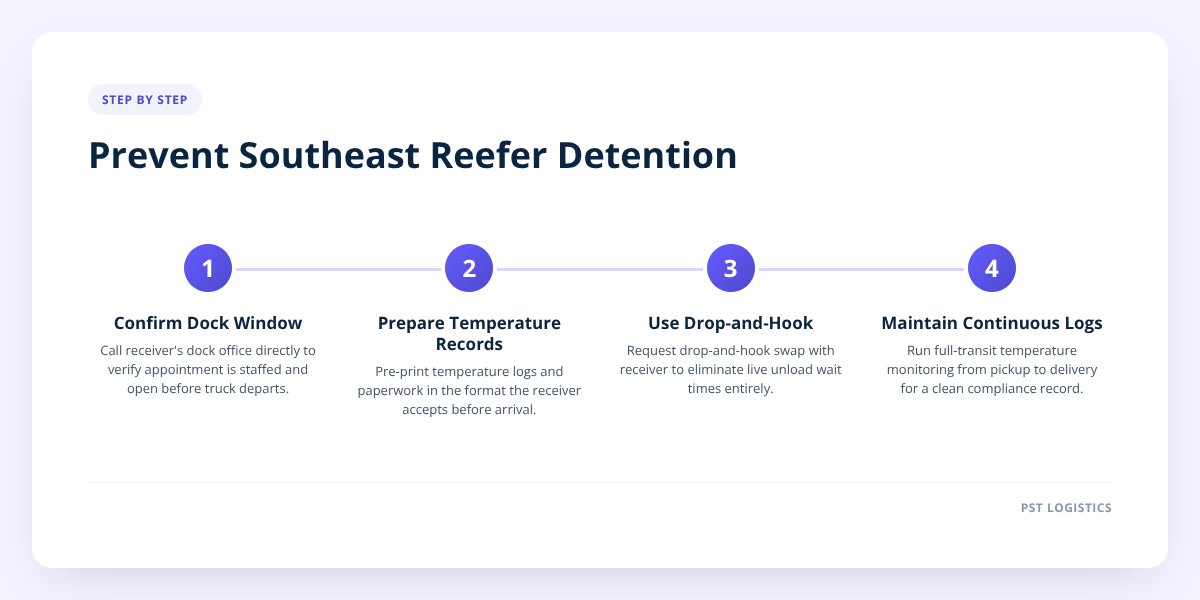
!Prevent Southeast Reefer Detention
What Detention Actually Costs on a Reefer Run
A detained reefer truck costs more than a detained dry van, because the reefer unit keeps burning fuel to hold setpoint while the trailer sits still. A shipper paying a flat detention rate still eats that fuel cost indirectly through the carrier's rate structure, and a driver who detains for three hours at a receiver in Savannah loses those same three hours on the next pickup window — which can push a multi-stop route past its hours-of-service limit for the day.
Southeast grocery and food-service distribution centers tend to run tighter dock schedules than Midwest facilities because they serve dense, fast-turning retail networks on short lead times. Fewer open doors per truck arrival means more trucks queue, and a reefer trailer in that queue is still running its compressor the whole time. We covered the general cost mechanics of this in How to Avoid Detention Fees on Interstate Freight Runs — the reefer-specific wrinkle is that temperature compliance checks add a second layer of delay on top of the dock wait.
That second layer is what makes produce and dairy runs different from a standard palletized load. A dry van driver backs in, breaks the seal, and starts unloading. A reefer driver first has to prove the load held temperature the whole way, and that proof-check is where a lot of Southeast detentions actually begin.
Step 1: Confirm the Dock Window Before the Truck Leaves
The single biggest lever a shipper has is confirming the appointment is real — not just scheduled, but confirmed with the specific receiving contact who will be on the dock that day. A scheduling system showing an open slot does not guarantee a door is actually free when the truck rolls up, especially at high-volume Southeast grocery DCs.
Before pickup, the shipper or dispatcher should:
- Call the receiver's dock office directly, not just the scheduling portal, to confirm the appointment window is staffed and open.
- Ask whether the facility is running behind that day — a five-minute question that often surfaces a known backlog before the truck is committed to it.
- Share the trailer's setpoint and commodity type in advance, so the receiving team knows what kind of temperature check to expect.
- Get a named contact and direct phone number for the driver to call on approach, not a general dock line.
- Confirm whether the facility requires a check-in kiosk, a QR code, or a physical paper BOL — Southeast facilities vary more on this than Midwest ones.
Don't skip this: if the receiver can't confirm a specific door and time within a defined window, assume detention risk is high and build extra slack into the next stop on a multi-stop route rather than hoping the dock clears on schedule.
This kind of pre-arrival coordination is the same discipline that prevents no-show delays on the pickup side, which we detailed in How to Avoid No-Shows and Delays on Truckload Pickups. The principle carries over directly to delivery: a confirmed human contact beats a scheduling system every time.
Step 2: Get Temperature Logs and Paperwork Ready Before the Truck Arrives
Most reefer detention at Southeast receivers starts with a temperature dispute, not a dock shortage. Many receivers — particularly those handling dairy and produce under retailer food-safety programs — require a documented temperature record before they'll break the seal, and if that record isn't ready the moment the driver checks in, the truck sits while someone tracks it down.
The fix is to have the full paper trail ready before pull-up, not after:
- Pre-cool the trailer to setpoint before loading, and confirm the reading is logged at load time, not estimated.
- Run continuous temperature monitoring for the full transit, not spot checks, so there's a complete record rather than gaps a receiver has to question.
- Print or digitally export the temperature log in the format the specific receiver accepts — some facilities want a printed strip chart, others take a digital download.
- Confirm the commodity's required setpoint range matches what's logged, especially on mixed loads where produce and dairy have different tolerances.
- Carry the bill of lading, any USDA inspection paperwork relevant to the commodity, and the carrier's certificate of insurance together, so nothing is missing when the receiver asks.
A continuous log that runs end to end — pickup through delivery — resolves most temperature disputes in minutes because the receiver has a complete record instead of a gap they have to investigate. This is standard practice on every temperature-controlled load PST Global hauls, and it's one of the clearest, fastest ways to shrink a dock wait that would otherwise stretch into billable detention.
Step 3: Choose Drop-and-Hook Over Live Unload Wherever Possible
Drop-and-hook avoids detention because the driver is never waiting at the dock in the first place. In a drop-and-hook arrangement, the driver drops the loaded trailer, hooks an empty or already-unloaded one, and leaves — the facility unloads on its own schedule, and the detention clock that applies to a live, driver-present unload never starts.
| Factor | Live Unload | Drop-and-Hook |
|---|---|---|
| Driver wait time | Full duration of unload | Minutes |
| Detention exposure | High, especially at congested Southeast docks | Essentially none |
| Requires receiver to pre-stage an empty/loaded trailer | No | Yes |
| Works for single-stop produce runs | Yes | Only if receiver supports a trailer pool |
| Best fit | Smaller receivers, one-off loads | High-volume repeat lanes |
The catch is that drop-and-hook only works if the receiver maintains a trailer pool or is willing to hold an extra trailer on-site — not every Southeast facility does. Where it's available, it should be the default for any recurring produce or dairy lane. We go deeper on when each option makes sense in How to Avoid Detention Fees on Drop-and-Hook Loads.
Where drop-and-hook isn't an option and a live unload is required, the next best move is tightening everything in Step 2 so the unload itself moves as fast as the receiver's dock crew allows.
Step 4: Work With a Carrier That Owns Its Equipment and Knows the Receiver
An asset-based carrier can manage reefer turnarounds faster than a broker because there's no handoff — the dispatcher who scheduled the pickup is the same person the driver calls when a Savannah dock runs two hours behind, and that person can make a same-minute call on whether to wait, reroute, or adjust the next stop. A brokered load adds a layer: the broker has to relay the delay to the carrier, the carrier relays it to the driver, and decisions take longer while the trailer sits.
Repeat-stop relationships compound this advantage. A carrier running the same Southeast grocery or dairy lane week after week builds a working relationship with the same dock staff, learns which door moves fastest, and knows in advance which receivers are chronically slow — information a one-time broker-sourced truck doesn't have. We laid out the broader case for this in Why Asset-Based Carriers Beat Brokers on Produce Freight.
PST Global runs 53-foot reefers pre-cooled before the door opens, with continuous or cycle-sentry temperature monitoring logged end to end, out of Naperville, Illinois, across all 48 states — including the Midwest-to-Southeast corridor and reload markets like Atlanta and Savannah. The same truck and driver run the whole trip, and a dispatcher answers the phone 24/7 if a dock runs behind, with a 99% on-time delivery rate behind that promise.
What to Do Next
Start with your next scheduled Southeast delivery, not your whole network. Call the receiving dock directly, confirm the appointment is staffed, and make sure your temperature log and paperwork will be ready the second the driver checks in — that alone resolves the majority of avoidable detention.
If a lane keeps detaining no matter what you tighten on your end, the carrier handling it may be part of the problem. Request a rate on your Southeast produce or dairy lane and ask PST Global's dispatch how they'd run that specific stop.
Checklist: Preventing Reefer Detention on Southeast Runs
- Call the receiver's dock office directly to confirm the appointment window is staffed.
- Share the trailer's setpoint and commodity type with the receiver before the truck leaves.
- Get a named contact and direct phone number for the driver to call on approach.
- Pre-cool the trailer to setpoint and log the reading at load time.
- Run continuous temperature monitoring for the entire transit, not spot checks.
- Export or print the temperature log in the exact format the receiver requires.
- Ask whether the receiver supports drop-and-hook before defaulting to a live unload.
- Keep the bill of lading, inspection paperwork, and insurance certificate together and ready.