What Happens Between Pickup and Delivery on Truckloads
Quick answer: A truckload shipment crossing state lines moves through six distinct stages: quote and booking, pickup and loading, in-transit checkpoints, weigh stations and inspections, delivery appointment, and proof-of-delivery paperwork. Each stage has its own risk points — a missed appointment window, a failed DOT inspection, a temperature excursion on a reefer load — and knowing where those risks sit helps shippers pick a carrier who controls the whole run instead of handing it off partway through.
Key takeaways
- A full truckload run typically involves one truck, one driver, and zero handoffs when the carrier doesn't cross-dock or transload — fewer touches means fewer chances for damage or delay.
- Federal Motor Carrier Safety Administration (FMCSA) rules cap most drivers at 11 hours of driving within a 14-hour on-duty window, which is why multi-day interstate runs are normal, not a red flag.
- Weigh stations and roadside inspections are a routine part of every interstate run, and current enforcement pushes — like the FMCSA-New York State Police effort on I-81 — mean commercial vehicles should expect more stops, not fewer.
- Reefer freight adds a seventh checkpoint most dry van loads skip: continuous temperature logging from pre-cool through delivery.
!Six Stages of an Interstate Truckload
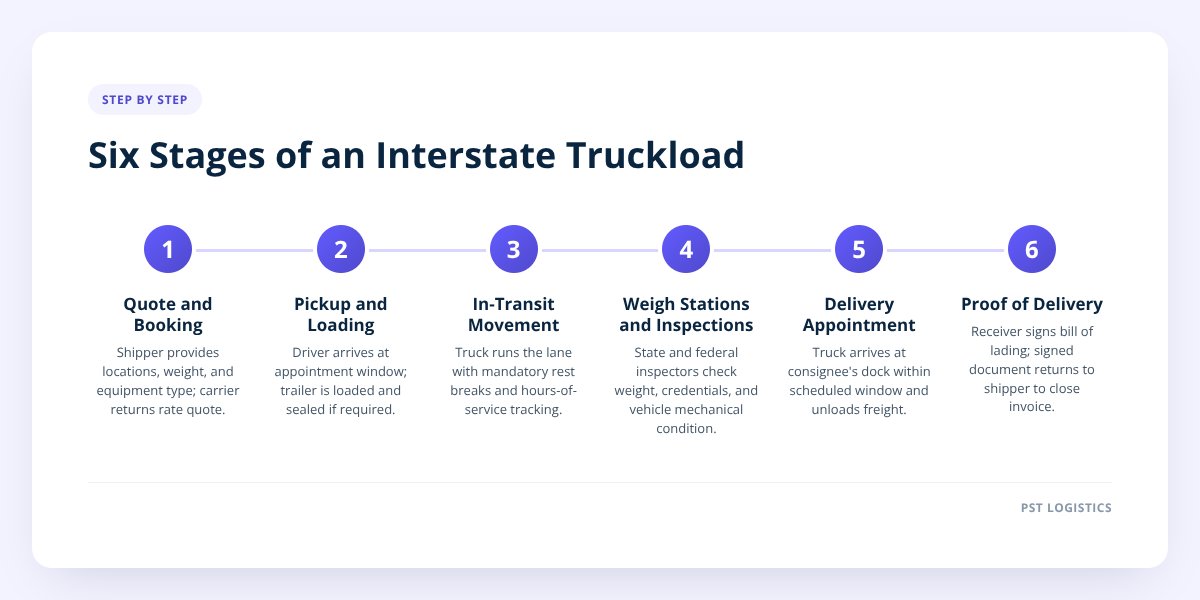
The Six Stages of an Interstate Truckload Shipment
Every truckload move follows roughly the same path, whether it's a short Midwest hop or a coast-to-coast haul. Here's the sequence, start to finish.
- Quote and booking. The shipper or broker provides pickup and delivery locations, freight weight, and equipment type (dry van or reefer), and the carrier returns a rate based on lane, fuel cost, and load requirements.
- Pickup and loading. The driver arrives at the appointment window, the trailer is loaded — palletized or floor-loaded — and the load is sealed if required.
- In-transit movement. The truck runs the lane, tracking hours of service and stopping for federally mandated rest breaks.
- Weigh stations and roadside checks. State and federal inspectors verify weight, credentials, and vehicle condition at fixed and mobile checkpoints along the route.
- Delivery appointment. The truck arrives at the consignee's dock within its scheduled window and unloads.
- Proof of delivery and paperwork. The receiver signs the bill of lading, and that signed document — along with any temperature logs — gets back to the shipper to close out the invoice.
That sequence sounds simple on paper. The difference between a smooth run and a late one almost always comes down to what happens at stage three and four — and whether the same driver who picked up the load is the one delivering it.
Why Does the Same Truck Matter for an Interstate Run?
A single truck and single driver for the entire route eliminates the two riskiest moments in freight: the handoffs. Every time freight moves from one trailer to another — what's known as cross-docking or transloading — there's a chance for damage, a chance for delay while the load sits waiting for the next available truck, and a chance for paperwork to get separated from the shipment.
PST Logistics runs every load with one truck and one driver from pickup to delivery, with no cross-docking or transloading in between. That matters most on reefer freight, where a load that sits unmonitored during a transfer can lose its setpoint temperature before anyone notices. We walked through the mechanics of this in How a Full Truckload Shipment Actually Moves, but the short version is: fewer touches means fewer things that can go wrong.
What Are Truckers Actually Checked For at Weigh Stations?
Weigh stations verify three things: vehicle weight, driver and carrier credentials, and mechanical condition — and a truck can be pulled for inspection at any point along its route, not just at fixed scale locations. According to FMCSA, inspectors check hours-of-service logs (now almost universally electronic under the ELD mandate), commercial driver's license status, and vehicle safety items like brakes, tires, and lights.
Enforcement isn't static. FMCSA has recently partnered with New York State Police on a commercial vehicle crackdown along I-81, and California and FMCSA are currently in court over a halt to non-domiciled CDL issuance — both signs that interstate carriers should expect scrutiny to stay high, not ease up. A carrier with clean maintenance records and current DOT inspections moves through these checks without the delays that come from a citation or an out-of-service order.
Don't skip this: an out-of-service violation at a roadside inspection doesn't just delay one truck — it can flag the carrier's entire safety record with FMCSA. Carriers that handle their own preventive maintenance and annual DOT inspections in-house catch problems before they become roadside violations.
For a deeper look at what federal rules actually require of carriers (as opposed to what shippers assume), see What Interstate Trucking Regulations Actually Require.
Dry Van vs. Reefer: Where Do the Checkpoints Differ?
A dry van load and a temperature-controlled load follow the same six stages, but reefer freight adds monitoring that never stops until the trailer doors open at delivery.
| Checkpoint | Dry Van Truckload | Reefer Truckload |
|---|---|---|
| Pre-load | Trailer inspected for cleanliness, seal applied | Trailer pre-cooled to setpoint before loading begins |
| In-transit | Standard route and hours-of-service tracking | Continuous or cycle-sentry temperature monitoring, logged end-to-end |
| Setpoint range | Not applicable | -20°F to 70°F depending on commodity |
| Weigh station | Standard weight and credential check | Same, plus unit may be checked for reefer fuel/run status |
| Delivery | Seal verified intact, freight unloaded | Temperature log handed over with proof of delivery |
| Post-delivery | Bill of lading signed | Bill of lading signed, plus washout documentation if next load requires food-grade trailer |
The reefer column is why temperature-controlled freight costs more and demands a carrier that treats logging as part of the job, not an add-on. If you're trying to decide which equipment type your freight actually needs, Dry Van Trucking Explained: What It Is and When to Use It breaks down the decision in more detail.
What Slows a Truckload Down Mid-Route?
Weather and traffic cause more delays than mechanical breakdowns or paperwork combined, and Midwest winter routes are a recurring example. A load moving through Illinois in January can lose hours to ice on I-80 or a closed weigh station rerouting trucks through secondary roads — delays that compound if the driver is close to running out of available hours under FMCSA's service rules.
Fuel cost volatility is a second, less visible drag. Diesel prices reaching record highs in markets like California doesn't just affect West Coast lanes — it ripples into rate quotes nationwide as carriers reprice fuel surcharges, and it's one more reason freight costs have moved alongside broader inflation pressure this year. A carrier running Midwest-to-Southeast and Texas-triangle lanes out of a hub like Naperville has some insulation from West Coast fuel spikes, but no lane is fully immune.
Here's a pre-shipment checklist that catches most of the common delay points before the truck ever leaves the dock:
- Confirm the pickup and delivery appointment windows in writing, not just verbally.
- Verify the equipment type matches the freight — reefer setpoint confirmed if temperature-controlled.
- Request a same-day insurance certificate if the receiving dock requires proof of coverage.
- Check the route for active weather advisories, especially November through March in the Midwest.
- Confirm the carrier's DOT number and safety rating before booking, particularly with an unfamiliar carrier.
- Ask whether the load will be handled by one driver start to finish, or transferred partway through.
How Should Shippers Read a Carrier's On-Time Record?
An on-time delivery percentage only means something if you know what it's measured against, so ask whether it reflects scheduled appointment windows or just calendar days. A carrier quoting 99% on-time delivery against firm appointment windows is a different claim than one measuring against a loose delivery date — and the distinction matters most for shippers with tight production schedules or retail delivery slots.
The other question worth asking: is dispatch reachable after hours if something changes mid-route? A load that hits a weather delay at 9 p.m. on a Sunday needs a dispatcher who answers the phone, not a voicemail that gets returned Monday morning. That's a fair question to ask any carrier before booking, and it's worth comparing against how a broker versus a carrier handles the same problem — a distinction covered in Trucking Company vs. Freight Broker: Who Should You Hire?
If you're shipping freight that needs to cross state lines — whether it's palletized dry goods or temperature-sensitive product — PST Logistics runs dry van and reefer truckload freight out of Naperville with one driver per load, 24/7 dispatch, and same-day insurance certificates on request. Call to get a rate quote or ask about lane coverage for your specific route.